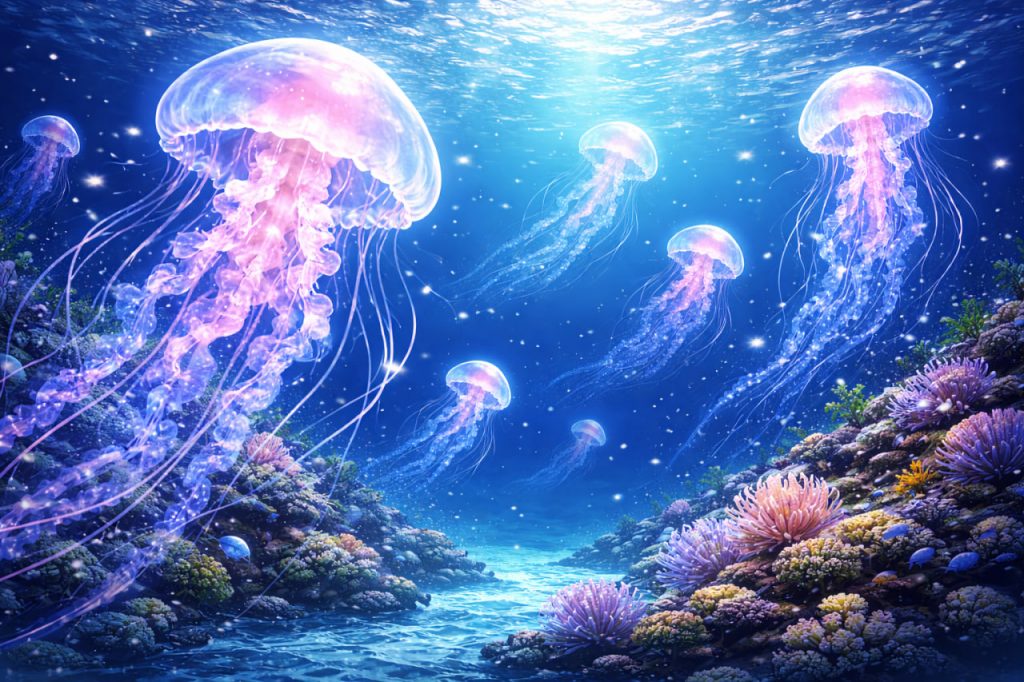
Jellyfish are among the oldest living creatures on Earth, drifting through the oceans for more than 500 million years. Despite their simple appearance, they are highly successful organisms that have survived multiple mass extinctions and dramatic climate changes. Jellyfish are found in nearly every marine environment, from shallow coastal waters to the deep sea, adapting effortlessly to different conditions. Their translucent bodies and slow, pulsing movements give them an almost otherworldly presence, captivating scientists and observers alike. Although they lack brains, hearts, and bones, jellyfish are remarkably efficient predators. Understanding how these seemingly fragile creatures function reveals a surprising level of biological sophistication.
Simple Structure, Effective Design
The body of a jellyfish is composed mostly of water, supported by a gelatinous substance called mesoglea. This structure allows jellyfish to be flexible, buoyant, and energy-efficient. Instead of a centralized brain, they possess a nerve net that enables them to sense light, chemicals, and movement in the water. Their tentacles are equipped with specialized cells called cnidocytes, which contain stinging structures used to capture prey and defend against predators. This simple yet effective design has remained largely unchanged for hundreds of millions of years. According to marine biologist Dr. Hannah Collins:
“Jellyfish are proof that complexity is not always necessary for survival.
Their design is minimal, but perfectly adapted to the ocean.”
This evolutionary efficiency explains their persistence through deep time.
Feeding and Hunting Behavior
Jellyfish are passive predators, relying on ocean currents to bring food within reach of their tentacles. When small fish or plankton make contact, stinging cells inject venom that immobilizes the prey almost instantly. The tentacles then guide food toward the jellyfish’s central mouth, which also functions as an exit for waste. Some species can regulate the strength of their sting depending on the prey, conserving energy. While jellyfish may appear slow and harmless, their hunting strategy is highly effective in open water environments. Large blooms of jellyfish can significantly impact local ecosystems by consuming vast quantities of plankton and fish larvae.
Life Cycle and Regeneration
One of the most fascinating aspects of jellyfish biology is their complex life cycle. Many species alternate between a stationary polyp stage and a free-swimming medusa stage. In some cases, jellyfish can revert from adulthood back to their juvenile form, effectively restarting their life cycle. This remarkable ability has earned certain species the nickname “biologically immortal.” Additionally, jellyfish can regenerate damaged tissue, allowing them to recover from injuries that would be fatal to most animals. Scientists study these processes to gain insights into aging, regeneration, and cellular repair.
Jellyfish Blooms and Environmental Change
In recent decades, jellyfish blooms—large population explosions—have become more frequent in some regions. Researchers link this trend to warming oceans, overfishing, and increased nutrient runoff from land. As competitors and predators decline, jellyfish often thrive, reshaping marine food webs. Blooms can disrupt fisheries, clog power plant cooling systems, and affect tourism. At the same time, jellyfish serve as important indicators of environmental imbalance. Their growing presence signals broader changes occurring within ocean ecosystems.
Role in Marine Ecosystems
Despite their reputation as nuisances, jellyfish play a vital role in marine ecosystems. They serve as food for sea turtles, certain fish species, and seabirds. When jellyfish die, their bodies sink to the ocean floor, delivering organic matter to deep-sea organisms. Some species even provide shelter for juvenile fish, which hide among their tentacles for protection. By participating in nutrient cycling and food webs, jellyfish contribute to the overall health and balance of the ocean. Their role is complex, reflecting the interconnected nature of marine life.
Interesting Facts
- Jellyfish are composed of over 95% water.
- Some species glow through bioluminescence in dark ocean depths.
- Jellyfish have existed longer than dinosaurs.
- Certain jellyfish species can reverse their aging process.
- A group of jellyfish is often called a bloom or swarm.
Glossary
- Cnidocytes — specialized stinging cells used for capturing prey and defense.
- Mesoglea — the jelly-like substance that forms most of a jellyfish’s body.
- Medusa — the free-swimming adult stage of a jellyfish.
- Polyp — the stationary juvenile stage attached to surfaces.
- Bioluminescence — the ability of organisms to produce light through chemical reactions.