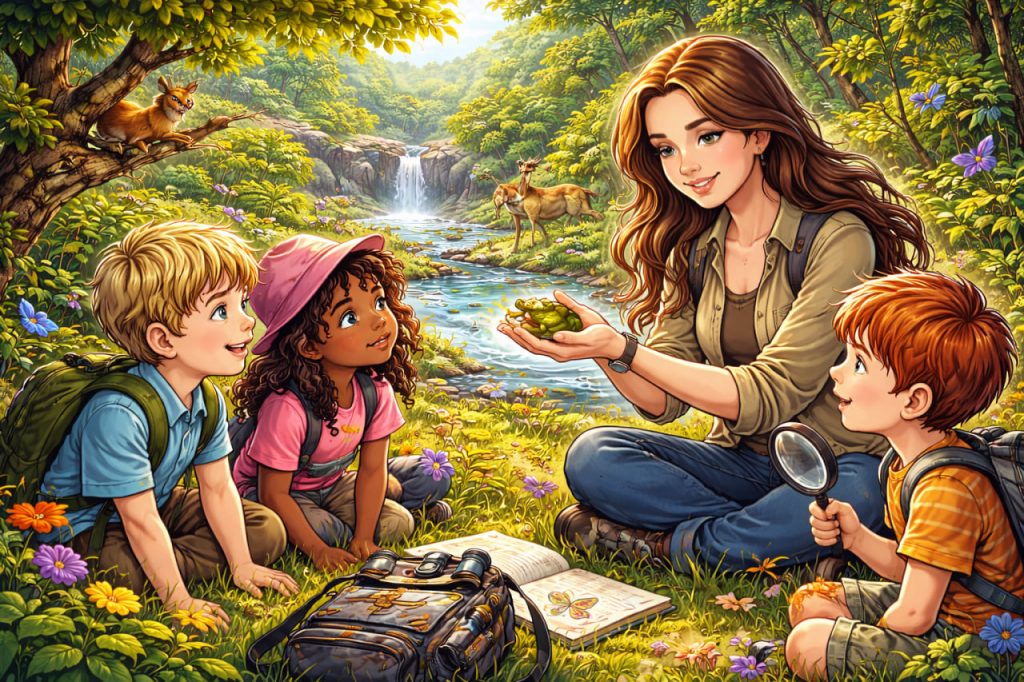
Environmental education plays a crucial role in shaping how future generations understand and interact with the natural world. Children form their core values, habits, and worldview at an early age, making childhood a critical period for developing respect for nature. Conversations about ecosystems, animals, and environmental responsibility help children see themselves as part of a larger living system. Rather than presenting nature as something distant or abstract, environmental education builds emotional connection and awareness. These early experiences influence lifelong attitudes toward conservation and sustainability. Teaching children about nature is not only about knowledge, but about nurturing responsibility and care.
How Children Perceive Nature
Children naturally relate to the world through curiosity, observation, and emotional response. They tend to see animals, plants, and landscapes as living companions rather than resources. This openness makes them especially receptive to environmental ideas. When children learn about nature through stories, exploration, and discussion, they develop empathy toward living systems. Such understanding forms the basis for ethical decision-making later in life. According to environmental psychologist Dr. Laura Greenfield:
“A child who feels connected to nature
is more likely to protect it as an adult.”
This emotional bond is as important as factual knowledge.
Building Environmental Responsibility Early
Early environmental education helps children understand cause and effect in the natural world. Simple explanations about pollution, waste, and resource use show how human actions influence ecosystems. When these ideas are introduced gradually and age-appropriately, children learn responsibility without fear or guilt. They begin to recognize that everyday choices matter. This sense of agency empowers children rather than overwhelming them. Responsibility learned early tends to become habitual and long-lasting.
Developing Critical Thinking and Systems Awareness
Talking to children about nature encourages systems thinking—the ability to see connections between different elements of the world. Children learn that forests, oceans, animals, and people are interconnected. This perspective supports critical thinking and problem-solving skills. Environmental topics often combine biology, geography, ethics, and social behavior, offering a holistic learning experience. Such integrated understanding prepares children to think beyond isolated facts and consider long-term consequences.
Counteracting Disconnection from the Natural World
Modern lifestyles increasingly separate children from direct contact with nature. Urban environments, digital entertainment, and structured schedules reduce opportunities for outdoor exploration. Environmental education helps counter this trend by encouraging curiosity about natural processes, even in everyday settings. Learning about local plants, weather, and animals reconnects children with their surroundings. This connection supports both environmental awareness and emotional well-being.
Encouraging Respect Rather Than Fear
It is important that environmental education focuses on respect and understanding rather than alarm. While environmental challenges are real, presenting them without context can cause anxiety. Effective education balances honesty with hope, showing children that positive action is possible. By highlighting conservation efforts and solutions, children learn that problems can be addressed through cooperation and care. This approach builds resilience rather than helplessness.
Long-Term Impact on Society
Children educated about nature grow into adults who are more likely to support sustainable practices, conservation policies, and responsible consumption. Environmental education contributes to informed citizenship and collective responsibility. Over time, these values influence communities, economies, and political decisions. Teaching children about nature is therefore an investment in long-term societal well-being. It shapes not only individual behavior, but the direction of future development.
Interesting Facts
- Children who spend time in nature show higher empathy toward animals.
- Early environmental education supports long-term sustainable behavior.
- Nature-based learning improves attention and emotional balance.
- Local environmental topics are often more effective than global abstractions.
- Environmental education strengthens community awareness and cooperation.
Glossary
- Environmental Education — learning that builds understanding of natural systems and responsibility.
- Ecosystem — a community of living organisms interacting with their environment.
- Systems Thinking — understanding how different elements influence one another.
- Sustainability — meeting present needs without harming future generations.
- Environmental Responsibility — awareness of how actions affect nature.