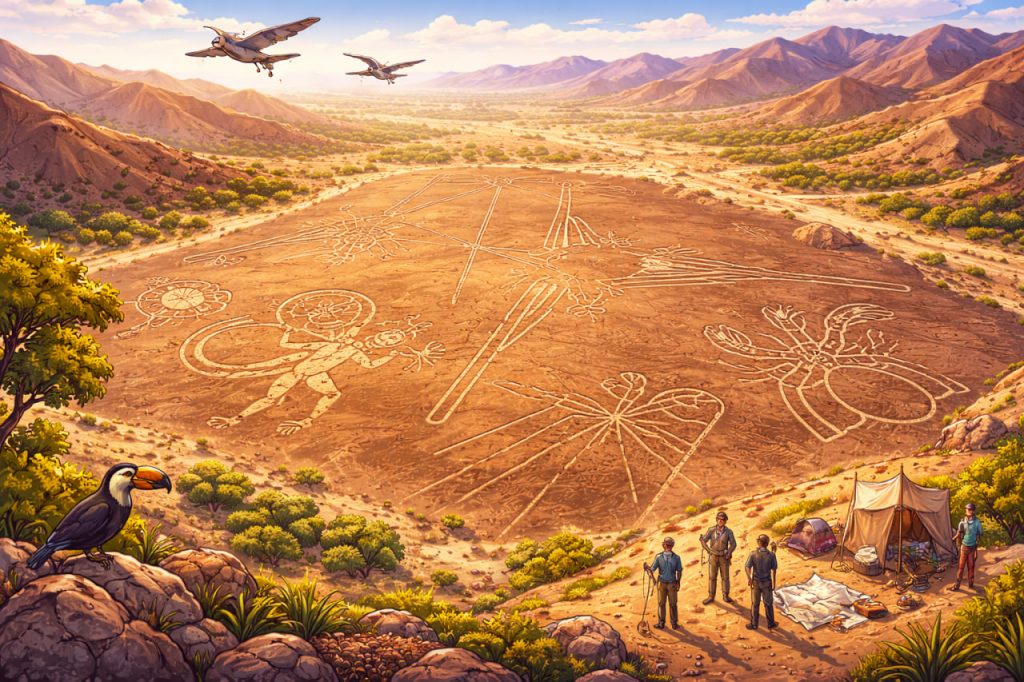
The Nazca geoglyphs are among the most enigmatic archaeological phenomena on Earth. Located in the arid desert of southern Peru, these enormous ground drawings depict animals, plants, geometric shapes, and long straight lines stretching for kilometers. Created centuries ago, they remain clearly visible today thanks to the region’s dry climate and stable soil. Their scale is so vast that the figures are best appreciated from the air, raising enduring questions about how and why they were made. The geoglyphs challenge modern assumptions about ancient technology, planning, and symbolic thinking.
Where the Geoglyphs Are Located
The geoglyphs are spread across the Nazca Desert near the Nazca Lines. This plateau lies between the Andes Mountains and the Pacific coast, an area with extremely low rainfall. The ground consists of dark stones covering lighter soil beneath. By removing the surface stones, ancient builders revealed pale lines that contrast sharply with the surrounding terrain. This simple yet effective technique allowed the designs to endure for centuries with minimal erosion.
Who Created the Nazca Geoglyphs
Archaeological evidence links the geoglyphs to the Nazca culture, which flourished roughly between 200 BCE and 600 CE. This society left behind pottery, textiles, and ceremonial centers, but no written language. The geoglyphs are considered part of their broader cultural and religious landscape. Creating such massive designs required organization, planning, and shared purpose. Their construction suggests a society capable of coordinated labor and long-term vision.
How the Geoglyphs Were Made
Despite their size, the Nazca geoglyphs were created using surprisingly simple tools. Workers cleared stones along planned paths, guided by stakes and ropes to maintain straight lines and proportions. Experiments have shown that large figures can be constructed accurately from the ground without aerial perspective. The precision of curves and symmetry indicates careful measurement and repeated correction. This demonstrates that advanced geometry can emerge from practical techniques rather than complex machinery.
Types of Figures and Designs
The Nazca geoglyphs fall into several categories. Some depict animals such as birds, monkeys, spiders, and marine creatures. Others consist of geometric forms, spirals, trapezoids, and long straight lines. The diversity of shapes suggests multiple functions or meanings. Animal figures may have held symbolic or ritual significance, while geometric lines may have served practical or ceremonial roles. The variety reflects a complex visual language rather than random decoration.
Theories About Their Purpose
Many theories attempt to explain why the geoglyphs were created. Some researchers suggest they were part of religious rituals linked to water and fertility in a harsh desert environment. Others propose astronomical functions, noting possible alignments with celestial events. There are also interpretations involving processional pathways used in ceremonies. While no single theory explains all geoglyphs, most scholars agree they were deeply connected to ritual and belief rather than everyday utility.
Why the Geoglyphs Are So Well Preserved
The remarkable preservation of the Nazca geoglyphs is due to environmental conditions. The desert experiences minimal rainfall, low humidity, and little wind erosion. Once the stones were removed, the exposed soil remained largely undisturbed. This natural preservation makes the site especially valuable for studying ancient human activity. It also means the geoglyphs are vulnerable to modern disturbance.
Scientific and Cultural Importance
The Nazca geoglyphs offer insight into how ancient societies interacted with landscape, symbolism, and belief. They show that large-scale artistic and ritual expression does not require advanced technology, only collective intent and knowledge. Ongoing research combines archaeology, geology, and remote sensing to better understand their construction and meaning. The geoglyphs continue to inspire both scientific inquiry and public imagination. They stand as a testament to human creativity across time.
P.S. Look for the Truth, my friends, the story is not as simple as it is in the textbooks, we are not apes, and we are not alone in the universe…
Interesting Facts
- Some Nazca lines stretch for several kilometers in length.
- The figures are best seen from the air, not from the ground.
- Simple tools were enough to create highly precise designs.
- The desert climate helped preserve the geoglyphs for over 1,500 years.
- New geoglyphs are still being discovered using modern imaging methods.
Glossary
- Geoglyph — a large design created on the ground by arranging or removing materials.
- Nazca Culture — an ancient civilization of southern Peru.
- Desert Plateau — a flat, elevated arid landscape.
- Ritual Landscape — terrain shaped for symbolic or ceremonial purposes.
- Archaeology — the study of past human cultures through material remains.