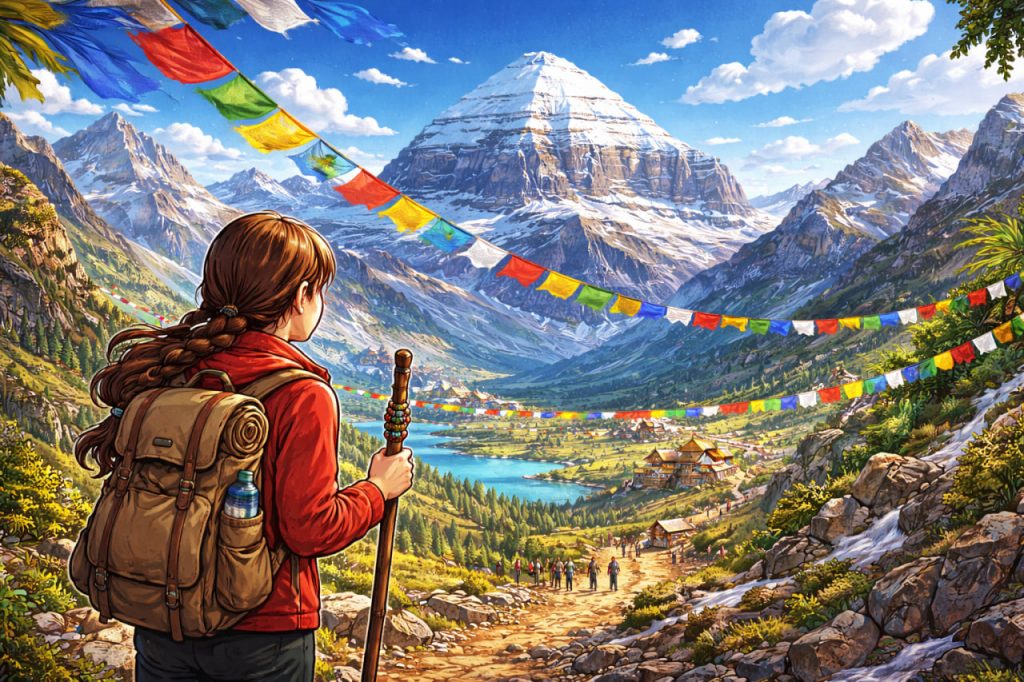
Mount Kailash is one of the most sacred mountains in the world, located in the remote western region of Tibet. Rising to an elevation of about 6,638 meters, it stands apart not only because of its striking pyramid-like shape but also because of its deep spiritual significance. For centuries, it has been revered in Hinduism, Buddhism, Jainism, and Bon, making it a rare symbol of shared religious importance. Unlike most high Himalayan peaks, Mount Kailash has never been officially climbed. Pilgrims believe the mountain is too sacred to be conquered, and climbing it is widely discouraged. Its isolation, symmetry, and spiritual aura have turned Kailash into both a geographical landmark and a cultural symbol.
Religious Significance Across Traditions
In Hindu belief, Mount Kailash is considered the earthly home of Lord Shiva, where he resides in meditation with his consort Parvati. For Buddhists, the mountain represents Mount Meru, the mythical center of the universe. In Jain tradition, it is associated with the site where the first Tirthankara attained liberation. The Bon religion, which predates Buddhism in Tibet, also holds the mountain as sacred. Religious studies scholar Dr. Anika Sharma explains:
“Few places on Earth hold such layered spiritual meaning.
Kailash is not just a mountain — it is a cosmic symbol.”
This shared reverence makes Kailash unique among sacred sites worldwide.
The Pilgrimage of Kora
One of the most important spiritual practices connected to Mount Kailash is the kora, a ritual circumambulation of the mountain. Pilgrims walk approximately 52 kilometers around the base, often at high altitude and in challenging weather conditions. Completing one circuit is believed to cleanse sins and bring spiritual merit. Some devotees perform full-body prostrations along the entire route, turning the journey into an act of deep devotion. The pilgrimage route crosses mountain passes exceeding 5,600 meters, demanding both physical endurance and spiritual determination.
Geographical and Natural Features
Mount Kailash stands near the sources of four major Asian rivers: the Indus, the Sutlej, the Brahmaputra, and the Karnali. This geographical position reinforces its symbolic status as a center of life and renewal. The mountain’s near-perfect symmetry and striated rock faces create a distinctive visual appearance. Unlike neighboring Himalayan peaks, Kailash appears isolated and sharply defined against the surrounding plateau. Scientists explain its shape through tectonic uplift and erosion patterns, yet its striking geometry continues to inspire myths and legends.
Why It Remains Unclimbed
Despite being lower than Mount Everest, Kailash has never been officially summited. Several attempts were proposed during the 20th century, but climbing expeditions were either denied or voluntarily withdrawn out of respect for religious beliefs. According to cultural historian Dr. Martin Alvarez:
“In a world driven by conquest,
Kailash stands as a reminder that not every summit must be reached.”
Its unclimbed status has strengthened its aura of mystery and reverence.
Cultural and Global Impact
Mount Kailash continues to attract thousands of pilgrims and travelers each year. It symbolizes spiritual endurance, humility, and harmony between nature and belief. While scientific research explains its geology, its deeper meaning remains rooted in tradition and faith. The mountain’s presence influences art, literature, and philosophy across Asia. Whether viewed through a spiritual or geological lens, Mount Kailash represents a rare convergence of natural grandeur and sacred symbolism.
Interesting Facts
- Mount Kailash has never been officially climbed.
- It lies near the source of four major Asian rivers.
- Pilgrims travel thousands of kilometers to complete the kora.
- The mountain’s pyramid-like shape enhances its mythical status.
- It is sacred in four major religious traditions.
Glossary
- Kora — a ritual pilgrimage walk around a sacred site.
- Mount Meru — a mythical mountain considered the center of the universe in Buddhist cosmology.
- Tirthankara — a spiritual teacher in Jainism who has achieved liberation.
- Bon — an ancient spiritual tradition of Tibet predating Buddhism.
- Tectonic Uplift — the geological process that raises sections of Earth’s crust.