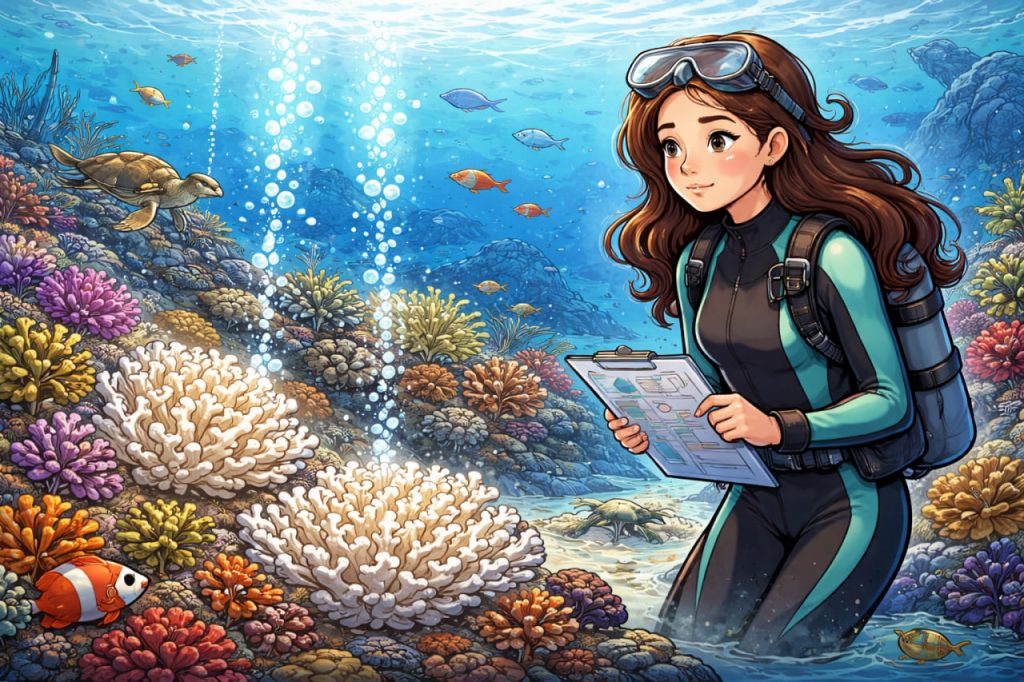
The world’s oceans absorb a significant portion of the carbon dioxide released into the atmosphere. While this process slows the pace of atmospheric warming, it triggers a chemical reaction in seawater that leads to ocean acidification. As carbon dioxide dissolves in water, it forms carbonic acid, lowering the ocean’s pH level. Although the change may seem small numerically, even slight shifts in pH can have major biological consequences. Marine organisms evolved under relatively stable chemical conditions, and rapid changes disrupt delicate ecological balances. Understanding why oceans are becoming more acidic is essential for predicting long-term impacts on marine ecosystems and global food systems.
The Chemistry Behind Ocean Acidification
When atmospheric carbon dioxide (CO₂) enters seawater, it reacts with water molecules to form carbonic acid. This acid then releases hydrogen ions, which reduce the pH of the water and alter carbonate chemistry. Carbonate ions are crucial for marine organisms that build shells and skeletons from calcium carbonate. As acidity increases, the availability of these carbonate ions decreases. According to marine chemist Dr. Laura Chen:
“Ocean acidification is not about the sea turning into acid.
It is about subtle chemical shifts that disrupt life at the microscopic level.”
These shifts affect everything from plankton to coral reefs.
Impact on Coral Reefs and Shell-Building Species
Coral reefs are among the ecosystems most vulnerable to acidification. Corals rely on carbonate ions to construct their rigid calcium carbonate structures. As seawater chemistry changes, reef-building becomes more difficult and energy-intensive. Shell-forming organisms such as oysters, mussels, and certain plankton species also struggle to maintain structural integrity. Weakening of these foundational species disrupts entire food chains. Coral reefs, often described as the “rainforests of the sea,” support immense biodiversity, and their decline affects fish populations and coastal communities.
Consequences for Marine Food Webs
The effects of acidification extend beyond coral reefs. Microscopic plankton species that form the base of marine food webs are sensitive to changes in water chemistry. If these organisms decline, larger species such as fish, seabirds, and marine mammals may face food shortages. Changes in ocean chemistry can also affect fish behavior, reproduction, and sensory perception. According to ocean ecologist Dr. Martin Alvarez:
“Acidification does not eliminate life overnight,
but it gradually alters survival conditions across entire ecosystems.”
Such gradual shifts may compound other environmental stresses such as warming temperatures and pollution.
Economic and Human Implications
Ocean acidification has direct economic consequences for fisheries, aquaculture, and tourism. Coastal communities that depend on shellfish industries may experience declining harvests. Coral reef degradation can reduce tourism revenue and weaken natural coastal protection against storms. Because oceans regulate climate and support global food supplies, chemical changes in seawater influence both environmental and economic stability. Addressing acidification requires reducing carbon emissions and improving global climate management strategies.
Future Outlook and Research
Scientists continuously monitor ocean pH levels using autonomous sensors, research vessels, and satellite-supported data models. Long-term datasets reveal that ocean acidity has increased significantly since the Industrial Revolution. Continued research focuses on identifying resilient species and developing conservation strategies. While ocean chemistry cannot be reversed quickly, coordinated climate action can slow further change. Protecting marine ecosystems depends on understanding and addressing the chemical processes reshaping the oceans.
Interesting Facts
- Since the Industrial Revolution, ocean acidity has increased by about 30%.
- Oceans absorb roughly one-quarter of global CO₂ emissions each year.
- Coral reefs support nearly 25% of all marine species.
- Some regions experience localized acidification faster than the global average.
- Small pH changes represent significant shifts on the logarithmic pH scale.
Glossary
- Ocean Acidification — the decrease in ocean pH caused by the absorption of atmospheric carbon dioxide.
- Carbonic Acid — a weak acid formed when CO₂ dissolves in water.
- Carbonate Ion — a chemical component needed by marine organisms to build shells and skeletons.
- Calcium Carbonate — the material used by corals and shellfish to form hard structures.
- pH Level — a scale that measures how acidic or alkaline a substance is.