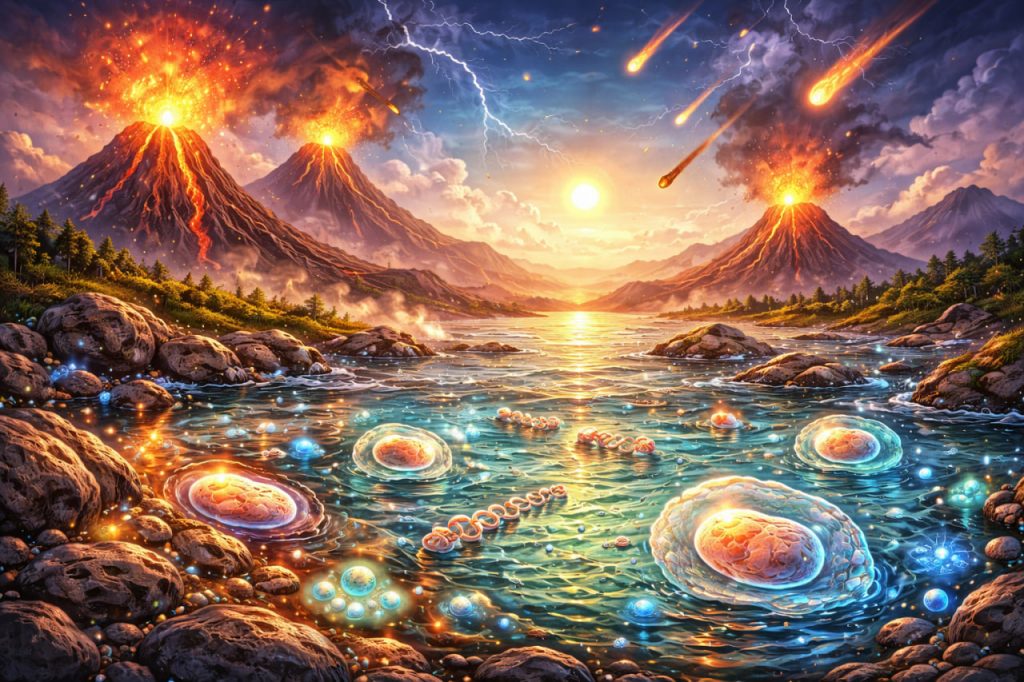
The origin of life on Earth is one of the most profound and complex questions in science. Scientists believe that life began billions of years ago under conditions very different from those we see today. Early Earth was a hot, unstable environment with volcanic activity, intense radiation, and a chemically rich atmosphere. Despite these harsh conditions, simple molecules gradually combined to form more complex structures. Over time, these structures developed the ability to replicate and evolve, marking the beginning of life. This process is known as abiogenesis, the transition from non-living matter to living systems. Understanding how life originated helps scientists explore not only our own beginnings but also the possibility of life elsewhere in the universe.
Early Earth Conditions
The early Earth provided a unique environment for chemical evolution. The atmosphere likely contained gases such as methane, ammonia, water vapor, and carbon dioxide. Frequent lightning strikes and volcanic activity supplied energy needed for chemical reactions. Astrobiologist Dr. Helen Carter explains:
“Life likely began as a series of chemical steps,
where simple molecules gradually formed complex systems.”
These conditions allowed organic molecules to form and accumulate over time. Water played a critical role, serving as a medium where reactions could occur. Oceans became a key location for early chemical processes. These environments set the stage for the emergence of life.
Formation of Organic Molecules
The first step toward life was the formation of organic molecules such as amino acids and nucleotides. Experiments like the famous Miller-Urey experiment showed that such molecules can form under conditions similar to early Earth. These molecules are the building blocks of proteins and genetic material. Over time, they combined into more complex structures. Chemical reactions driven by energy sources led to increasing complexity. This stage marked the transition from simple chemistry to pre-biological systems. It was a crucial step toward the development of life.
The Role of RNA and Early Systems
One leading theory suggests that RNA played a central role in the origin of life. RNA can both store information and catalyze chemical reactions, making it a strong candidate for early life processes. In the so-called RNA world hypothesis, RNA molecules were the first self-replicating systems. These molecules could evolve and become more efficient over time. Eventually, more stable systems involving DNA and proteins developed. This transition marked the evolution of more complex life forms. RNA remains a key molecule in all living organisms today.
From Molecules to Cells
The next step in the origin of life was the formation of simple cells. Molecules became enclosed within membranes, creating structures similar to modern cells. These early cells could maintain internal conditions and carry out basic metabolic processes. Over time, natural selection favored more efficient and stable systems. This led to the development of increasingly complex organisms. The emergence of cellular life marked a major milestone in Earth’s history. It allowed life to diversify and adapt to different environments.
Why This Process Matters
Understanding how life began on Earth has implications far beyond our planet. It helps scientists search for life on other planets and understand the conditions necessary for its existence. Studying the origin of life also reveals how complex systems can arise from simple beginnings. It connects chemistry, biology, and physics in a unified framework. The process of abiogenesis shows how natural laws can lead to the emergence of life. This knowledge continues to evolve as new discoveries are made. The origin of life remains one of the most exciting areas of scientific research.
Interesting Facts
- Life on Earth began over 3.5 billion years ago
- Water played a crucial role in early chemical reactions
- RNA may have been the first molecule of life
- Early Earth had a very different atmosphere
- The origin of life is still an active area of research
Glossary
- Abiogenesis — origin of life from non-living matter
- Organic Molecules — molecules containing carbon, essential for life
- RNA — molecule involved in genetic processes
- Cell — basic unit of life
- Chemical Evolution — gradual formation of complex molecules