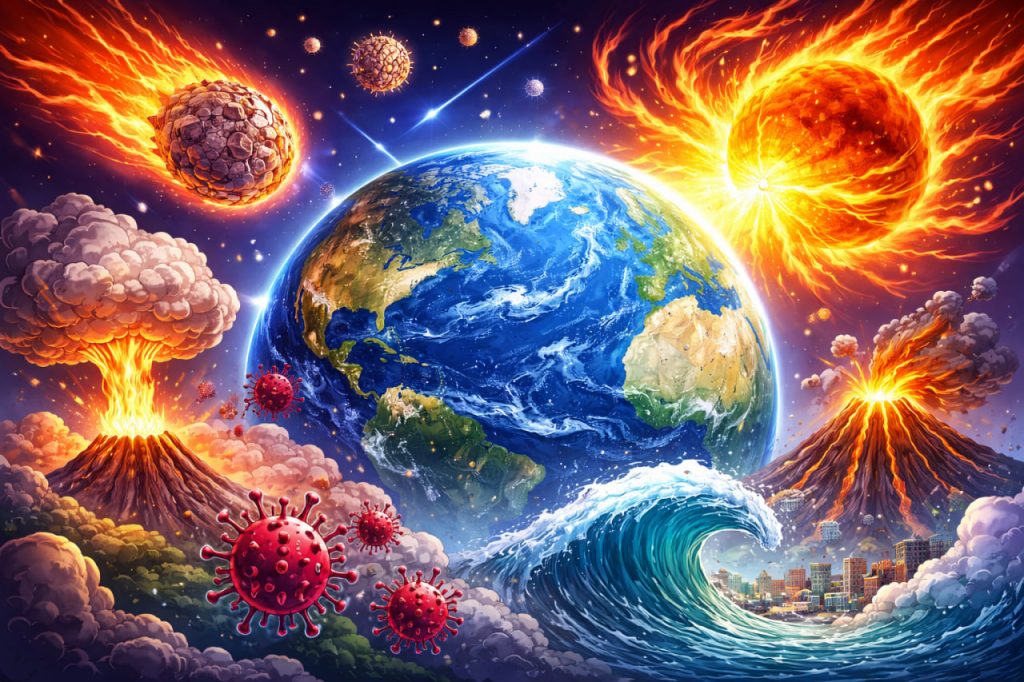
The idea of a sudden global catastrophe is something that often captures human imagination and concern. From asteroid impacts to supervolcanic eruptions or extreme solar storms, such scenarios are widely discussed in both science and media. However, when examined scientifically, the probability of a global catastrophe occurring on any given day—such as tomorrow—is extremely low. Earth has existed for billions of years, and while catastrophic events have occurred, they are rare on human timescales. Scientists use statistical models and historical data to estimate the likelihood of such events. These models consistently show that the chance of a sudden global disaster happening in the immediate future is very small. Understanding real risks helps separate fear from scientific reality.
Types of Global Catastrophes
Global catastrophes can take many forms, including natural and human-related events. Natural disasters include asteroid impacts, supervolcanic eruptions, pandemics, and extreme space weather. Human-related risks may involve technological failures or large-scale conflicts. Risk analyst Dr. Andrew Collins explains:
“Global catastrophes are possible,
but their probability on any given day is extremely low.”
Each type of event has its own probability and timescale. For example, large asteroid impacts occur over millions of years, while pandemics are more frequent but rarely globally catastrophic in a single day. Understanding these differences is key to evaluating risk.
Asteroids and Space Threats
One of the most well-known global threats is the possibility of an asteroid impact. However, space agencies continuously monitor near-Earth objects and track their trajectories. Currently, there are no known large asteroids on a collision course with Earth in the near future. The probability of a civilization-ending impact happening tomorrow is effectively negligible. Smaller objects enter Earth’s atmosphere more frequently, but they usually burn up before reaching the surface. Monitoring systems significantly reduce uncertainty in this area. This makes asteroid-related risks one of the most controlled natural threats.
Supervolcanoes and Geological Events
Supervolcanic eruptions are among the most powerful natural events on Earth. However, they occur extremely rarely, often separated by hundreds of thousands of years. There is currently no evidence suggesting that such an eruption is imminent. Geological monitoring allows scientists to detect early warning signs long before an eruption occurs. While earthquakes and smaller eruptions happen regularly, they do not pose global catastrophic risk. The slow nature of geological processes makes sudden global events unlikely. This reduces the probability of such disasters occurring without warning.
Solar Storms and Technological Risks
Solar storms can affect modern infrastructure, but even strong events are unlikely to cause instant global collapse. Most impacts would be regional or temporary rather than immediate worldwide catastrophes. Technological risks, such as large-scale system failures, also tend to develop over time rather than instantly. Systems are designed with redundancies to prevent total collapse. While vulnerabilities exist, they are managed through monitoring and planning. This reduces the likelihood of sudden global failure.
Why the Probability Is So Low
The key reason global catastrophes are unlikely on any given day is their timescale. Most such events occur over long periods or require specific conditions to align. The probability of all necessary factors occurring simultaneously is extremely small. Statistical models show that the chance of a global catastrophe tomorrow is close to zero, though not mathematically impossible. This distinction is important: possible does not mean probable. Scientific understanding helps put these risks into perspective. It allows us to focus on realistic concerns rather than unlikely scenarios.
Why Understanding Risk Matters
Understanding the probability of global catastrophes helps reduce unnecessary fear and improve preparedness. It allows governments and scientists to focus on monitoring real risks and developing response strategies. While the chance of a disaster tomorrow is extremely low, long-term risks still exist and require attention. Awareness and preparation are more effective than speculation. Studying these risks also improves our ability to protect humanity in the future. Knowledge turns uncertainty into manageable understanding. This makes science a powerful tool for addressing global concerns.
P.S. Despite the low probability of global-scale natural disasters, we have seen an unprecedented increase in climate-related disasters over the past 100 years, and it is only a matter of time before disaster strikes our homes. Therefore, it is crucial to prepare for potential disasters and remember that we may not wake up tomorrow, so we must live today in a way that our conscience will not condemn us when we go to sleep.
Interesting Facts
- Large asteroid impacts are extremely rare events
- Supervolcano eruptions occur over long timescales
- Space agencies monitor near-Earth objects continuously
- Most global risks develop over years, not days
- Probability of a catastrophe tomorrow is extremely low
Glossary
- Global Catastrophe — event affecting the entire planet
- Probability — likelihood of an event occurring
- Supervolcano — volcano capable of massive eruptions
- Near-Earth Object — asteroid or comet near Earth’s orbit
- Risk Analysis — study of potential dangers and their likelihood