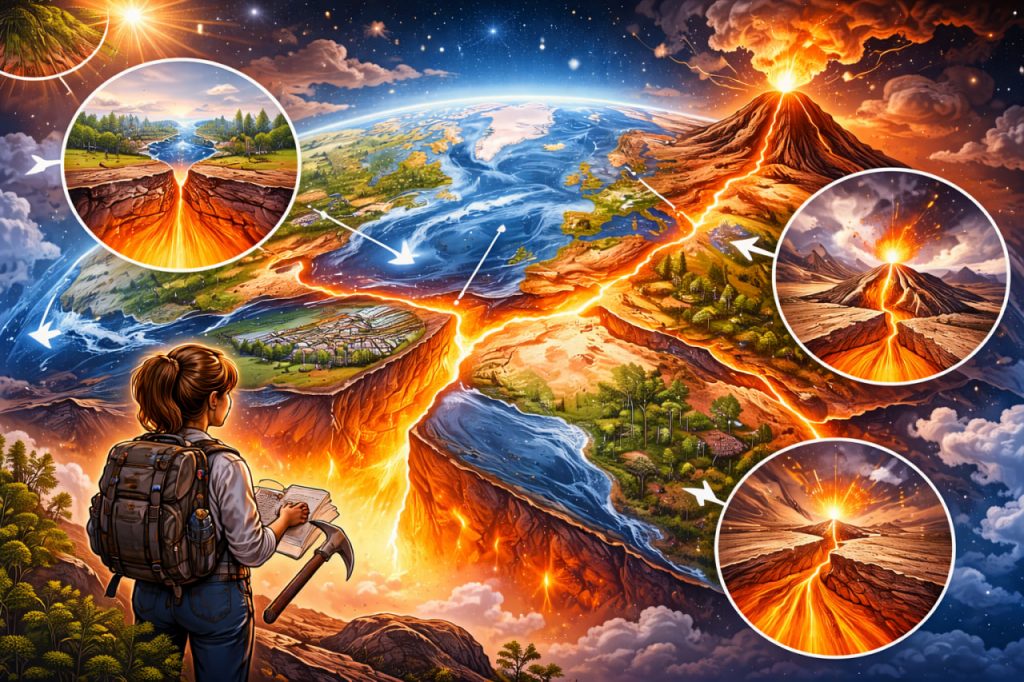
The Earth is not a static planet—it is constantly changing, shifting, and evolving. At the heart of this dynamic behavior lies plate tectonics, a powerful geological process that shapes continents, forms mountains, and drives earthquakes and volcanoes. This system makes Earth unique among known planets, as it actively recycles its surface and regulates long-term climate. Without plate tectonics, our planet would look completely different and might not even support life as we know it. Understanding this mechanism reveals why Earth is often described as a “living planet.”
What Are Tectonic Plates
The Earth’s outer layer, called the lithosphere, is broken into large pieces known as tectonic plates. These plates float on a semi-fluid layer beneath them called the asthenosphere. There are several major plates and many smaller ones, all moving slowly—usually just a few centimeters per year. Despite this slow speed, their movement over millions of years dramatically reshapes the planet’s surface.
How Plates Move
The movement of tectonic plates is driven by heat from Earth’s interior. This heat creates convection currents in the mantle, causing material to rise, cool, and sink again. These currents push and pull the plates in different directions. Plates can move apart, collide, or slide past each other, creating different geological features and events depending on the type of interaction.
Types of Plate Boundaries
- Divergent boundaries — plates move apart, forming new crust (e.g., mid-ocean ridges)
- Convergent boundaries — plates collide, creating mountains or subduction zones
- Transform boundaries — plates slide past each other, causing earthquakes
These interactions are responsible for much of Earth’s geological activity, including the formation of continents and ocean basins.
Why Plate Tectonics Is Important
Plate tectonics plays a crucial role in maintaining Earth’s habitability. It helps regulate the carbon cycle by recycling carbon dioxide between the surface and the interior. This process stabilizes the climate over long periods. It also creates diverse landscapes and environments, supporting a wide range of ecosystems. Without plate tectonics, Earth could become geologically inactive and less capable of sustaining life.
A Unique Planetary Feature
So far, Earth is the only known planet with active plate tectonics. Other planets, like Mars and Venus, do not show the same level of surface recycling. This makes plate tectonics a key factor in what makes Earth special. It is not just a geological process—it is a system that connects the planet’s interior, surface, atmosphere, and even life itself.
Interesting Facts
- Tectonic plates move at about the same speed as fingernails grow
- The Himalayas are still rising due to plate collision
- Most earthquakes occur along plate boundaries
- New ocean crust is constantly forming at mid-ocean ridges
- Plate tectonics has been active for billions of years
Glossary
- Plate Tectonics — the movement of large sections of Earth’s crust
- Lithosphere — the rigid outer layer of Earth
- Asthenosphere — a semi-fluid layer beneath the lithosphere
- Convection Currents — heat-driven movement inside Earth
- Subduction — the process where one plate moves under another