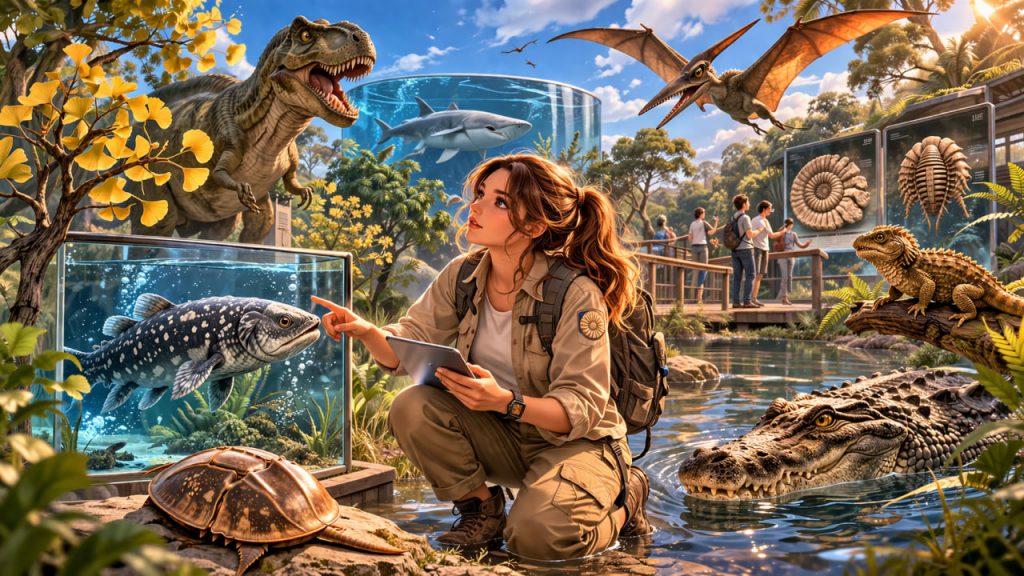
When we think of prehistoric monsters, images of dinosaurs and ancient beasts usually come to mind—creatures that ruled the Earth millions of years ago and then disappeared forever. However, not all prehistoric life is truly gone. Some species that exist today are often called “living fossils” because they have changed very little over millions of years. These organisms provide a unique glimpse into Earth’s distant past, showing how life once looked and evolved. While they may not be as dramatic as dinosaurs, they are real, fascinating, and still alive today. Studying them helps scientists understand evolution, survival, and the resilience of life.
What Are Living Fossils
The term living fossil refers to species that have remained relatively unchanged for extremely long periods of time. These organisms have survived major extinction events and environmental changes, often because they are well adapted to stable ecological niches. They may not look “primitive,” but their body structures and behaviors closely resemble their ancient ancestors. This makes them valuable for studying how life has evolved over geological time.
Examples of Prehistoric Survivors
Several modern species can be considered prehistoric survivors:
- Coelacanth — a deep-sea fish once thought extinct for 65 million years
- Horseshoe crab — a marine animal that has existed for over 400 million years
- Crocodiles — predators that have changed little since the age of dinosaurs
- Sharks — some species have ancient evolutionary origins
- Ginkgo tree — a plant species that dates back to prehistoric times
These organisms demonstrate how certain life forms can remain stable while others evolve rapidly.
Why They Survived
The survival of these species is often due to their adaptability and stable environments. Many live in ecosystems that have not changed drastically over time, such as deep oceans or isolated habitats. Others have body designs that are already highly efficient, requiring little evolutionary change. Their success shows that evolution does not always mean constant transformation—sometimes stability is the best strategy.
Are There Real “Monsters” Today
While modern prehistoric animals are not giant monsters like those in movies, some can still appear unusual or even intimidating. Deep-sea creatures, for example, often have strange shapes and features adapted to extreme environments. These animals remind us that the natural world still holds many mysteries and that ancient traits can persist in unexpected ways.
Why They Matter
Living fossils are important for science because they provide direct links to the past. By studying them, scientists can learn how species survive environmental changes and why some lineages remain stable over time. They also highlight the importance of biodiversity conservation, as losing these species would mean losing unique connections to Earth’s history.
Interesting Facts
- The coelacanth was thought extinct until it was rediscovered in 1938
- Horseshoe crabs existed before the first dinosaurs appeared
- Crocodiles have survived multiple mass extinction events
- Some sharks have existed for over 400 million years
- The ginkgo tree is often called a “living fossil plant”
Glossary
- Living Fossil — a species that has changed little over millions of years
- Extinction — the disappearance of a species
- Evolution — the process of biological change over time
- Biodiversity — the variety of life in an ecosystem
- Habitat — the natural environment where an organism lives