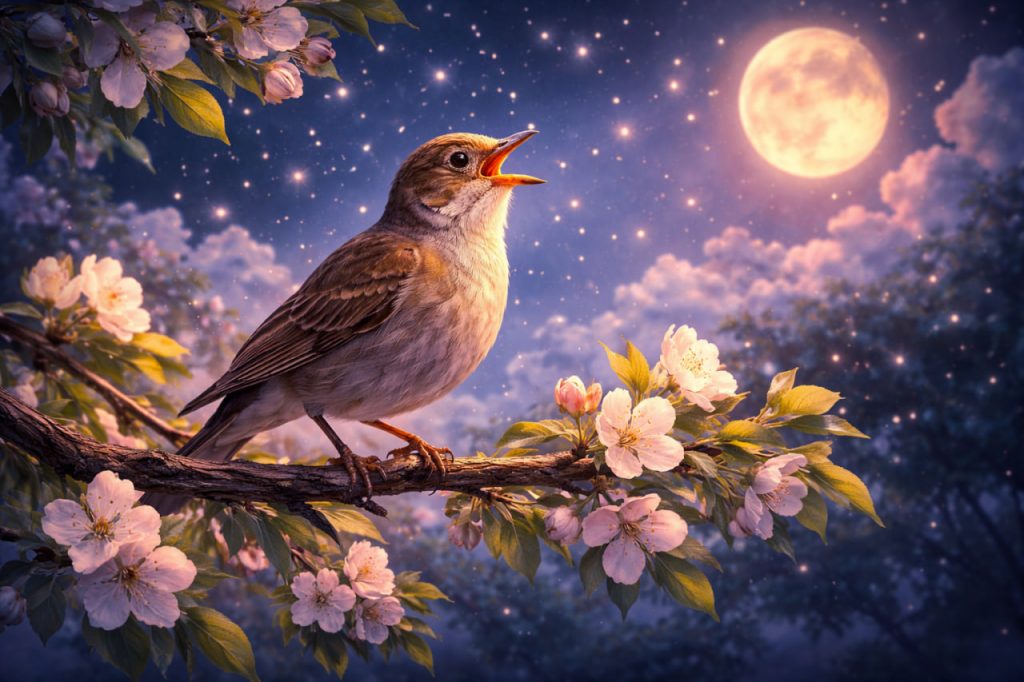
The nightingale is one of the most celebrated songbirds in the world, known for its rich, melodic, and incredibly powerful voice. Despite its small and rather plain appearance, this bird has inspired poets, musicians, and scientists for centuries. The nightingale’s song stands out not only because of its beauty but also because of its complexity and emotional depth. Unlike many other birds, it often sings at night, filling the silence with a sound that feels both mysterious and expressive. This unique behavior has made the nightingale a symbol of art, love, and nature’s hidden wonders. Understanding how and why this bird sings reveals fascinating insights into communication in the natural world.
Why Nightingales Sing
The primary reason nightingales sing is communication, especially during the breeding season. Male nightingales use their songs to attract females and to defend their territory from rivals. Their vocal performance serves as a signal of strength, health, and genetic quality. A more complex and varied song often indicates a stronger and more desirable mate. According to ornithologists:
“The nightingale’s song is not just music—it is a sophisticated signal,
carrying information about the bird’s fitness and territory.”
This means that singing plays a critical role in survival and reproduction.
The Complexity of Their Song
Nightingales are known for having one of the most complex vocal repertoires among birds. A single bird can produce hundreds of different sounds, combining whistles, trills, and rapid sequences into intricate patterns. These songs are not random—they follow structured sequences that can change depending on the situation. The ability to vary tone, rhythm, and intensity makes the nightingale’s song uniquely expressive. Scientists study these patterns to understand how animals use sound to communicate detailed information.
Why They Sing at Night
One of the most distinctive features of the nightingale is its habit of singing at night. This behavior gives the bird its name and sets it apart from most other species. Singing in the quiet nighttime environment allows the sound to travel further without interference from other birds. It also reduces competition, making the song more noticeable to potential mates. Night singing is especially common in unmated males, who use this strategy to increase their chances of attracting a partner.
The Science Behind the Sound
The nightingale produces its song using a specialized vocal organ called the syrinx, located at the base of its windpipe. This organ allows birds to create multiple sounds simultaneously, giving their songs remarkable richness and variation. Airflow, muscle control, and precise timing all contribute to the final sound. Researchers use advanced recording and analysis techniques to study how these vocalizations are produced and how they evolve over time.
Cultural and Artistic Influence
Throughout history, the nightingale has been a powerful symbol in literature and art. Its song has been associated with love, longing, beauty, and creativity. Poets and writers have often used the nightingale as a metaphor for deep emotion and inspiration. Even today, its song continues to captivate listeners and inspire artistic expression. The bird’s influence shows how nature can shape human culture in profound ways.
Interesting Facts
- Nightingales can produce over 200 different song patterns.
- They are known to sing at volumes louder than many larger birds.
- Only male nightingales sing regularly during the breeding season.
- Their song can be heard from hundreds of meters away in quiet conditions.
- Night singing often stops once the bird finds a mate.
Glossary
- Nightingale — a small songbird famous for its powerful and complex vocal abilities.
- Syrinx — the vocal organ of birds that produces sound.
- Territory — an area defended by an animal against others of the same species.
- Repertoire — the range of sounds or songs a bird can produce.
- Ornithology — the scientific study of birds.