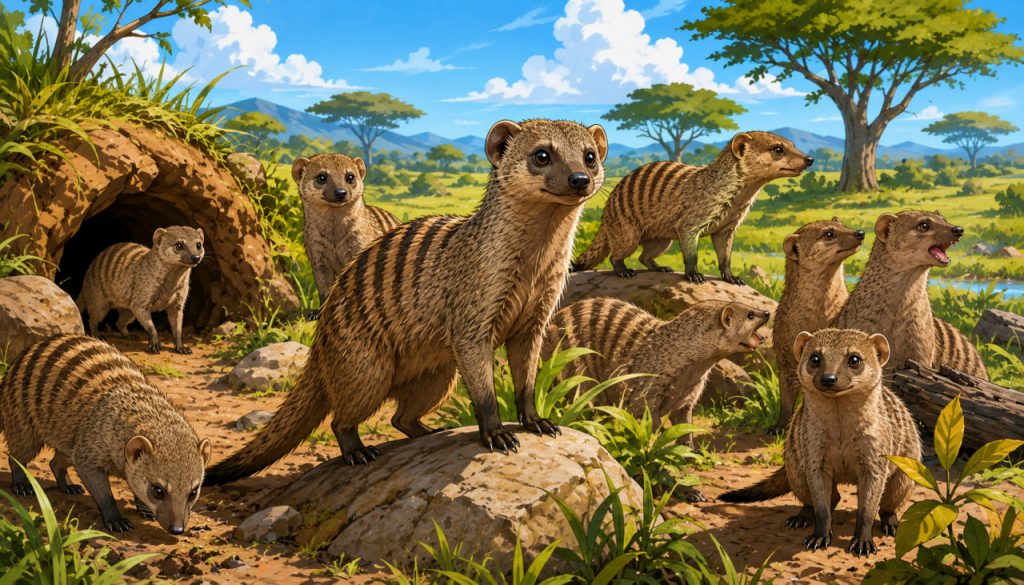
The banded mongoose, scientifically known as Mungos mungo, is one of the most fascinating small mammals living in Africa. Famous for its social behavior, teamwork, and remarkable intelligence, this animal has attracted the attention of zoologists and wildlife enthusiasts for decades.
Unlike many solitary predators, banded mongooses live in highly organized groups where cooperation plays a crucial role in survival. These energetic animals hunt together, defend each other from danger, raise their young collectively, and communicate through a variety of sounds and behaviors.
Although mongooses are often associated with their legendary ability to fight snakes, the real lives of these animals are even more interesting and complex.
What Is the Banded Mongoose?
The banded mongoose is a small carnivorous mammal native to sub-Saharan Africa.
It belongs to the mongoose family, which includes several species adapted for hunting small prey.
The animal can be recognized by:
- Its long body
- Short legs
- Pointed face
- Bushy tail
- Distinctive dark stripes across its back
These stripes give the species its common name.
Adult banded mongooses usually weigh between 1.5 and 2 kilograms, making them agile and fast-moving predators.
Where Banded Mongooses Live
Banded mongooses inhabit a wide range of environments across Africa, including:
- Savannas
- Open woodlands
- Grasslands
- Rocky areas
They often prefer regions near water sources and areas offering shelter among rocks or abandoned burrows.
Unlike some shy animals, banded mongooses adapt surprisingly well to areas near human settlements.
Highly Social Animal Communities
One of the most remarkable features of banded mongooses is their social structure.
They live in groups called troops, which may contain:
- 10 to 40 individuals
- Multiple family generations
- Shared responsibilities
Group living provides important advantages:
- Better protection from predators
- More efficient food searching
- Cooperative care for offspring
Scientists consider banded mongooses among the most socially advanced small mammals.
Behavioral ecologist Tim Clutton-Brock, who studied cooperative animals extensively, explained:
“Banded mongooses demonstrate extraordinary levels of cooperation and collective behavior.”
Their societies are surprisingly sophisticated for animals of their size.
How Banded Mongooses Communicate
These animals communicate constantly through:
- Chirps
- Growls
- Alarm calls
- Body movements
Different sounds warn the group about:
- Predators
- Food sources
- Territorial threats
Researchers have found that mongooses even produce distinct calls while foraging together to maintain group coordination.
This communication helps the troop stay organized while moving through complex environments.
Diet and Hunting Behavior
Banded mongooses are opportunistic hunters.
Their diet includes:
- Insects
- Small reptiles
- Rodents
- Eggs
- Birds
- Fruits
They use strong claws and excellent smell to search for hidden prey.
Mongooses are highly active during the day and spend much of their time exploring and digging.
The Famous Snake Myth
Mongooses are widely known for fighting venomous snakes such as cobras.
While they can kill dangerous snakes, the reality is often exaggerated.
Their success comes from:
- Fast reflexes
- Agility
- Thick fur protection
- Partial resistance to some snake venom toxins
However, mongooses are not completely immune to venom and can still be injured or killed during snake encounters.
Cooperative Parenting
Banded mongooses raise young collectively rather than individually.
In many groups:
- Females give birth around the same time
- Pups are raised together
- Adults help feed and protect offspring
Some adults even act as “babysitters” while others search for food.
This cooperative care improves survival rates for young mongooses.
Intelligence and Learning
Scientists have observed impressive problem-solving abilities in banded mongooses.
They are capable of:
- Learning through observation
- Remembering safe feeding locations
- Adapting hunting strategies
Young mongooses often learn survival skills by watching older members of the troop.
This social learning resembles behavior seen in more cognitively advanced mammals.
Predators and Survival Challenges
Despite their intelligence, banded mongooses face many threats in the wild.
Predators include:
- Birds of prey
- Large snakes
- Jackals
- Wild cats
Group cooperation helps reduce these dangers.
When threatened, troops may:
- Scatter rapidly
- Hide in burrows
- Produce alarm calls
Their vigilance and teamwork are critical survival strategies.
Why Scientists Study Mongooses
Banded mongooses provide valuable insight into:
- Social evolution
- Animal cooperation
- Group communication
- Collective behavior
Researchers use them as models for understanding how complex social systems develop in animals.
Their societies demonstrate that intelligence and cooperation are not limited to primates or large mammals.
The Ecological Importance of Mongooses
Mongooses play an important role in African ecosystems by controlling populations of:
- Insects
- Rodents
- Small reptiles
This helps maintain ecological balance in their habitats.
As predators and scavengers, they contribute to healthy ecosystem functioning.
Interesting Facts
- Banded mongooses often sleep together in underground dens.
- Some troops contain several dozen members.
- Mongooses communicate constantly while searching for food.
- Young mongooses sometimes form strong bonds with specific adult helpers.
- Their quick reflexes help them survive encounters with venomous snakes.
Glossary
- Troop — A social group of animals living and moving together.
- Carnivorous Mammal — A mammal that primarily eats meat or animal-based food.
- Opportunistic Hunter — An animal that eats a wide variety of available foods.
- Social Learning — Learning behaviors by observing others.
- Ecological Balance — Stability within an ecosystem between species and environmental conditions.