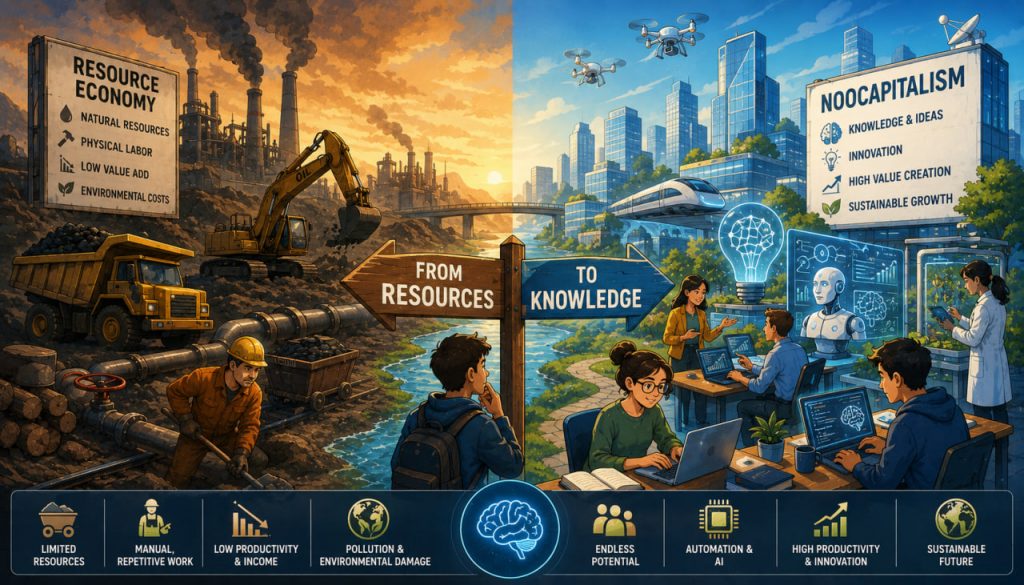
For centuries, the wealth of nations depended primarily on physical resources. Countries became powerful through access to land, oil, coal, metals, factories, and industrial production. However, the 21st century is increasingly shaped by a different kind of power — knowledge.
Economists, futurists, and technologists now discuss the rise of noocapitalism, a system where intellectual capital, information, innovation, and human creativity become more valuable than raw materials. In this new economic reality, ideas can generate more wealth than entire natural resource industries.
The competition between traditional resource economies and knowledge-driven economies is transforming global politics, business, education, and labor markets faster than ever before.
What Is Noocapitalism?
The term noocapitalism comes from the Greek word nous, meaning “mind” or “intellect.”
Noocapitalism describes an economic model where the main source of value becomes:
- Knowledge
- Innovation
- Information
- Technology
- Intellectual property
- Human creativity
Unlike industrial economies focused on extracting and processing physical resources, noocapitalism centers on producing ideas and technological solutions.
In this system:
- Software may become more valuable than oil
- Algorithms may influence economies more than factories
- Data becomes a strategic resource
From Industrial Economies to Knowledge Economies
During the Industrial Revolution, economic success depended heavily on:
- Manufacturing
- Heavy industry
- Resource extraction
- Physical infrastructure
But digital technology radically changed this structure.
Modern companies can become enormously valuable through:
- Software platforms
- Artificial intelligence
- Online services
- Intellectual property
Many of the world’s most powerful corporations now own comparatively few physical resources.
Their real power comes from:
- Data
- Technology
- Networks
- Human expertise
Why Knowledge Became So Valuable
Knowledge scales differently from physical resources.
For example:
- Oil must be extracted continuously
- Physical products require manufacturing and transportation
But digital products can often be replicated globally almost instantly.
A single software platform may serve millions or billions of users simultaneously.
This creates extraordinary economic efficiency.
Economist Peter Drucker predicted this transformation decades ago when he wrote:
“Knowledge has become the key economic resource.”
His prediction became increasingly accurate in the digital age.
The Power of Human Capital
In noocapitalism, education and expertise become strategic national assets.
Countries investing heavily in:
- Science
- Engineering
- Research
- Higher education
- Innovation ecosystems
often gain long-term economic advantages.
Human capital becomes more important than raw resource ownership alone.
This explains why some countries with limited natural resources achieved extraordinary technological success through education and innovation.
Resource Economies vs Knowledge Economies
Traditional resource economies depend heavily on:
- Oil
- Gas
- Mining
- Agriculture
- Heavy industry
These industries remain extremely important.
However, resource-based systems often face challenges such as:
- Price volatility
- Environmental risks
- Dependence on global commodity markets
Knowledge economies rely more on:
- Innovation
- Technology exports
- Digital infrastructure
- Intellectual property
Such economies may adapt faster to technological change.
Data: The New Strategic Resource
Many experts now describe data as “the new oil.”
Modern companies collect enormous amounts of information about:
- Consumer behavior
- Markets
- Logistics
- Communication patterns
Artificial intelligence systems transform this data into economic value.
Companies able to process and analyze information effectively gain major competitive advantages.
This shift makes information itself a strategic asset.
Artificial Intelligence and Automation
AI is accelerating the transition toward noocapitalism.
Automation increasingly replaces repetitive physical labor while increasing demand for:
- Creativity
- Problem-solving
- Technical expertise
- Strategic thinking
Future economic success may depend less on manual production and more on intellectual adaptability.
This transformation is reshaping labor markets worldwide.
The Risks of Noocapitalism
Despite its advantages, noocapitalism also creates serious challenges.
Potential risks include:
- Growing inequality
- Concentration of technological power
- Digital monopolies
- Loss of traditional jobs
- Dependence on large technology corporations
People lacking access to education or digital infrastructure may become increasingly disadvantaged.
This raises important social and political questions.
Education Becomes Economic Infrastructure
In industrial economies, infrastructure meant:
- Railroads
- Factories
- Power plants
In knowledge economies, education itself becomes a critical form of infrastructure.
Countries increasingly compete through:
- Universities
- Research institutions
- Technological ecosystems
- Scientific innovation
Lifelong learning also becomes more important because technology changes rapidly.
Geopolitics in the Knowledge Era
Global power is increasingly tied to:
- Semiconductor technology
- Artificial intelligence
- Cybersecurity
- Biotechnology
- Quantum computing
Competition between nations now involves not only military and natural resources, but also scientific and technological leadership.
Knowledge itself becomes a geopolitical force.
Why Resource Economies Still Matter
Despite the rise of noocapitalism, physical resources remain essential.
Modern technologies still require:
- Energy
- Rare earth metals
- Manufacturing infrastructure
- Global logistics
The future economy will likely combine:
- Resource industries
- Advanced technology
- Intellectual capital
Rather than completely replacing one another, these systems are becoming increasingly interconnected.
The Future of Noocapitalism
Many experts believe future economies will rely heavily on:
- AI-driven industries
- Digital platforms
- Knowledge-intensive services
- Global innovation networks
Success may depend increasingly on how societies develop human intelligence, creativity, and adaptability.
The nations and companies able to generate new ideas fastest may dominate the future global economy.
Interesting Facts
- Some technology companies are worth more than entire industrial sectors.
- Data processing became one of the world’s fastest-growing industries.
- Countries with limited natural resources can become economic leaders through innovation.
- Artificial intelligence is accelerating the value of knowledge-based industries.
- Intellectual property has become a major global economic asset.
Glossary
- Noocapitalism — An economic system where knowledge and intellectual capital become primary sources of value.
- Human Capital — The economic value of skills, education, and expertise.
- Intellectual Property — Legal ownership of inventions, designs, software, or creative works.
- Knowledge Economy — An economy primarily driven by information, technology, and innovation.
- Automation — The use of technology to perform tasks with minimal human involvement.