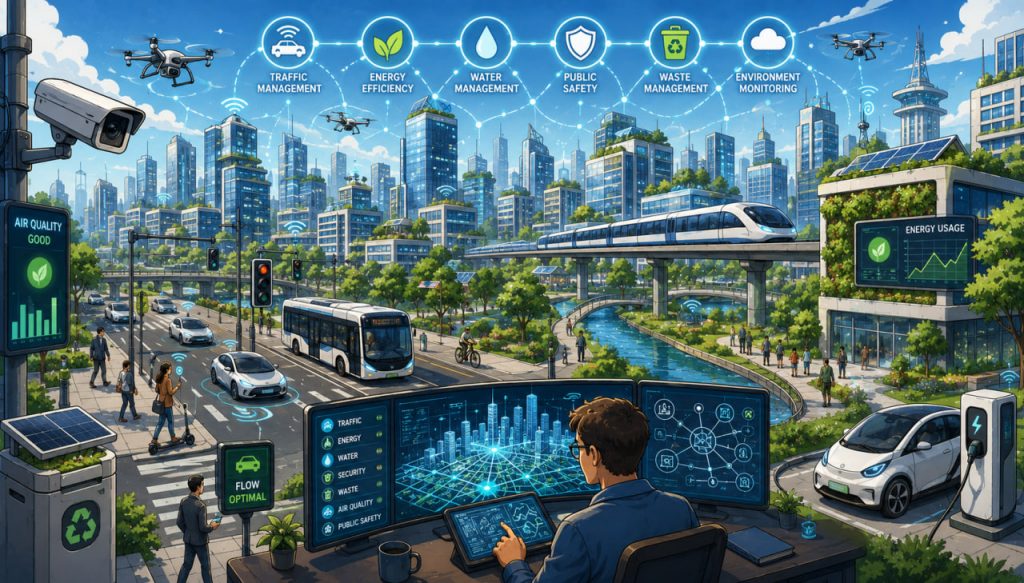
Cities are becoming increasingly intelligent. Traffic lights adjust automatically to congestion, public transport predicts passenger flows, surveillance systems analyze movement in real time, and buildings optimize energy consumption through artificial intelligence. This transformation is giving rise to the concept of the smart city — a city that operates almost like a giant interconnected computer.
Smart cities combine:
- Sensors
- Artificial intelligence
- Internet-connected infrastructure
- Big data analysis
- Automation systems
to improve urban life. Supporters believe smart cities may solve many problems of modern urbanization, including traffic congestion, pollution, energy waste, and inefficient public services. Critics warn about privacy risks, surveillance, and growing dependence on technology.
As urban populations continue growing worldwide, smart cities may become one of the defining technological trends of the 21st century.
What Is a Smart City?
A smart city uses digital technology and data systems to manage urban infrastructure more efficiently.
This includes:
- Transportation
- Electricity
- Water supply
- Waste management
- Security systems
- Public services
The goal is to make cities:
- Safer
- More efficient
- More sustainable
- More comfortable for residents
Unlike traditional infrastructure, smart systems continuously collect and analyze information in real time.
How Cities Become “Smart”
Smart cities rely heavily on interconnected devices often called the Internet of Things (IoT).
These include:
- Traffic sensors
- Smart cameras
- Connected streetlights
- Environmental monitors
- Intelligent parking systems
Data from these devices is processed by centralized computer systems or AI algorithms.
The city effectively behaves like a digital nervous system constantly monitoring itself.
Smart Traffic and Transportation
Traffic management is one of the most important smart city applications.
Modern smart transportation systems can:
- Analyze congestion in real time
- Adjust traffic lights automatically
- Optimize bus and train schedules
- Predict traffic patterns
This helps reduce:
- Traffic jams
- Fuel consumption
- Air pollution
Some cities are also testing:
- Autonomous buses
- AI-controlled intersections
- Smart parking guidance systems
Urban planner Carlo Ratti explained:
“Cities are becoming responsive systems rather than static infrastructure.”
This reflects the shift toward adaptive urban environments.
Energy Efficiency and Smart Buildings
Smart cities often focus strongly on energy optimization.
Smart buildings may automatically control:
- Lighting
- Heating
- Air conditioning
- Electricity usage
This can significantly reduce energy waste.
Some modern cities use intelligent electrical grids capable of:
- Balancing energy demand
- Integrating renewable energy
- Detecting outages rapidly
As climate concerns increase, energy-efficient urban systems become increasingly important.
Environmental Monitoring
Sensors throughout smart cities can monitor:
- Air quality
- Noise pollution
- Water quality
- Weather conditions
Real-time environmental data allows authorities to respond more quickly to problems.
For example:
- Pollution spikes can trigger traffic restrictions
- Flood sensors may provide early warnings
- Smart irrigation systems can reduce water waste
Technology helps cities react dynamically rather than relying only on fixed schedules.
Smart Security and Surveillance
Many smart cities use advanced surveillance technologies.
These may include:
- AI-powered cameras
- Facial recognition systems
- Automated emergency response systems
Supporters argue these systems improve:
- Crime prevention
- Public safety
- Emergency response times
However, critics warn about:
- Privacy loss
- Mass surveillance
- Data misuse
- Government overreach
This remains one of the biggest ethical debates surrounding smart cities.
Artificial Intelligence in Urban Management
AI increasingly plays a central role in urban operations.
Artificial intelligence can help:
- Predict infrastructure failures
- Optimize energy consumption
- Analyze traffic behavior
- Manage public transportation
Future cities may rely on AI systems making millions of real-time decisions continuously.
This creates enormous efficiency potential but also raises concerns about technological dependence.
The Role of Big Data
Smart cities generate massive amounts of data daily.
This data includes:
- Transportation patterns
- Energy usage
- Population movement
- Consumer behavior
Big data analysis helps city planners:
- Improve infrastructure
- Predict urban growth
- Allocate resources more effectively
In many ways, information itself becomes the “fuel” powering smart urban systems.
Challenges and Risks of Smart Cities
Despite their advantages, smart cities face major challenges.
Potential risks include:
- Cybersecurity threats
- System failures
- High infrastructure costs
- Technological inequality
- Privacy concerns
A hacked smart infrastructure system could potentially disrupt:
- Transportation
- Water systems
- Electrical grids
This makes cybersecurity critically important for future urban development.
Smart Cities and Sustainability
One major goal of smart cities is environmental sustainability.
Smart systems may help reduce:
- Energy waste
- Traffic emissions
- Water overuse
- Resource inefficiency
Some experts believe intelligent urban planning will become essential as climate change and population growth intensify.
Sustainable cities may increasingly depend on digital optimization technologies.
Examples of Smart City Development
Several cities worldwide are heavily investing in smart infrastructure.
Examples include:
- Singapore
- Seoul
- Dubai
- Tokyo
- Barcelona
These cities experiment with:
- AI traffic systems
- Smart public transport
- Connected infrastructure
- Digital government services
Many governments view smart cities as strategic investments for the future economy.
The Future of Urban Life
Future smart cities may include:
- Autonomous public transportation
- AI-managed utilities
- Fully connected infrastructure
- Digital citizen services
- Robot-assisted maintenance systems
Cities may increasingly behave like complex operating systems coordinating millions of moving parts in real time.
The challenge will be balancing technological efficiency with human freedom, privacy, and social equality.
Interesting Facts
- Smart traffic systems can reduce congestion significantly in some cities.
- Modern smart buildings automatically optimize energy consumption.
- Some cities use sensors to monitor air quality block by block.
- Smart infrastructure generates enormous amounts of urban data daily.
- Cybersecurity has become a major priority for future smart cities.
Glossary
- Smart City — A city using digital technologies and data systems to improve urban management.
- Internet of Things (IoT) — A network of connected devices exchanging information through the internet.
- Big Data — Extremely large data sets analyzed for patterns and insights.
- Artificial Intelligence (AI) — Computer systems capable of performing tasks requiring human-like intelligence.
- Infrastructure — The fundamental systems and structures supporting a city or society.