Rising electricity prices, climate concerns, and rapid technological progress are encouraging more homeowners to explore renewable energy solutions. What once seemed expensive and experimental is now increasingly accessible. Modern households can already generate, store, and manage their own electricity using solar panels, batteries, smart systems, and other renewable technologies.
For many people, renewable energy is no longer only about environmental responsibility — it is also about:
- Energy independence
- Long-term savings
- Protection against outages
- Greater control over household energy usage
Although full energy independence remains challenging in some regions, modern renewable systems can already significantly reduce dependence on traditional power grids.
Why Home Renewable Energy Is Growing Rapidly
Several major trends are driving renewable energy adoption.
These include:
- Falling solar panel costs
- Improved battery technology
- Government incentives
- Rising fossil fuel prices
- Increased climate awareness
In many countries, residential renewable systems became far more affordable than they were just a decade ago.
At the same time, modern smart home technologies make energy management easier than ever.
Step 1: Analyze Your Home’s Energy Consumption
Before installing renewable systems, experts recommend understanding current energy usage.
Homeowners should evaluate:
- Monthly electricity consumption
- Peak usage times
- Major energy-consuming devices
- Seasonal changes in demand
This helps determine:
- System size
- Battery requirements
- Expected savings
Energy consultant Saul Griffith explained:
“The cheapest energy is the energy you never have to use.”
Improving efficiency first often reduces renewable system costs dramatically.
Step 2: Improve Energy Efficiency First
Reducing energy waste is often the smartest starting point.
Simple improvements may include:
- LED lighting
- Better insulation
- Energy-efficient appliances
- Smart thermostats
- Improved windows and doors
Efficient homes require smaller renewable systems, reducing installation expenses significantly.
Many experts recommend:
- Reduce energy waste first
- Install renewable generation second
This approach maximizes cost-effectiveness.
Step 3: Solar Panels — The Most Popular Option
Solar energy remains the most common residential renewable technology.
Modern photovoltaic panels convert sunlight into electricity.
Advantages include:
- Mature technology
- Long lifespan
- Falling prices
- Low maintenance
Solar systems work especially well in regions with:
- Strong sunlight
- Large roof areas
- Favorable regulations
Even cloudy regions may still benefit because modern panels function under indirect sunlight as well.
How Solar Systems Work
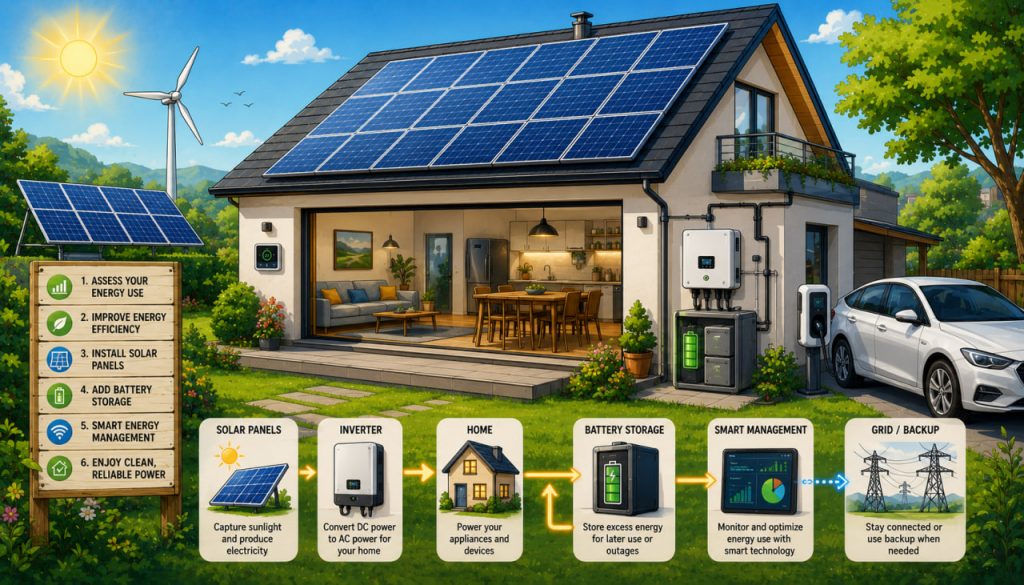
A basic home solar system usually includes:
- Solar panels
- Inverters
- Mounting systems
- Electrical controls
Panels generate direct current (DC) electricity.
The inverter converts it into alternating current (AC) used by household appliances.
Excess energy may:
- Charge home batteries
- Be sold back to the grid
- Power other devices directly
Step 4: Home Battery Storage
Batteries dramatically increase renewable energy independence.
Without batteries:
- Solar panels generate electricity mainly during daylight
With batteries:
- Energy can be stored for nighttime use or emergencies
Modern lithium-ion batteries may provide:
- Backup power
- Reduced grid dependence
- Better energy optimization
Battery prices remain significant, but costs continue decreasing rapidly.
Step 5: Smart Energy Management Systems
Modern smart home systems help optimize renewable energy usage automatically.
AI-driven software may:
- Monitor energy production
- Shift appliance usage
- Reduce electricity costs
- Optimize battery charging
For example:
- Washing machines may run automatically during peak solar production
- Batteries may charge when electricity is cheapest
This increases overall efficiency.
Step 6: Heat Pumps and Efficient Heating
Heating often consumes enormous amounts of household energy.
Modern heat pumps are becoming increasingly popular because they provide:
- Efficient heating
- Cooling capability
- Lower energy usage
When powered by renewable electricity, heat pumps significantly reduce fossil fuel dependence.
Some systems are several times more efficient than traditional electric heating.
Step 7: Backup Systems and Hybrid Solutions
Complete off-grid independence remains difficult for many households.
Therefore, many homeowners use hybrid systems combining:
- Solar panels
- Batteries
- Grid connection
- Backup generators
This provides flexibility and reliability.
During outages, batteries may continue powering essential systems.
Can Wind Turbines Work for Homes?
Small residential wind turbines are possible but less common than solar systems.
Wind systems work best in:
- Rural areas
- Open landscapes
- Regions with strong consistent winds
Urban and suburban environments often limit wind efficiency due to turbulence and space constraints.
For most homeowners, solar remains more practical.
Costs and Financial Considerations
Renewable energy systems require upfront investment.
Costs depend on:
- System size
- Battery capacity
- Local labor
- Roof structure
- Government incentives
However, long-term benefits may include:
- Lower utility bills
- Energy resilience
- Increased property value
Payback periods vary significantly between countries and electricity prices.
Common Mistakes Homeowners Make
Experts warn against several common problems:
- Oversized systems
- Ignoring energy efficiency
- Poor installation quality
- Unrealistic expectations
- Cheap low-quality equipment
Professional assessment and proper planning remain very important.
Environmental Benefits
Renewable systems may reduce:
- Carbon emissions
- Fossil fuel dependence
- Air pollution
They also decentralize energy production, making power systems potentially more resilient.
Millions of small renewable systems may collectively transform national energy infrastructure.
The Future of Home Energy
Future homes may increasingly include:
- Solar roofs
- Intelligent batteries
- AI energy management
- Electric vehicle integration
- Smart appliances
Homes may eventually function as small interconnected energy hubs rather than passive electricity consumers.
Why Renewable Energy Matters
Renewable energy is no longer only a futuristic idea.
Modern technology already allows many households to:
- Produce electricity
- Store energy
- Reduce utility costs
- Increase resilience
As technology improves further, home renewable energy systems may become standard infrastructure for future homes worldwide.
Interesting Facts
- Solar panel prices have fallen dramatically over the last two decades.
- Some smart homes can automatically optimize electricity usage using AI.
- Modern home batteries often use technology similar to electric vehicles.
- Heat pumps may provide highly efficient heating and cooling simultaneously.
- Some homeowners already operate partially off-grid using hybrid systems.
Glossary
- Renewable Energy — Energy generated from naturally replenishing sources such as sunlight or wind.
- Photovoltaic Panel — A solar panel that converts sunlight into electricity.
- Inverter — A device converting DC electricity into AC electricity for home use.
- Heat Pump — An energy-efficient system used for heating and cooling.
- Off-Grid — Operating independently from centralized electrical infrastructure.