For billions of people around the world, reliable electricity is still not guaranteed. In many rural regions of Africa, Asia, and parts of Latin America, families continue living without stable access to power grids. For decades, millions of households relied on kerosene lamps for lighting after sunset. These lamps provided basic illumination, but they also created serious health, financial, and environmental problems.
Today, small-scale renewable energy technologies — especially solar-powered lamps — are transforming life in many developing regions. What may seem like a simple device in wealthy countries can become a revolutionary tool in areas with limited infrastructure.
Micro renewable energy systems are increasingly viewed as one of the most practical and affordable solutions for improving living conditions, education, health, and economic opportunities in underserved communities.
The Global Electricity Problem
Despite modern technological progress, energy inequality remains enormous.
According to international energy organizations, hundreds of millions of people still lack reliable electricity access.
This affects:
- Education
- Healthcare
- Economic development
- Communication
- Safety
In many remote villages, building traditional power infrastructure is extremely expensive due to:
- Geographic isolation
- Difficult terrain
- Limited investment resources
As a result, decentralized renewable technologies are becoming increasingly important.
Why Kerosene Became Common
Before affordable solar technology, kerosene lamps were often the simplest available lighting solution.
Kerosene lamps are relatively:
- Portable
- Cheap initially
- Easy to use
However, they create multiple problems.
Burning kerosene produces:
- Indoor air pollution
- Toxic smoke
- Fire risks
- Carbon emissions
Children studying under kerosene lamps often inhale harmful particles for hours every evening.
Health researchers compare some indoor kerosene pollution levels to cigarette smoke exposure.
The Rise of Solar Lamps
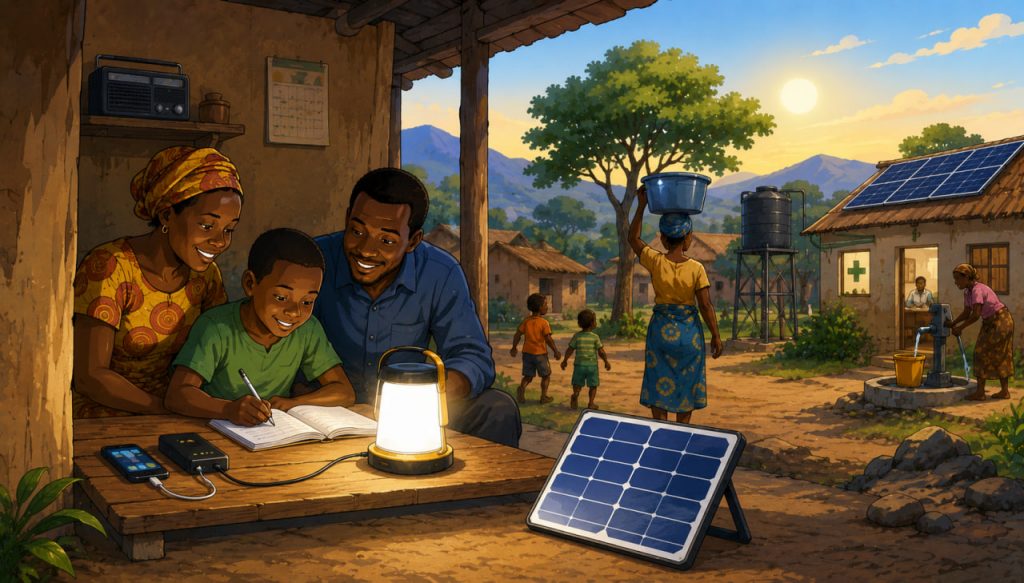
Solar lamps combine:
- Small photovoltaic panels
- Rechargeable batteries
- LED lighting
During the day:
- Solar panels charge the battery using sunlight
At night:
- Stored energy powers the lamp
This simple technology eliminates the need for fuel purchases and indoor combustion.
Modern LED lamps are also far more energy-efficient than traditional lighting systems.
Why Solar Lamps Matter So Much
In developed countries, lighting is often taken for granted.
In energy-poor regions, reliable light can dramatically affect daily life.
Solar lamps may improve:
- Evening education
- Safety at night
- Household productivity
- Access to communication devices
Development economist Muhammad Yunus emphasized:
“Energy access is deeply connected to human opportunity.”
Even small amounts of electricity can significantly influence quality of life.
Education and Children’s Learning
One of the biggest impacts involves education.
Without lighting, children may struggle to:
- Read
- Complete homework
- Study after sunset
Kerosene lamps often provide weak, unstable light.
Solar lamps offer:
- Brighter illumination
- Longer usage time
- Safer indoor conditions
Researchers found that improved evening lighting may positively affect educational opportunities in rural communities.
Health Benefits
Kerosene combustion releases pollutants harmful to human health.
Long-term exposure may contribute to:
- Respiratory problems
- Eye irritation
- Lung disease
Solar lighting eliminates indoor smoke entirely.
This is especially important for:
- Children
- Elderly individuals
- Families living in poorly ventilated homes
Cleaner indoor air may significantly improve long-term health outcomes.
Economic Advantages
Although solar lamps require initial investment, they often reduce long-term costs.
Families no longer need continuous kerosene purchases.
This may free household income for:
- Food
- Education
- Healthcare
- Small business activity
Some solar systems also allow:
- Phone charging
- Radio operation
- Small electronics usage
This increases connectivity and economic opportunity.
Women and Energy Access
Energy poverty disproportionately affects women in many regions.
Women often spend more time:
- Cooking indoors
- Managing households
- Caring for children
Cleaner lighting and electricity access may:
- Reduce health risks
- Improve safety
- Extend productive hours
Some development programs specifically target women entrepreneurs using solar technologies.
Microgrids and Small Renewable Systems
Beyond individual lamps, some communities now use:
- Solar home systems
- Village microgrids
- Community battery storage
These systems may power:
- Schools
- Clinics
- Water pumps
- Refrigeration systems
Decentralized renewable energy allows regions to bypass expensive centralized infrastructure.
Challenges Still Exist
Despite progress, several barriers remain.
Challenges include:
- Upfront equipment costs
- Battery replacement
- Maintenance access
- Limited technical support
Low-quality products may also fail quickly, damaging trust in renewable technologies.
Reliable distribution and education remain essential.
The Role of Mobile Technology
Interestingly, mobile phones accelerated renewable energy adoption in many developing countries.
Solar systems increasingly support:
- Phone charging
- Mobile banking
- Internet access
Digital payment systems now allow some households to purchase solar systems gradually through small daily payments.
This model expanded access significantly.
Environmental Impact
Replacing kerosene with solar lighting reduces:
- Carbon emissions
- Air pollution
- Fossil fuel dependence
Millions of small household changes may collectively create substantial environmental benefits.
Renewable energy adoption in developing regions therefore supports both:
- Human development
- Climate goals
The Future of Micro Renewable Energy
Future innovations may involve:
- More efficient solar panels
- Longer-lasting batteries
- AI-powered energy systems
- Portable modular microgrids
Costs continue decreasing while technology improves.
Many experts believe decentralized renewable systems may electrify rural regions faster than traditional infrastructure expansion.
Why This Transformation Matters
Access to electricity changes nearly every aspect of modern life.
Something as simple as a solar lamp can influence:
- Education
- Health
- Economic growth
- Personal safety
- Communication
Micro renewable energy technologies demonstrate how small-scale innovation may create enormous human impact.
Interesting Facts
- Solar lamps often use highly efficient LED technology.
- Some families save significant money after switching from kerosene.
- Mobile banking helped expand solar adoption in rural regions.
- Indoor kerosene smoke may contribute to respiratory illness.
- Small solar systems can also charge phones and radios.
Glossary
- Photovoltaic Panel — A solar panel converting sunlight into electricity.
- Microgrid — A small local electrical network operating independently or alongside larger grids.
- LED — A highly energy-efficient type of lighting technology.
- Kerosene — A liquid fossil fuel commonly used in lamps and heaters.
- Renewable Energy — Energy generated from naturally replenishing sources such as sunlight or wind.