Leaves are among the most recognizable and essential structures in the natural world. Every spring, billions of trees around the planet begin producing new leaves, transforming forests, parks, and landscapes into vibrant green ecosystems. Although leaves may seem simple, they are actually highly sophisticated biological systems responsible for some of the most important processes sustaining life on Earth.
Leaves allow trees to:
- Capture sunlight
- Produce energy
- Exchange gases
- Regulate water balance
- Support entire ecosystems
Without leaves, forests could not survive, oxygen production would collapse, and Earth’s climate would function very differently.
Modern botany reveals that leaf formation is an extraordinarily complex process controlled by genetics, hormones, environmental signals, and evolutionary adaptation.
What Is a Leaf?
A leaf is a specialized plant organ primarily designed for photosynthesis.
Most leaves contain:
- Flat surfaces for light absorption
- Veins transporting water and nutrients
- Tiny pores for gas exchange
- Specialized cells containing chlorophyll
Leaves are connected to branches through structures called petioles or stems.
Their shape and structure vary enormously depending on climate, species, and evolutionary adaptation.
How Leaves Begin Forming
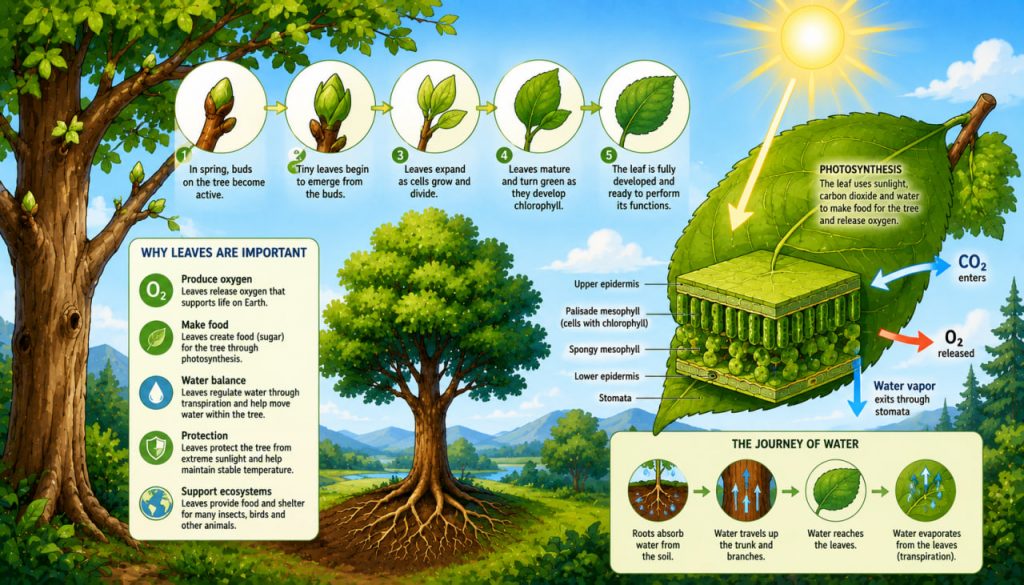
Leaves start developing from tiny structures called buds.
During favorable conditions — usually spring in temperate climates — tree buds become active.
Inside buds are:
- Undeveloped leaf tissues
- Protective outer scales
- Growth cells
Plant hormones trigger cell division and expansion.
As temperatures rise and daylight increases, buds gradually open and young leaves emerge.
This process is carefully regulated by both genetics and environmental conditions.
The Role of Plant Hormones
Plant growth depends heavily on chemical messengers called hormones.
Several hormones influence leaf formation, including:
- Auxins
- Cytokinins
- Gibberellins
These substances regulate:
- Cell growth
- Leaf shape
- Timing of development
- Branch coordination
Botanist Wilhelm Hofmeister, one of the pioneers of plant developmental science, helped establish the understanding that plant structures develop through highly organized cellular patterns rather than random growth.
Modern plant biology continues expanding this knowledge.
Why Leaves Are Usually Green
Leaves appear green because they contain chlorophyll, a pigment essential for photosynthesis.
Chlorophyll absorbs mainly:
- Blue light
- Red light
while reflecting green wavelengths.
This reflected green light is what human eyes perceive.
Chlorophyll plays a central role in converting solar energy into chemical energy.
Photosynthesis: The Core Function of Leaves
The most important leaf function is photosynthesis.
During photosynthesis, leaves use:
- Sunlight
- Carbon dioxide
- Water
to produce:
- Glucose (plant energy)
- Oxygen
This process supports nearly all complex life on Earth.
Without photosynthesis:
- Food chains would collapse
- Atmospheric oxygen would decline
- Ecosystems could not function
How Leaves Breathe
Leaves contain tiny pores called stomata.
Stomata allow leaves to exchange gases with the atmosphere.
Through these pores:
- Carbon dioxide enters
- Oxygen exits
- Water vapor escapes
This process is called transpiration.
Transpiration also helps move water upward through the tree from roots to leaves.
Why Leaf Shapes Differ
Different environments produce different leaf adaptations.
Examples include:
- Broad leaves in humid climates
- Needle-shaped leaves in cold regions
- Thick waxy leaves in dry environments
Leaf shape affects:
- Water retention
- Sunlight capture
- Wind resistance
- Temperature regulation
Evolution gradually optimized leaves for survival under specific environmental conditions.
Seasonal Leaf Changes
In many climates, trees lose leaves during autumn.
This occurs because:
- Daylight decreases
- Temperatures fall
- Photosynthesis becomes less efficient
Trees begin breaking down chlorophyll and recovering nutrients before leaves fall.
As chlorophyll disappears, other pigments become visible:
- Yellow carotenoids
- Red anthocyanins
This creates autumn colors.
Leaf shedding also helps trees conserve water during winter.
Leaves and Climate Regulation
Leaves play major roles in Earth’s climate system.
Forests influence:
- Carbon dioxide absorption
- Humidity
- Rainfall patterns
- Temperature regulation
Large forest ecosystems act as important carbon sinks helping moderate atmospheric CO₂ levels.
Deforestation therefore affects global climate stability.
Leaves and Oxygen Production
Much of Earth’s oxygen ultimately originates from photosynthetic organisms.
Trees and plants continuously contribute oxygen to the atmosphere through leaf activity.
However, oceans also play major roles because microscopic marine algae perform enormous amounts of global photosynthesis.
Still, forests remain critically important for atmospheric balance and biodiversity.
How Leaves Defend Themselves
Leaves are vulnerable to:
- Insects
- Disease
- Fungi
- Herbivores
Plants evolved various defenses such as:
- Toxic chemicals
- Tough surfaces
- Waxy coatings
- Defensive compounds
Some plants even release airborne chemical signals warning nearby plants about danger.
This demonstrates how biologically sophisticated leaves truly are.
Why Leaves Matter to Humans
Human civilization depends heavily on leaves.
Leaves support:
- Oxygen production
- Agriculture
- Climate stability
- Medicine
- Food systems
Many medicines originate from compounds produced in plant leaves.
Forests also help regulate water cycles and environmental balance essential for human survival.
Interesting Facts
- A single mature tree may contain thousands of leaves.
- Leaves use sunlight to create chemical energy through photosynthesis.
- Tiny stomata allow leaves to “breathe.”
- Autumn colors appear when chlorophyll breaks down.
- Some leaves evolved natural chemical defenses against insects.
Glossary
- Photosynthesis — The process plants use to convert sunlight into chemical energy.
- Chlorophyll — The green pigment responsible for capturing sunlight in plants.
- Stomata — Tiny pores on leaves used for gas exchange.
- Transpiration — The release of water vapor from plant leaves.
- Bud — A protective structure containing undeveloped plant tissues.