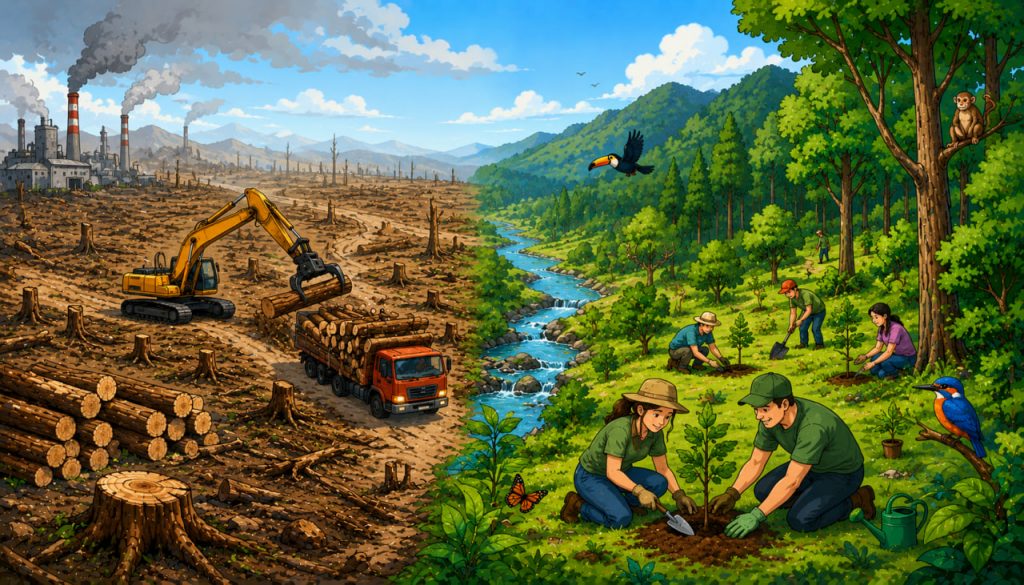
Forests are among the most important ecosystems on Earth. They regulate climate, store carbon, protect biodiversity, stabilize soils, influence rainfall, and support millions of species — including humans. Yet during the last century, humanity has destroyed enormous areas of forests at an unprecedented speed.
Industrial expansion, agriculture, urbanization, mining, and infrastructure development transformed global landscapes dramatically. Some regions lost vast portions of their original forests, while others now face critical ecological pressure.
Today, deforestation is no longer viewed only as a local environmental issue. Scientists increasingly consider it one of the major global challenges connected to:
- Climate change
- Biodiversity loss
- Water cycle disruption
- Soil degradation
- Extreme weather instability
The future of forests may significantly shape the future of civilization itself.
What Is Deforestation?
Deforestation refers to the large-scale removal of forests and trees, usually for human land use.
Forests are commonly cleared for:
- Agriculture
- Cattle farming
- Logging
- Mining
- Urban development
- Roads and infrastructure
Sometimes forests are partially degraded rather than completely removed, which can still damage ecosystems severely.
Modern satellite monitoring now allows scientists to track forest loss globally in near real time.
How Much Forest Has Humanity Lost?
Over the past 100 years, humanity dramatically altered Earth’s forests.
Many regions lost huge portions of native forest cover due to industrial growth and population expansion.
Major affected regions include:
- The Amazon rainforest
- Southeast Asia
- Central Africa
- Parts of North America and Europe historically
Although some countries increased reforestation efforts, old-growth forests remain especially difficult to replace because they require centuries to fully develop.
Ancient ecosystems cannot simply be recreated quickly.
Why Forests Are So Important
Forests perform essential planetary functions.
They help:
- Absorb carbon dioxide
- Produce oxygen
- Regulate rainfall
- Stabilize temperatures
- Prevent soil erosion
- Protect biodiversity
Ecologist E.O. Wilson warned:
“Destroying rainforests for economic gain is like burning a Renaissance painting to cook a meal.”
This reflects how irreplaceable many forest ecosystems truly are.
The Amazon Rainforest Crisis
The Amazon became one of the most symbolic examples of modern deforestation.
Large areas have been cleared mainly for:
- Cattle ranching
- Soy farming
- Logging
- Infrastructure projects
Scientists worry that excessive forest loss could eventually push parts of the Amazon toward ecological collapse.
Rainforests generate much of their own rainfall through evaporation and moisture cycling.
If deforestation becomes too extensive, regional climate systems may destabilize.
Deforestation and Climate Change
Forests act as enormous carbon storage systems.
Trees absorb atmospheric carbon dioxide through photosynthesis.
When forests are destroyed:
- Stored carbon is released
- Carbon absorption capacity decreases
- Greenhouse gas levels rise
This contributes to global warming.
Scientists now consider forest protection one of the most important climate mitigation strategies.
Biodiversity Loss
Forests contain extraordinary biological diversity.
Rainforests especially support:
- Mammals
- Birds
- Insects
- Amphibians
- Plants
- Microorganisms
Many species remain undiscovered by science.
When forests disappear:
- Habitats fragment
- Species populations collapse
- Extinction risk increases
Some scientists believe Earth may currently be experiencing a major biodiversity crisis partly driven by habitat destruction.
Soil and Water Problems
Deforestation strongly affects soil stability.
Tree roots normally help:
- Hold soil together
- Prevent erosion
- Retain moisture
Without forests:
- Flooding may increase
- Landslides become more likely
- Soil fertility declines
Forests also regulate water cycles by influencing:
- Rainfall patterns
- Groundwater recharge
- River systems
Deforestation may therefore affect agriculture and drinking water availability.
Indigenous Communities and Forests
Millions of indigenous people depend directly on forests for:
- Food
- Shelter
- Culture
- Spiritual traditions
- Medicine
Forest destruction often threatens traditional ways of life.
Research increasingly shows that indigenous-managed lands frequently preserve biodiversity more effectively than many industrial systems.
Protecting forests therefore also involves protecting cultural knowledge and human rights.
Reforestation and Restoration Efforts
Not all trends are negative.
Many countries and organizations now invest heavily in:
- Reforestation
- Afforestation
- Sustainable forestry
- Conservation projects
Satellite technology, drones, and AI increasingly assist forest monitoring and restoration.
However, experts warn that planting new trees does not immediately replace ancient ecosystems.
Young plantations are biologically different from mature natural forests.
The Role of Technology
Modern technology plays an important role in both destruction and protection.
Today scientists use:
- Satellite imaging
- AI analysis
- Environmental sensors
- Drones
to monitor illegal logging and forest health.
At the same time, industrial machinery accelerated forest clearing capabilities dramatically during the 20th century.
Technology itself is neutral — its impact depends on how humans use it.
What Could Happen in the Future?
The future depends heavily on political decisions, economic systems, and global cooperation.
Possible future scenarios include:
- Increased conservation efforts
- Expansion of sustainable agriculture
- Large-scale ecosystem restoration
- Improved climate policies
However, continued large-scale deforestation may contribute to:
- More extreme climate instability
- Ecosystem collapse
- Water shortages
- Agricultural disruption
Scientists increasingly emphasize that forest protection is not only an environmental issue, but also an economic and civilizational issue.
Why Forests Matter More Than Ever
Forests support planetary stability in ways humanity is only beginning to fully understand.
Modern civilization depends on stable ecosystems for:
- Agriculture
- Climate regulation
- Clean water
- Biodiversity
- Public health
The next century may determine whether humanity preserves enough natural systems to maintain long-term ecological balance.
Interesting Facts
- Tropical forests contain enormous biodiversity despite covering a relatively small portion of Earth’s surface.
- Trees store carbon absorbed from the atmosphere.
- Forests strongly influence rainfall and regional climate patterns.
- Some ancient forests are thousands of years old.
- Satellite systems now monitor global forest loss continuously.
Glossary
- Deforestation — Large-scale removal of forests for human activities.
- Biodiversity — The variety of living organisms within ecosystems.
- Reforestation — Replanting trees in previously forested areas.
- Carbon Sink — A system that absorbs more carbon dioxide than it releases.
- Ecosystem — A network of living organisms interacting with their environment.