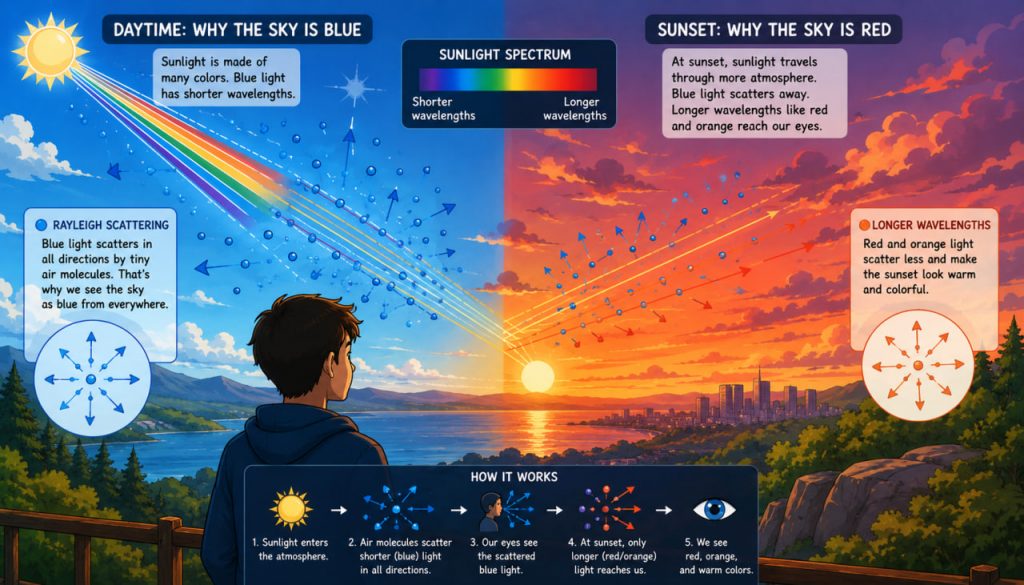
The colors of the sky are among the most beautiful and recognizable natural phenomena on Earth. During the day, the sky appears bright blue, while sunsets and sunrises often glow with:
- Red
- Orange
- Pink
- Purple
For thousands of years, humans admired these colors without fully understanding their origin. Today, physics explains that the sky’s changing colors are connected to:
- Light
- Atmosphere
- Wave behavior
- Scattering processes
The colors we see are not actually “painted” into the sky. Instead, they result from the interaction between sunlight and tiny particles in Earth’s atmosphere.
Understanding why the sky changes color reveals fascinating principles involving:
- Electromagnetic waves
- Human vision
- Atmospheric physics
- Solar radiation
This phenomenon demonstrates how physics shapes everyday experiences in ways most people rarely notice.
What Is Sunlight?
Sunlight may appear white to human eyes, but it actually contains many colors combined together.
Visible light includes:
- Red
- Orange
- Yellow
- Green
- Blue
- Violet
Each color corresponds to a different:
- Wavelength
Shorter wavelengths appear toward the blue-violet part of the spectrum, while longer wavelengths appear red.
The atmosphere affects these wavelengths differently.
Earth’s Atmosphere and Light Interaction
Earth’s atmosphere contains:
- Nitrogen molecules
- Oxygen molecules
- Water vapor
- Dust particles
- Aerosols
When sunlight enters the atmosphere, light waves collide with these tiny particles.
This process is called:
- Scattering
Scattering changes the direction of light and determines which colors become most visible to human observers.
Why the Sky Appears Blue
The main reason the sky looks blue involves:
- Rayleigh scattering
This physical effect causes shorter wavelengths of light to scatter much more strongly than longer wavelengths.
Blue and violet light scatter widely across the atmosphere.
As a result:
- Blue light reaches human eyes from many directions across the sky
Physicist Lord Rayleigh mathematically described this scattering process in the 19th century.
Although violet light scatters even more strongly than blue, human eyes are:
- More sensitive to blue light
- Less sensitive to violet
Additionally, some violet light becomes absorbed in the upper atmosphere.
Together, these effects make the sky appear predominantly blue.
Why Sunsets Become Red and Orange
Sunsets occur when the Sun moves closer to the horizon.
At this angle, sunlight must travel through:
- Much more atmosphere
The longer atmospheric path causes most shorter wavelengths:
- Blue
- Violet
to scatter away before reaching observers directly.
Longer wavelengths such as:
- Red
- Orange
survive the journey more effectively.
As a result, sunsets often glow with warm colors.
Atmospheric scientist Richard Feynman once explained:
“The sky is blue because molecules scatter blue light more strongly.”
This simple principle helps explain one of nature’s most famous visual effects.
Dust, Pollution, and Sunset Colors
Atmospheric conditions strongly influence sunset appearance.
Dust, smoke, pollution, and volcanic particles may intensify:
- Red
- Orange
- Purple
colors during sunsets.
Tiny particles scatter light differently depending on:
- Size
- Composition
- Concentration
This is why sunsets may look dramatically different from one day to another.
Large volcanic eruptions sometimes create exceptionally vivid sunsets worldwide.
Why Clouds Change Color
Clouds themselves do not produce light.
Instead, clouds:
- Reflect
- Scatter
- Absorb
sunlight.
During daytime, thick clouds usually appear:
- White
- Gray
At sunset, clouds may reflect remaining red and orange wavelengths, creating dramatic colorful skies.
Cloud shape, thickness, and altitude all affect appearance.
Why Space Looks Black
Interestingly, space itself does not appear blue.
Without an atmosphere, there is very little scattering.
Astronauts observing Earth from space see:
- A black sky
- Bright sunlight
- A thin blue atmospheric layer around Earth
This demonstrates that Earth’s atmosphere creates the blue sky effect rather than sunlight itself.
Human Vision and Color Perception
Color perception also depends on human biology.
The human eye contains specialized cells called:
- Cones
These cells detect different wavelengths of visible light.
The brain then interprets these signals as:
- Colors
- Brightness
- Visual patterns
Without human visual systems, “color” itself would not exist in the same subjective way.
Physics and biology therefore work together to create visual experiences.
Atmospheric Physics and Climate
Sky color also helps scientists study atmospheric conditions.
Researchers analyze light scattering to examine:
- Air pollution
- Aerosol concentration
- Climate conditions
- Volcanic effects
Satellites and atmospheric instruments use light analysis extensively in environmental science.
Understanding atmospheric optics became important not only for physics, but also for climate research.
Why the Moon Sometimes Looks Red
The same scattering principles also explain:
- Red moons
- Orange moons
during certain conditions.
When the Moon appears near the horizon, moonlight passes through more atmosphere.
Shorter wavelengths scatter away, leaving warmer colors visible.
Lunar eclipses may also produce reddish tones because Earth’s atmosphere bends and filters sunlight toward the Moon.
Light Scattering Beyond Earth
Other planets may have different sky colors depending on atmospheric composition.
For example:
- Mars often has dusty reddish skies
- Titan has thick orange haze
Sky colors across the universe depend heavily on:
- Atmospheric particles
- Gas composition
- Sunlight interaction
Planetary atmospheres therefore create unique visual worlds.
Why This Physics Matters
The colors of the sky demonstrate how invisible physical laws shape everyday beauty.
A simple blue sky or glowing sunset represents:
- Wave physics
- Electromagnetic radiation
- Atmospheric chemistry
- Human perception
These familiar natural scenes connect astronomy, physics, biology, and environmental science in one of the most visually stunning examples of nature’s complexity.
The next time someone watches a sunset, they are actually witnessing a massive atmospheric optical experiment happening above Earth in real time.
Interesting Facts
- Sunlight contains all visible rainbow colors combined together.
- Blue light scatters more strongly than red light in Earth’s atmosphere.
- Space appears black because it lacks atmospheric scattering.
- Volcanic eruptions may intensify sunset colors worldwide.
- Different planets may have completely different sky colors.
Glossary
- Wavelength — The distance between repeating parts of a wave.
- Scattering — The redirection of light by particles or molecules.
- Atmosphere — The layer of gases surrounding a planet.
- Rayleigh Scattering — Scattering of light by particles much smaller than light wavelengths.
- Electromagnetic Radiation — Energy traveling as waves, including visible light.