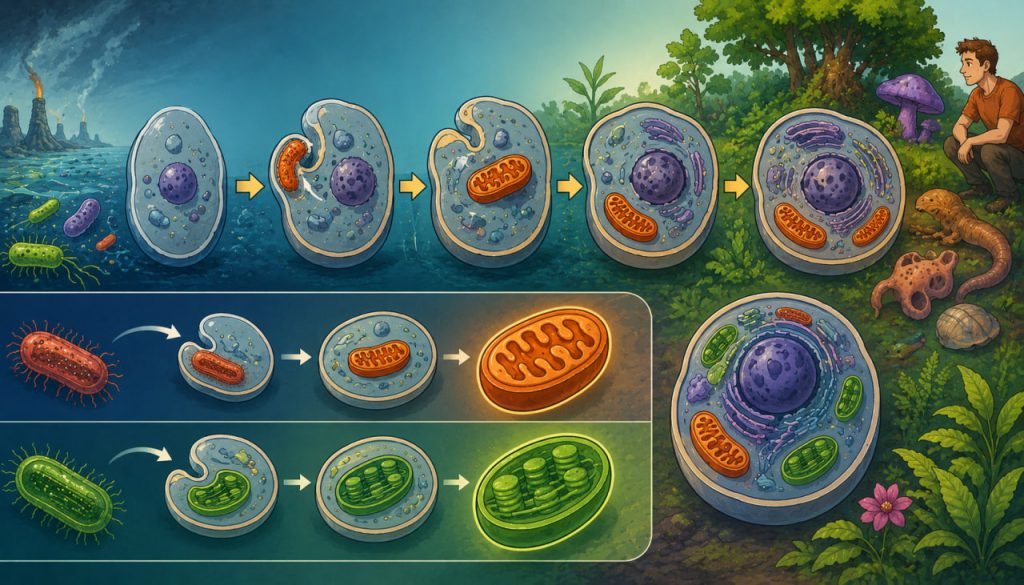
One of the most important events in the history of Earth happened billions of years ago when tiny primitive cells began cooperating instead of simply competing. According to modern biology, some cells actually absorbed other living cells — and instead of digesting them, they formed permanent partnerships.
This revolutionary process is called:
- Symbiogenesis
Symbiogenesis helped create:
- Complex cells
- Plants
- Animals
- Fungi
- Eventually humans
Without this ancient biological merger, complex multicellular life might never have evolved.
Today scientists believe that structures inside human cells, especially:
- Mitochondria
were once independent bacteria living freely billions of years ago.
This idea completely transformed biology because it showed evolution sometimes advances not only through:
- Competition
but also through: - Cooperation
- Integration
- Symbiosis
Understanding symbiogenesis reveals one of the most fascinating stories in evolutionary science and explains how life on Earth became dramatically more complex over time.
What Is Symbiogenesis?
Symbiogenesis is an evolutionary process where:
- Different organisms merge together into a new biological system.
The word comes from:
- Symbiosis
meaning organisms living together
and: - Genesis
meaning creation or origin
Instead of one organism simply consuming another for food, both organisms survive and eventually become:
- Interdependent
Over long evolutionary periods, they may function as:
- A single new organism
This concept became central to understanding the evolution of complex life.
The Early Earth and Primitive Life
Billions of years ago, Earth contained only:
- Simple microscopic organisms
These early cells were:
- Prokaryotes
meaning they lacked:
- Nuclei
- Complex internal structures
Primitive bacteria dominated Earth for enormous stretches of time before more advanced cells appeared.
At some point, evolution made a dramatic leap.
The Birth of Eukaryotic Cells
Modern complex organisms are built from:
- Eukaryotic cells
These cells contain:
- Nuclei
- Internal organelles
- Complex organization
Animals, plants, and fungi all depend on eukaryotic cells.
Scientists long wondered:
- How did these advanced cells evolve from simpler bacteria?
Symbiogenesis provided the answer.
The Mitochondria Revolution
One of the most important discoveries involved:
- Mitochondria
Mitochondria are structures inside cells responsible for:
- Energy production
They are often called:
- The powerhouses of the cell
According to symbiogenesis theory:
- Mitochondria were once free-living bacteria.
Ancient larger cells absorbed smaller bacteria capable of highly efficient energy production.
Instead of destroying them:
- The cells formed a partnership.
The bacteria received:
- Protection
- Nutrients
The host cell gained:
- Massive energy advantages
This relationship changed life forever.
Evidence Supporting Symbiogenesis
Scientists discovered strong evidence that mitochondria were once independent organisms.
Mitochondria possess:
- Their own DNA
- Bacterial-like ribosomes
- Double membranes
- Independent replication abilities
These features differ from most other cell structures.
Biologist Lynn Margulis became one of the strongest defenders of symbiogenesis theory.
She famously argued:
“Life did not take over the globe by combat, but by networking.”
Her work helped revolutionize evolutionary biology.
Chloroplasts and Ancient Cyanobacteria
Plants contain another important organelle:
- Chloroplasts
Chloroplasts perform:
- Photosynthesis
allowing plants to convert sunlight into energy.
Scientists believe chloroplasts also originated through symbiogenesis.
Ancient cells absorbed:
- Cyanobacteria
which already possessed photosynthetic abilities.
Instead of digestion:
- Permanent cooperation evolved.
This event eventually helped create:
- Plants
- Forests
- Oxygen-rich ecosystems
across Earth.
Why Symbiogenesis Was So Important
Before symbiogenesis:
- Life remained relatively simple.
The incorporation of mitochondria dramatically increased cellular energy production.
More available energy allowed evolution of:
- Larger genomes
- Complex structures
- Multicellular organisms
- Nervous systems
- Brains
Some scientists argue mitochondria provided the energetic foundation necessary for complex life itself.
Cooperation Versus Competition
Classical evolutionary thinking often emphasized:
- Competition
- Survival of the fittest
Symbiogenesis showed another powerful evolutionary force:
- Cooperation
Life sometimes advances through:
- Integration
- Mutual benefit
- Biological partnership
Modern ecosystems constantly demonstrate symbiosis involving:
- Plants and fungi
- Animals and bacteria
- Coral and algae
Life on Earth depends heavily on cooperation between organisms.
Humans as Ecosystems
Interestingly, humans themselves are deeply connected to symbiotic biology.
The human body contains enormous numbers of:
- Microorganisms
- Gut bacteria
- Microbiomes
These microorganisms help with:
- Digestion
- Immunity
- Metabolism
Humans are not biologically isolated organisms — they are complex ecosystems.
This idea strongly reflects the principles of symbiosis.
Why Mitochondria Still Resemble Bacteria
Even today mitochondria preserve ancient bacterial traits.
They:
- Reproduce independently
- Contain circular DNA
- Use bacterial-like machinery
Scientists believe their ancestors entered host cells roughly:
- 1.5 to 2 billion years ago
Over time:
- Host cells and bacteria became inseparable.
Modern humans literally carry descendants of ancient bacteria inside almost every cell.
The Endosymbiotic Theory
The scientific explanation for this process became known as:
- Endosymbiotic theory
“Endo” means:
- Inside
The theory describes organisms living:
- Inside other organisms
This theory is now widely accepted in modern biology.
Why Symbiogenesis Was Controversial
When Lynn Margulis promoted symbiogenesis strongly in the 1960s:
- Many scientists initially rejected the idea.
At the time, mainstream biology focused heavily on:
- Mutation
- Natural selection
- Competition
Eventually, genetic and molecular evidence strongly supported her theories.
Today symbiogenesis became one of biology’s most important concepts.
Symbiosis Across Nature
Symbiotic relationships exist everywhere in nature.
Examples include:
- Bees pollinating flowers
- Coral hosting algae
- Fungi helping plant roots
- Gut bacteria assisting animals
Life evolved not only through conflict, but also through:
- Cooperation networks
Symbiogenesis represents one of the most dramatic examples of this principle.
Evolution and Complexity
The rise of complex life required enormous biological innovation.
Symbiogenesis allowed primitive cells to combine specialized abilities into:
- More advanced integrated systems
This may have accelerated evolutionary complexity dramatically.
Without these ancient cellular mergers:
- Humans likely would not exist.
Why Symbiogenesis Matters
Symbiogenesis changed humanity’s understanding of evolution itself.
The theory revealed that:
- Cooperation can drive major evolutionary breakthroughs.
- Complex life emerged partly through biological partnerships.
- Ancient bacteria still live inside modern cells today.
Every breath humans take depends on mitochondria — descendants of ancient free-living microbes absorbed billions of years ago.
In a profound sense:
- Complex life is built from ancient alliances between microscopic organisms.
And the history of life on Earth may ultimately be a story not only of survival — but also of cooperation.
Interesting Facts
- Mitochondria possess their own DNA separate from human DNA.
- Chloroplasts likely evolved from ancient cyanobacteria.
- Humans contain trillions of symbiotic microorganisms.
- Symbiogenesis became widely accepted only in recent decades.
- Complex multicellular life may not exist without mitochondria.
Glossary
- Symbiogenesis — Evolution through permanent biological partnership between organisms.
- Mitochondria — Organelles responsible for cellular energy production.
- Eukaryotic Cell — Complex cell containing nuclei and organelles.
- Prokaryote — Simple cell lacking a nucleus.
- Endosymbiosis — One organism living inside another in a cooperative relationship.