Japan is one of the most technologically advanced countries in the world when it comes to disaster preparedness and emergency warning systems. Located in one of the planet’s most geologically active regions, Japan constantly faces threats such as:
- Earthquakes
- Tsunamis
- Typhoons
- Volcanic eruptions
- Landslides
- Floods
Because of these natural dangers, Japan developed some of the world’s most sophisticated early warning technologies designed to protect millions of people.
Japanese emergency systems combine:
- Artificial intelligence
- Seismic sensors
- Satellite communication
- Mobile networks
- Public broadcasting
- Automated infrastructure controls
The goal is simple but critically important:
- Warn people before disaster strikes whenever possible.
Although even a few seconds of warning may seem small, those seconds can save countless lives by allowing:
- Trains to stop
- Factories to shut down
- Elevators to open
- Citizens to seek shelter
Japan’s disaster warning systems became a global model for emergency preparedness in the modern technological era.
Why Japan Faces So Many Natural Disasters
Japan sits along the:
- Pacific Ring of Fire
This is one of Earth’s most active geological zones.
Several tectonic plates meet near Japan, creating intense seismic activity.
As a result, the country experiences:
- Frequent earthquakes
- Volcanic activity
- Tsunami risks
In addition, Japan’s climate exposes it to:
- Seasonal typhoons
- Heavy rainfall
- Coastal flooding
Living in such conditions forced Japanese society to prioritize disaster resilience for centuries.
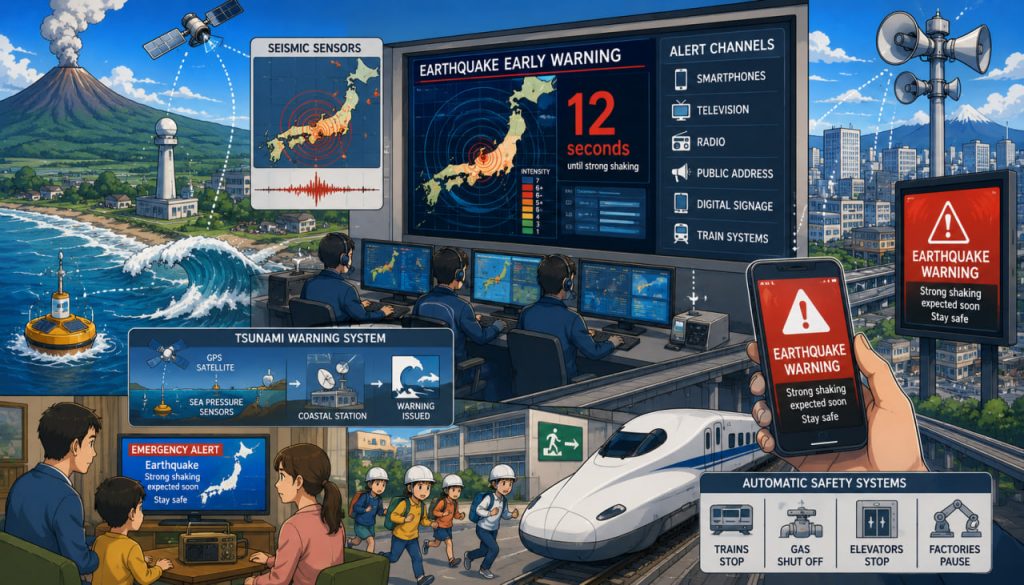
The Japanese Earthquake Early Warning System
One of Japan’s most famous technologies is its:
- Earthquake Early Warning (EEW) system
This system detects seismic waves immediately after an earthquake begins.
Earthquakes produce different wave types:
- Fast primary waves
- Slower destructive waves
The system analyzes the first waves and quickly estimates:
- Magnitude
- Epicenter
- Expected intensity
Warnings are then transmitted across the country within seconds.
This may provide:
- A few seconds
- Sometimes tens of seconds
before strong shaking arrives.
How the Warning Reaches People
Japan distributes emergency alerts through multiple channels simultaneously.
Warnings may appear on:
- Smartphones
- Television
- Radio
- Public loudspeakers
- Digital billboards
- Train systems
Many phones in Japan automatically emit loud emergency sounds during major warnings.
This system ensures rapid communication even during crowded urban conditions.
Automatic Safety Systems
Japan’s warning technologies are directly connected to critical infrastructure.
During major earthquakes:
- Bullet trains automatically brake
- Gas systems may shut down
- Industrial equipment stops
- Elevators pause at nearest floors
These automated responses reduce:
- Accidents
- Fires
- Secondary disasters
Automation became one of the most important aspects of modern disaster prevention.
Tsunami Warning Systems
Following powerful undersea earthquakes, tsunami detection becomes critically important.
Japan operates advanced ocean monitoring systems using:
- Seismic sensors
- Offshore pressure detectors
- Coastal monitoring stations
- Satellites
Warnings may be issued within minutes after large underwater earthquakes.
Coastal residents receive instructions regarding:
- Evacuation
- Safe zones
- Wave arrival timing
The devastating 2011 Tōhoku earthquake and tsunami demonstrated both the strengths and limitations of modern warning systems.
Disaster Education in Japanese Society
Technology alone is not enough.
Japan also invests heavily in:
- Public education
- Emergency drills
- Preparedness training
Children practice evacuation procedures regularly in schools.
Many workplaces and communities conduct:
- Earthquake simulations
- Tsunami drills
- Emergency exercises
Preparedness became deeply integrated into Japanese culture.
Disaster researcher Shoji Sawada explained:
“Preparedness is not only technology — it is social behavior.”
This philosophy strongly shapes Japan’s approach to disaster management.
Typhoon and Weather Monitoring
Japan also operates highly advanced meteorological systems.
The country closely monitors:
- Typhoons
- Rainfall
- Flood risk
- Landslides
Weather agencies use:
- Radar networks
- Satellites
- AI forecasting systems
Warnings help authorities prepare evacuations and emergency responses before severe weather arrives.
Climate change may increase the importance of these systems in the future.
Artificial Intelligence and Predictive Technology
Modern Japanese disaster management increasingly uses:
- Artificial intelligence
- Big data analysis
- Machine learning
AI systems help:
- Analyze seismic patterns
- Improve forecasting
- Optimize evacuation planning
- Manage emergency logistics
Future warning systems may become even faster and more accurate through AI integration.
Challenges and Limitations
Despite advanced technology, no warning system is perfect.
Challenges include:
- False alarms
- Infrastructure damage
- Extremely fast disasters
- Public panic
- Communication failures
Some earthquakes occur so close to cities that warning times become extremely short.
Disaster prevention therefore combines:
- Technology
- Engineering
- Public preparedness
- Emergency planning
rather than relying on warnings alone.
Japan and Global Disaster Technology
Many countries study Japanese systems to improve their own emergency preparedness.
Japan became an international leader in:
- Seismic engineering
- Early warning networks
- Disaster-resistant infrastructure
Its technologies influence emergency systems worldwide.
Global cooperation increasingly helps share:
- Seismic research
- Monitoring technologies
- Safety strategies
Human Psychology During Emergencies
Early warnings are only effective if people respond properly.
Human behavior during disasters may involve:
- Panic
- Confusion
- Delay
Japanese preparedness programs focus heavily on:
- Calm response
- Repeated practice
- Clear instructions
Psychology therefore became an important part of disaster science.
The Future of Early Warning Systems
Future emergency systems may include:
- AI-driven prediction models
- Drone communication networks
- Real-time hazard mapping
- Smart city integration
Scientists continue researching whether technology might eventually improve earthquake prediction capabilities further.
However, precise long-term earthquake prediction remains extremely difficult scientifically.
Why Japan’s Warning Systems Matter
Japan demonstrates how technology, education, and preparation can reduce disaster risks even in one of the world’s most dangerous natural environments.
Its systems show that:
- Seconds matter
- Preparation saves lives
- Technology works best alongside public awareness
As climate risks and urban populations continue growing globally, disaster preparedness may become increasingly important for many countries in the 21st century.
Japan’s experience provides valuable lessons about resilience, engineering, and the role of science in protecting human life.
Interesting Facts
- Japan experiences thousands of earthquakes every year.
- Bullet trains automatically stop during major earthquake warnings.
- Emergency alerts may appear on phones within seconds after quake detection.
- Japanese schools regularly conduct disaster evacuation drills.
- Tsunami monitoring systems use underwater sensors and satellites.
Glossary
- Early Warning System — Technology designed to alert people before danger arrives.
- Tsunami — A large ocean wave caused by underwater disturbances such as earthquakes.
- Seismic Wave — Energy waves produced during earthquakes.
- Evacuation — Organized movement of people away from danger.
- Infrastructure — Physical systems such as transportation, communication, and utilities.