Today Earth’s oceans appear blue, full of life, and essential for the survival of modern ecosystems. However, the first oceans on Earth were dramatically different from anything humans see today.
Billions of years ago, the young Earth was:
- Hot
- Violent
- Volcanic
- Toxic
- Constantly bombarded by asteroids
The first oceans formed during one of the most important stages in planetary history. These ancient waters may have played a crucial role in:
- The origin of life
- Early chemistry
- Planetary cooling
- Atmospheric evolution
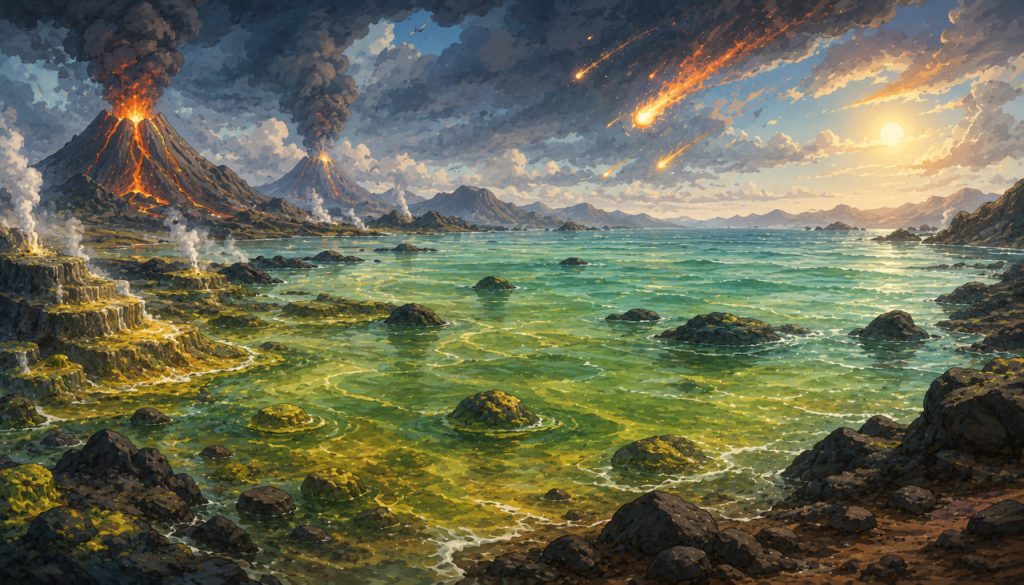
Scientists believe Earth’s first oceans looked dark, mineral-rich, acidic, and possibly greenish rather than bright blue.
Understanding these primordial oceans helps researchers explore some of humanity’s biggest scientific questions:
- How did life begin?
- What was early Earth like?
- Could similar oceans exist on alien planets?
Modern geology, chemistry, and planetary science continue uncovering clues about the mysterious ancient waters that covered the early Earth billions of years ago.
The Early Earth Was Extremely Hostile
Roughly:
- 4.5 billion years ago
Earth formed from:
- Dust
- Rock
- Gas
orbiting the young Sun.
The newborn planet looked nothing like modern Earth.
Its surface was dominated by:
- Lava oceans
- Massive volcanoes
- Extreme heat
- Constant asteroid impacts
Temperatures were so high that:
- Liquid water could not exist initially.
The atmosphere also lacked:
- Oxygen
- Ozone protection
- Complex ecosystems
Instead, early Earth’s atmosphere likely contained:
- Carbon dioxide
- Methane
- Ammonia
- Water vapor
- Sulfur compounds
This created a harsh and toxic environment.
How the First Oceans Formed
As Earth gradually cooled, enormous amounts of water vapor in the atmosphere began condensing into:
- Rain
Scientists believe rain may have fallen continuously for:
- Thousands or even millions of years
Eventually, water collected in:
- Low regions of the crust
forming the first oceans.
Some researchers also suggest additional water arrived through:
- Comets
- Water-rich asteroids
during the early bombardment period.
What Color Were the First Oceans?
Earth’s earliest oceans probably did not look bright blue.
Scientists suspect they may have appeared:
- Dark green
- Brownish
- Murky
- Iron-rich
Why?
The ancient oceans contained huge amounts of:
- Dissolved iron
- Minerals
- Volcanic chemicals
Before oxygen became common, iron remained dissolved in seawater instead of forming rust deposits.
Some modern research suggests high iron concentrations could have given the oceans:
- Greenish coloration
The sky above may also have looked very different due to atmospheric chemistry.
Why Ancient Oceans Had No Oxygen
Modern oceans contain dissolved oxygen supporting:
- Fish
- Plants
- Marine ecosystems
The first oceans lacked free oxygen almost entirely.
This is because:
- Photosynthetic organisms had not evolved yet.
Without oxygen-producing life:
- The atmosphere and oceans remained chemically reducing environments.
Many early microorganisms likely survived using:
- Sulfur chemistry
- Methane metabolism
- Hydrothermal energy
instead of oxygen respiration.
Hydrothermal Vents and the Origin of Life
One of the most important ideas in origin-of-life research involves:
- Hydrothermal vents
These underwater volcanic systems release:
- Heat
- Minerals
- Chemical-rich fluids
into ocean water.
Scientists suspect hydrothermal vents may have provided:
- Energy sources
- Chemical gradients
- Protective environments
for early life formation.
Biochemist Nick Lane explained:
“Hydrothermal vents may have supplied the energy needed for life to emerge.”
Some researchers believe the first primitive cells evolved near these environments billions of years ago.
Constant Asteroid Bombardment
The young Earth experienced intense asteroid impacts during a period called:
- The Late Heavy Bombardment
Large impacts may have:
- Boiled parts of the oceans
- Vaporized water temporarily
- Altered ocean chemistry
Despite these catastrophic events, oceans repeatedly reformed as the planet cooled again.
This demonstrates how resilient Earth’s water systems became over geological time.
The Chemistry of Primordial Oceans
The chemistry of the first oceans differed greatly from modern seawater.
Ancient oceans likely contained high concentrations of:
- Iron
- Sulfur compounds
- Dissolved metals
- Volcanic minerals
The water may also have been:
- More acidic
than modern oceans.
Without oxygen, many chemical reactions behaved very differently from today’s marine environments.
These unusual chemical conditions may have helped drive:
- Prebiotic chemistry
- Organic molecule formation
important for life’s emergence.
The First Microbial Life
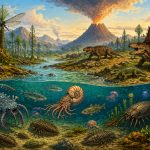
Eventually, microscopic organisms appeared in Earth’s oceans.
These early life forms were extremely simple:
- Single-celled microbes
The oldest known evidence of life dates back roughly:
- 3.5 to 3.8 billion years
Ancient microorganisms gradually transformed the planet’s chemistry.
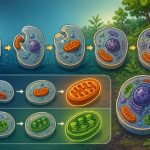
Some evolved:
- Photosynthesis
which eventually released oxygen into oceans and the atmosphere.
This later caused the:
- Great Oxygenation Event
dramatically changing Earth forever.
Why the Oceans Eventually Turned Blue
Modern oceans appear blue mainly because:
- Water absorbs red wavelengths of sunlight more effectively.
However, oxygenation also transformed ocean chemistry.
As oxygen increased:
- Dissolved iron oxidized and precipitated out.
This removed much of the iron responsible for darker or greener water tones.
Over immense timescales:
- Oceans became clearer and more similar to those seen today.
Could Alien Oceans Look Similar?
Scientists studying exoplanets now investigate whether alien worlds may contain oceans resembling Earth’s ancient seas.
Planets with:
- Volcanic atmospheres
- Iron-rich chemistry
- Low oxygen levels
could potentially host:
- Green oceans
- Dark mineral seas
Studying Earth’s first oceans therefore helps astrobiologists search for:
- Extraterrestrial life
through planetary chemistry.
Why Ancient Oceans Matter
The first oceans were not merely pools of water.
They became:
- Chemical laboratories
- Climate regulators
- Cradles of life
Without ancient oceans:
- Life on Earth may never have evolved.
These waters connected:
- Geology
- Chemistry
- Atmosphere
- Biology
during one of the most important transitions in planetary history.
Earth’s Transformation Over Billions of Years
The difference between ancient oceans and modern seas demonstrates how dramatically Earth evolved.
The planet transformed from:
- A volcanic hostile world
into:
- A biologically rich blue planet
through billions of years of:
- Geological activity
- Chemical evolution
- Biological innovation
The first oceans played a central role in this transformation.
Why the First Oceans Still Fascinate Scientists
Scientists remain deeply interested in Earth’s earliest oceans because they may hold clues about:
- The origin of life
- Planetary habitability
- Evolution of atmospheres
- Conditions on alien worlds
The story of Earth’s first oceans is ultimately the story of how a chaotic young planet slowly became capable of supporting complex life.
And somewhere inside those dark mineral-rich waters, the first steps toward every living organism on Earth may have begun.
Interesting Facts
- Earth’s first oceans may have looked green because of dissolved iron.
- Early oceans lacked oxygen entirely.
- Hydrothermal vents may have helped life originate.
- Ancient asteroid impacts repeatedly disrupted the oceans.
- Modern blue oceans developed gradually over billions of years.
Glossary
- Hydrothermal Vent — An underwater volcanic system releasing hot mineral-rich fluids.
- Photosynthesis — Process by which organisms convert sunlight into chemical energy.
- Great Oxygenation Event — Period when oxygen levels rose dramatically on Earth.
- Prebiotic Chemistry — Chemical processes occurring before life existed.
- Exoplanet — A planet orbiting a star outside our solar system.