When people imagine prehistoric Earth, they usually think about:
- Giant dinosaurs
- Tyrannosaurus rex
- Triceratops
- Massive reptiles dominating the planet
However, dinosaurs appeared relatively late in Earth’s history.
Before the first dinosaurs evolved roughly:
- 230 million years ago
our planet had already experienced:
- Billions of years of evolution
- Strange ancient oceans
- Massive volcanic disasters
- Alien-looking forests
- Giant insects
- Primitive reptiles
- Early amphibians
Entire ecosystems existed long before dinosaurs ever appeared.
Some ancient creatures before the dinosaurs looked even stranger than the famous Jurassic animals seen in movies today.
Understanding pre-dinosaur Earth reveals how life evolved step by step through:
- Catastrophes
- Adaptation
- Evolutionary experimentation
The story of Earth before dinosaurs is one of the most fascinating chapters in natural history.
Earth Before Complex Life
For most of Earth’s history:
- No animals existed at all.
The planet formed around:
- 4.5 billion years ago
while the first dinosaurs appeared only about:
- 230 million years ago.
This means Earth existed for billions of years before dinosaurs evolved.
Early Earth was dominated by:
- Volcanoes
- Toxic atmospheres
- Primitive oceans
- Single-celled organisms
Life remained microscopic for enormous periods of time.
The First Simple Life Forms
The earliest life forms were:
- Tiny microorganisms
These primitive organisms likely appeared in ancient oceans more than:
- 3.5 billion years ago.
Most early life consisted of:
- Bacteria-like cells
- Simple microbial colonies
Over time, photosynthetic organisms slowly released:
- Oxygen
into Earth’s atmosphere.
This dramatically changed the planet during an event called:
- The Great Oxygenation Event
Without this oxygen revolution:
- Complex animals could never evolve later.
The Rise of Multicellular Life
Roughly:
- 600 million years ago
multicellular organisms became more common.
Early soft-bodied creatures appeared in oceans during the:
- Ediacaran Period
These organisms looked extremely strange compared to modern animals.
Some resembled:
- Flat discs
- Feather-like structures
- Tubes
- Soft carpets on the seafloor
Scientists still debate exactly how some of these ancient life forms were related to modern animals.
The Cambrian Explosion
One of the most important moments in biological history was:
- The Cambrian Explosion
around:
- 541 million years ago.
During this period:
- Animal diversity increased dramatically.
Suddenly oceans filled with:
- Predators
- Hard shells
- Eyes
- Complex body structures
Life evolved rapidly into many different forms.
Some bizarre Cambrian animals included:
- Anomalocaris
- Hallucigenia
- Trilobites
Many looked almost alien by modern standards.
Ancient Oceans Before Dinosaurs
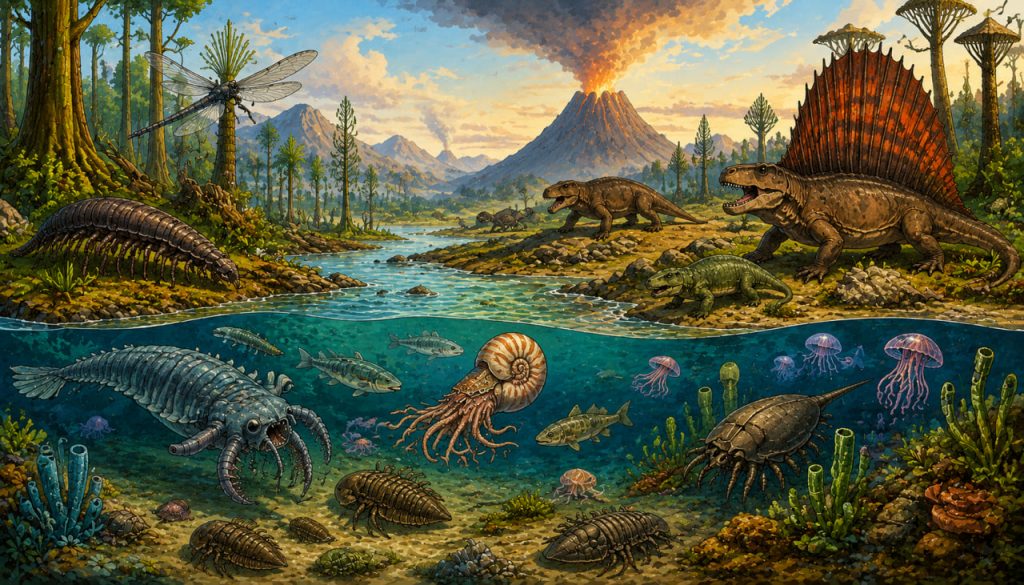
Long before dinosaurs walked on land, Earth’s oceans were filled with strange creatures.
Marine life included:
- Giant arthropods
- Primitive fish
- Early sharks
- Armored sea animals
Some ancient sea scorpions grew:
- Over 2 meters long.
The oceans remained the center of biological evolution for millions of years before large land ecosystems fully developed.
The First Plants on Land
Around:
- 470 million years ago
plants began colonizing land.
Early plants were:
- Small
- Simple
- Moss-like
Over time forests evolved, dramatically changing Earth’s environment.
Plants helped:
- Stabilize soils
- Produce oxygen
- Create habitats
This allowed more complex land ecosystems to develop.
Giant Insects and Oxygen-Rich Air
Before dinosaurs, some insects became enormous.
During the:
- Carboniferous Period
Earth’s atmosphere contained higher oxygen levels than today.
This allowed giant arthropods such as:
- Dragonflies with wingspans over 70 centimeters
- Massive millipede-like creatures
to thrive.
Ancient forests during this period were:
- Swampy
- Dense
- Humid
filled with giant ferns and towering primitive trees.
Amphibians Rule the Land
Before reptiles dominated Earth, large amphibians became some of the first major land vertebrates.
These creatures evolved from:
- Fish-like ancestors
Some ancient amphibians resembled:
- Giant salamanders
- Crocodile-like predators
Although they lived partly on land, many still depended heavily on:
- Water environments
for reproduction.
The Evolution of Reptiles
Eventually reptiles evolved important advantages over amphibians.
Reptiles developed:
- Waterproof skin
- Stronger eggs
- Better land adaptation
This allowed them to spread into:
- Drier environments
Early reptiles diversified into many evolutionary branches.
Some of these groups eventually gave rise to:
- Dinosaurs
- Crocodiles
- Birds
- Mammal ancestors
The Permian Period: A Strange Lost World
Before dinosaurs, Earth experienced the:
- Permian Period
This world looked completely different from later dinosaur ecosystems.
The dominant land animals included:
- Synapsids
- Dimetrodon
- Gorgonopsians
Some had:
- Sail-like backs
- Saber teeth
- Massive skulls
Interestingly, many of these creatures were not dinosaurs at all.
Some were actually closer relatives to:
- Mammals
than reptiles.
Dimetrodon Was Not a Dinosaur
One famous misconception involves:
- Dimetrodon
Many people assume it was a dinosaur because it lived long ago and looked reptilian.
In reality:
- Dimetrodon lived before dinosaurs even evolved.
It belonged to an older evolutionary lineage related to:
- Mammal ancestors
This demonstrates how different Earth’s ecosystems were before the dinosaur age began.
The Largest Mass Extinction in History
Before dinosaurs rose to dominance, Earth experienced the:
- Permian-Triassic Extinction
about:
- 252 million years ago.
This was the most catastrophic extinction event known.
Scientists estimate:
- Around 90% of marine species disappeared.
- Huge numbers of land species also vanished.
Possible causes include:
- Massive volcanic eruptions
- Climate change
- Ocean oxygen collapse
- Methane release
Earth nearly lost complex life entirely.
How Dinosaurs Finally Appeared
After the Permian extinction:
- Ecosystems slowly recovered.
New reptile groups evolved during the:
- Triassic Period
Among them were the first:
- Dinosaurs
Initially dinosaurs were:
- Small
- Fast
- Relatively minor animals
Only later did they become dominant across Earth.
Why Life Before Dinosaurs Matters
The world before dinosaurs demonstrates that Earth’s history is far older and more complex than many people realize.
Dinosaurs ruled for roughly:
- 165 million years
but life existed for billions of years before them.
Pre-dinosaur Earth created the evolutionary foundations necessary for:
- Complex ecosystems
- Land animals
- Forests
- Vertebrate evolution
Without these earlier worlds:
- Dinosaurs themselves would never have appeared.
Ancient Earth Was Constantly Changing
Earth before dinosaurs was not one stable environment.
The planet continuously changed through:
- Continental drift
- Climate shifts
- Extinctions
- Evolutionary innovation
- Volcanic catastrophes
Life repeatedly adapted and reinvented itself.
This long evolutionary story eventually led to:
- Dinosaurs
- Mammals
- Humans
and modern ecosystems.
Why Scientists Still Study Pre-Dinosaur Life
Ancient pre-dinosaur ecosystems help scientists understand:
- Evolution
- Climate change
- Extinction events
- Biological adaptation
Studying these ancient worlds may also help researchers understand:
- Future environmental changes
- Alien ecosystems on other planets
Earth’s distant past remains one of science’s greatest natural laboratories.
Interesting Facts
- Earth existed for billions of years before dinosaurs evolved.
- Giant dragonflies once flew through ancient forests.
- Dimetrodon was not actually a dinosaur.
- The Permian extinction was larger than the extinction that killed dinosaurs.
- Some pre-dinosaur animals were related to mammal ancestors.
Glossary
- Cambrian Explosion — Rapid increase in animal diversity about 541 million years ago.
- Synapsid — Early animal group related to mammal ancestors.
- Permian Period — Geological period before the rise of dinosaurs.
- Mass Extinction — Event causing massive global species loss.
- Ecosystem — A community of organisms interacting with their environment.