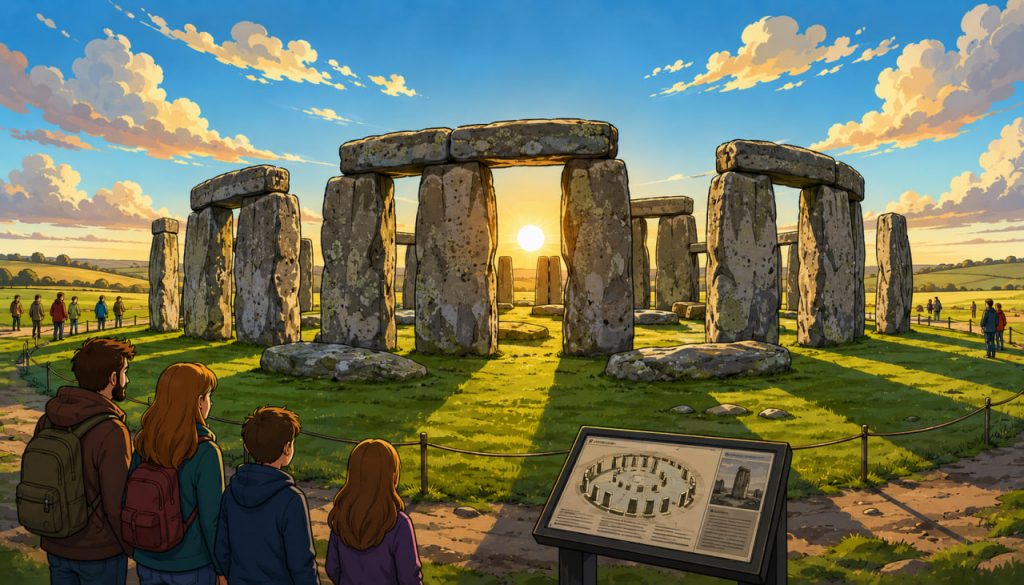
Stonehenge is one of the most famous prehistoric monuments on Earth. Rising from the plains of southern England, its massive stone circles have fascinated historians, archaeologists, and travelers for centuries. The monument’s age, unusual construction, and unknown original purpose have inspired countless legends, ranging from magical powers and alien builders to ancient astronomical observatories.
While many mysteries remain, modern archaeology has revealed far more about Stonehenge than people knew even a few decades ago. Separating fact from fiction helps us better understand the remarkable achievements of the prehistoric societies that built this iconic structure.
What Is Stonehenge?
Stonehenge is a prehistoric stone monument located in Wiltshire, England.
The site consists of:
- Massive standing stones
- Horizontal lintel stones placed across the tops
- Circular earthworks
- Burial sites
- Nearby ceremonial structures
Construction occurred over many centuries rather than as a single project.
Today, Stonehenge is recognized as a UNESCO World Heritage Site and remains one of the most studied archaeological locations in the world.
How Old Is Stonehenge?
One of the most surprising facts about Stonehenge is its age.
The earliest construction began around 3000 BCE, making the monument more than 5,000 years old.
The structure was built in several stages:
- Initial earthworks and ditches
- Wooden structures
- Placement of smaller bluestones
- Construction of the massive sandstone circles
Archaeological evidence suggests that work continued for approximately 1,500 years.
This means multiple generations contributed to the monument’s development.
How Were the Stones Transported?
Perhaps the greatest engineering mystery concerns transportation.
The largest stones, known as sarsens, weigh up to 25 tons each.
Some smaller stones, called bluestones, originated in Wales, over 200 kilometers away.
Researchers believe prehistoric builders likely used combinations of:
- Wooden sledges
- Rollers
- Ropes
- Human labor
- Possibly waterways
Although the exact methods remain debated, experiments have demonstrated that moving such stones using ancient technology was possible.
Myth: Stonehenge Was Built by Aliens
One of the most popular myths claims extraterrestrials built Stonehenge.
Supporters often argue that ancient humans lacked the technology necessary for such construction.
However, archaeological evidence strongly supports human builders.
Scientists have discovered:
- Stone-working tools
- Nearby settlements
- Construction remains
- Human burials associated with the site
No evidence supports alien involvement.
Instead, Stonehenge demonstrates the ingenuity and organizational abilities of prehistoric societies.
Myth: Merlin Used Magic to Create Stonehenge
Medieval legends often attributed Stonehenge to the wizard Merlin from Arthurian stories.
According to one tale, Merlin magically transported the stones from Ireland.
These stories emerged thousands of years after Stonehenge was built and are considered folklore rather than historical evidence.
Nevertheless, they helped contribute to the monument’s legendary status.
Fact: Stonehenge Has Astronomical Alignments
One of the most important discoveries about Stonehenge involves astronomy.
The monument aligns closely with:
- The summer solstice sunrise
- The winter solstice sunset
During the summer solstice, the Sun rises in a position that aligns with key elements of the monument.
This alignment appears intentional and suggests that celestial observations played an important role in its design.
Many archaeologists believe Stonehenge functioned at least partly as a ceremonial site connected to seasonal cycles.
Was Stonehenge a Calendar?
Some researchers have proposed that Stonehenge functioned as a giant calendar.
Its arrangement may have helped ancient communities track:
- Seasons
- Agricultural cycles
- Important ceremonial dates
However, archaeologists continue debating exactly how sophisticated these astronomical functions were.
Most experts agree that the monument incorporated astronomical knowledge, but it may not have served as a precise calendar in the modern sense.
Stonehenge as a Ceremonial Center
Current evidence suggests Stonehenge was much more than a collection of stones.
Excavations have revealed:
- Burial sites
- Processional routes
- Ritual artifacts
- Nearby gathering places
Many scholars believe Stonehenge served as an important ceremonial and religious center.
People may have traveled considerable distances to participate in gatherings, rituals, and seasonal celebrations.
Expert Perspective
Archaeologist Mike Parker Pearson, one of the leading Stonehenge researchers, has argued:
“Stonehenge was built by people who were bringing communities together on an unprecedented scale.”
His research suggests the monument may have symbolized unity and cooperation among different groups across prehistoric Britain.
Why Stonehenge Continues to Fascinate Us
Despite decades of scientific investigation, Stonehenge still inspires wonder.
Part of its appeal comes from unanswered questions:
- Why was it built exactly where it stands?
- What ceremonies took place there?
- How were massive construction projects organized without modern technology?
The combination of known facts and remaining mysteries keeps Stonehenge at the center of archaeological research.
What Stonehenge Teaches Us About Ancient Humans
Perhaps the most important lesson of Stonehenge is that prehistoric societies were far more capable than people once assumed.
Its construction required:
- Planning
- Engineering
- Social organization
- Astronomical knowledge
- Long-term cooperation
Far from being primitive, the builders demonstrated remarkable intelligence and creativity.
Stonehenge remains a powerful reminder that ancient humans possessed sophisticated skills long before the development of modern civilization.
Interesting Facts
- Stonehenge is older than the Egyptian pyramids of Giza.
- Some stones traveled more than 200 kilometers before reaching the site.
- The monument was built over many centuries rather than all at once.
- Thousands of prehistoric burials have been found nearby.
- Stonehenge attracts more than a million visitors each year.
Glossary
- Sarsen — A large sandstone block used in the main Stonehenge structure.
- Bluestone — Smaller stones transported from Wales to Stonehenge.
- Solstice — The longest or shortest day of the year, caused by Earth’s tilt.
- Archaeology — The study of past human societies through material remains.
- UNESCO World Heritage Site — A location recognized for its outstanding cultural or natural importance.