Few places on Earth inspire as much curiosity as Easter Island. Located in the southeastern Pacific Ocean, thousands of kilometers from the nearest continent, this isolated island is famous for its enormous stone statues known as moai. These silent giants have fascinated explorers, archaeologists, and historians for centuries, raising questions about how they were built, why they were created, and what happened to the civilization that carved them.
Far from being merely an archaeological mystery, Easter Island offers valuable insights into human ingenuity, environmental challenges, and cultural resilience. Today, it remains one of the world’s most remarkable historical and cultural treasures.
Where Is Easter Island?
Easter Island, known to its indigenous inhabitants as Rapa Nui, is one of the most isolated inhabited islands on Earth.
The island belongs to Chile and lies approximately:
- 3,700 kilometers west of mainland Chile
- More than 2,000 kilometers from the nearest inhabited island
Its remote location contributed significantly to the development of a unique culture that evolved largely independent of the outside world.
European explorers first recorded the island in 1722 when Dutch navigator Jacob Roggeveen arrived on Easter Sunday, giving the island its modern name.
The Origins of the Rapa Nui People
Archaeological evidence suggests that Polynesian settlers reached Easter Island around the first millennium CE.
These skilled navigators traveled enormous distances across the Pacific using:
- Canoes
- Celestial navigation
- Ocean currents
- Wind patterns
Despite the island’s isolation, the settlers established a thriving society with its own language, traditions, and religious beliefs.
Modern genetic and archaeological studies strongly support the Polynesian origin of the Rapa Nui people.
The Famous Moai Statues
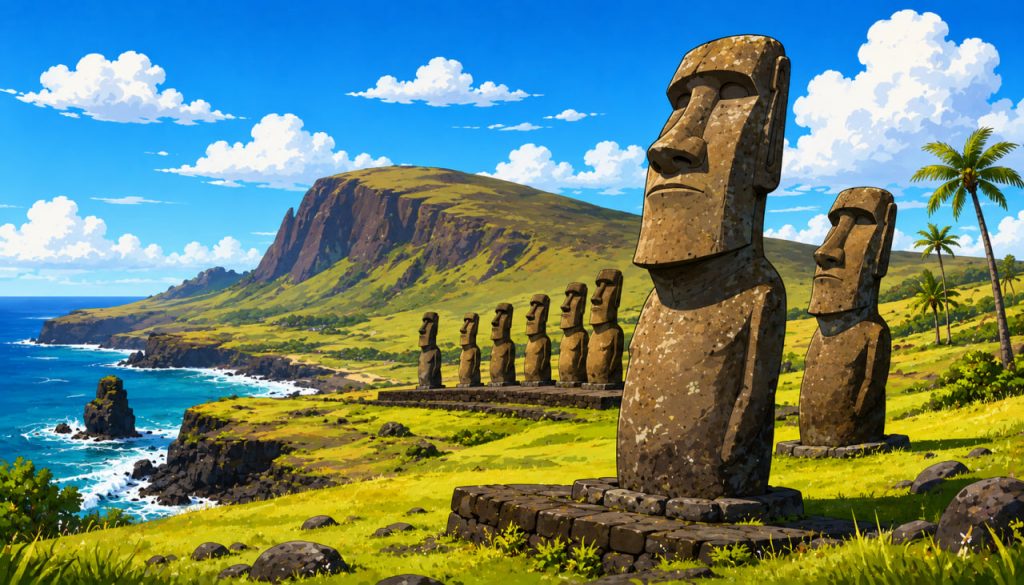
The most recognizable feature of Easter Island is its collection of massive stone statues.
Nearly 1,000 moai have been identified across the island.
These statues vary in size, but many stand several meters tall and weigh dozens of tons.
Most moai were carved from volcanic tuff, a relatively soft rock found at the quarry of Rano Raraku.
The statues typically feature:
- Large heads
- Prominent noses
- Strong chins
- Elongated ears
Contrary to popular belief, many moai possess full torsos buried beneath centuries of accumulated soil.
Why Were the Moai Built?
The exact purpose of the moai is still debated, but archaeologists generally agree they represented important ancestors.
The statues likely served several functions:
- Honoring deceased leaders
- Demonstrating clan status
- Providing spiritual protection
- Strengthening social identity
Most moai were positioned facing inland rather than toward the ocean, suggesting they were symbolically watching over local communities.
How Were the Statues Moved?
One of Easter Island’s greatest mysteries involves transportation.
Some moai weigh more than 80 tons.
For many years, researchers wondered how prehistoric islanders moved such enormous structures without modern machinery.
Several theories have been proposed:
- Wooden sledges
- Log rollers
- Rope systems
Recent experiments suggest that some statues may have been “walked” upright using ropes and coordinated human effort.
This method allows a statue to rock side-to-side while gradually moving forward.
The idea helps explain local oral traditions that describe the statues as walking to their destinations.
The Environmental Collapse Theory
For decades, a popular explanation claimed that Easter Island’s society collapsed because its inhabitants completely destroyed the island’s forests.
According to this theory:
- Trees were cut down to transport statues.
- Deforestation caused soil erosion.
- Food production declined.
- Society collapsed.
While environmental changes certainly occurred, modern research paints a more complex picture.
A More Nuanced Understanding
Many contemporary archaeologists believe earlier explanations oversimplified events.
Evidence suggests multiple factors contributed to social changes, including:
- Environmental pressures
- Climate fluctuations
- Introduced species such as rats
- Internal competition
- Later European contact
Rather than a sudden collapse, many researchers now see Easter Island’s history as one of adaptation and resilience.
The Impact of European Contact
European arrival brought dramatic changes.
Foreign visitors introduced:
- Diseases
- Slave raids
- Economic disruption
During the nineteenth century, the island’s population declined severely.
Many cultural traditions were lost, and the Rapa Nui people faced immense hardships.
Despite these challenges, their descendants continue to preserve and celebrate their heritage today.
Modern Archaeological Discoveries
Scientific research continues to reveal new information about Easter Island.
Recent discoveries indicate:
- Sophisticated agricultural techniques
- Careful resource management
- Complex social organization
- Advanced stone-working skills
Researchers increasingly recognize the achievements of the Rapa Nui civilization rather than focusing solely on theories of decline.
Expert Perspective
Archaeologist Terry Hunt, one of the leading modern researchers of Easter Island, has argued:
“The story of Rapa Nui is not simply one of collapse. It is also a story of remarkable human adaptation in one of the most isolated places on Earth.”
His work has helped reshape public understanding of the island’s history.
Why Easter Island Still Matters
Easter Island remains relevant because it illustrates the relationship between human societies and their environments.
Its history raises important questions about:
- Resource management
- Cultural resilience
- Environmental sustainability
- Human creativity
At the same time, the island stands as a testament to what determined communities can accomplish even in the most challenging circumstances.
The towering moai continue to watch over the landscape, reminding visitors of a civilization that achieved extraordinary feats far from the rest of the world.
Interesting Facts
- Nearly 1,000 moai statues have been documented on Easter Island.
- Some unfinished statues at Rano Raraku are larger than any completed moai.
- Easter Island is one of the most remote inhabited islands on Earth.
- Many moai have bodies buried beneath the soil, not just heads.
- The Rapa Nui language belongs to the Polynesian language family.
Glossary
- Moai — Large stone statues created by the Rapa Nui people.
- Rapa Nui — The indigenous name of Easter Island and its people.
- Volcanic Tuff — A soft rock formed from compacted volcanic ash.
- Polynesia — A vast region of islands spread across the Pacific Ocean.
- Deforestation — The removal of forests or large numbers of trees.