When people think about farming, they usually imagine humans cultivating crops, raising livestock, and managing agricultural landscapes. For a long time, scientists believed agriculture was a uniquely human invention. However, nature has revealed a remarkable surprise: several animal species also practice forms of farming.
These animal farmers actively cultivate food resources, protect them from competitors, maintain growing conditions, and harvest them later. Some have been farming for millions of years—far longer than humans have existed. Their agricultural systems demonstrate that complex resource management can evolve independently in very different forms of life.
Studying animal agriculture helps scientists better understand evolution, cooperation, ecosystem engineering, and the origins of farming itself.
What Does It Mean to Be an Animal Farmer?
Agriculture involves more than simply collecting food.
True farming generally includes several behaviors:
- Cultivating a food source
- Protecting it from threats
- Improving growing conditions
- Harvesting it later
- Repeating the process over generations
Several animal species meet these criteria surprisingly well.
Their farming systems differ from human agriculture, but the underlying principles are remarkably similar.
Leafcutter Ants: Nature’s Master Farmers
Among the most famous animal farmers are leafcutter ants.
These ants do not eat the leaves they collect.
Instead, workers:
- Cut pieces of leaves
- Carry them underground
- Use them as fertilizer for fungi
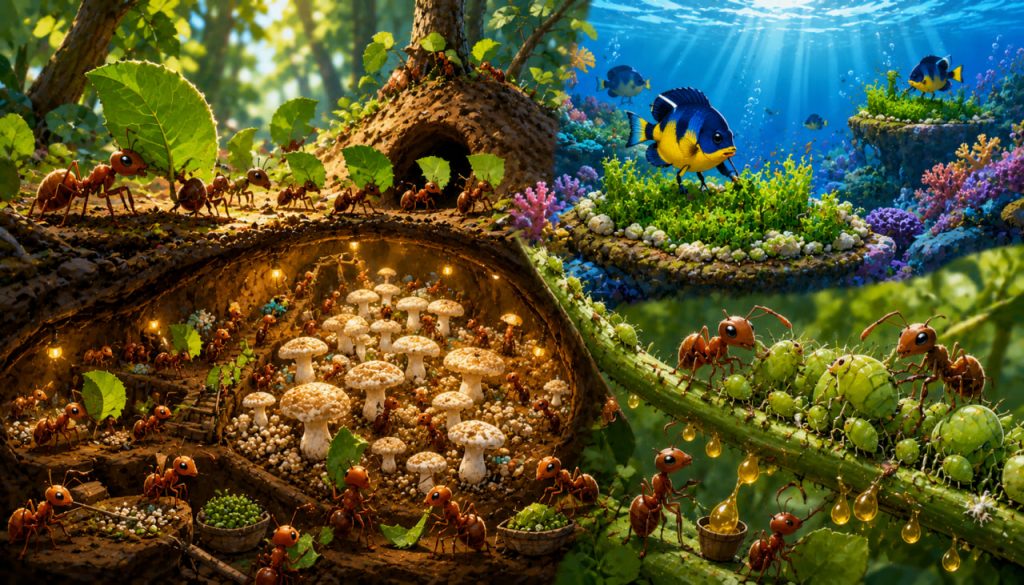
The ants cultivate specialized fungal gardens inside their nests.
The fungus becomes their primary food source.
This relationship has existed for approximately 50 million years.
Scientists consider leafcutter ant agriculture one of the most sophisticated non-human farming systems on Earth.
How Ant Fungus Farms Work
Inside the nest, worker ants carefully maintain fungal gardens.
They perform tasks similar to human farmers:
- Removing diseased material
- Fertilizing crops
- Controlling pests
- Managing humidity
Some ant species even use antibiotic-producing bacteria to protect their fungal crops from harmful microorganisms.
This natural pest-control system evolved millions of years before humans discovered antibiotics.
Termites and Their Underground Farms
Certain termite species also cultivate fungi.
In parts of Africa and Asia, fungus-growing termites construct enormous mounds containing specialized chambers.
Within these chambers:
- Plant material is collected
- Fungi grow on prepared substrates
- Termites harvest the fungal food
The fungus helps break down tough plant fibers that termites would otherwise struggle to digest.
This mutualistic relationship benefits both organisms.
Damselfish: Farmers of the Coral Reef
Not all animal farmers live on land.
Some reef-dwelling fish actively cultivate algae.
Damselfish establish territories on coral reefs and maintain algae gardens.
They:
- Defend their plots aggressively
- Remove unwanted species
- Encourage preferred algae growth
Researchers have observed damselfish chasing away herbivores that attempt to feed on their algae crops.
This behavior closely resembles territorial crop management.
The World’s Smallest Ranchers
Some insects practice a form of livestock farming.
Ants are particularly famous for their relationship with aphids.
Aphids produce a sugary liquid called honeydew.
Certain ant species:
- Protect aphids from predators
- Move them between plants
- Care for their eggs
- Harvest honeydew
Because of these behaviors, aphids are sometimes described as the ants’ “livestock.”
The relationship parallels animal husbandry in surprising ways.
Farming in the Oceans
Marine ecosystems contain additional examples of agriculture.
Some marine invertebrates maintain relationships with algae and microorganisms that resemble farming systems.
These partnerships often involve:
- Resource management
- Habitat maintenance
- Nutrient exchange
Scientists continue discovering new examples of surprisingly sophisticated food-production strategies in ocean environments.
Why Animal Agriculture Evolved
Farming offers important advantages.
Rather than relying entirely on unpredictable food sources, farming allows animals to create more reliable supplies.
Benefits include:
- Greater food security
- Reduced competition
- Stable nutrition
- Long-term resource control
Natural selection may favor farming when environmental conditions make food difficult to obtain consistently.
Cooperation Makes Farming Possible
Many animal farming systems depend on cooperation.
Leafcutter ant colonies may contain millions of individuals performing specialized roles.
Workers may:
- Gather leaves
- Care for fungal gardens
- Defend the colony
- Remove waste
This division of labor resembles some aspects of human agricultural societies.
Complex farming often requires teamwork.
Animal Farmers as Ecosystem Engineers
Animal agriculture can influence entire ecosystems.
For example:
- Ant nests alter soil chemistry.
- Termite mounds affect vegetation.
- Algae-farming fish influence reef communities.
By modifying their environments, these animals become ecosystem engineers that shape habitats for many other species.
What Animal Farming Teaches Us About Evolution
The existence of animal agriculture demonstrates that farming is not uniquely human.
Instead, evolution has repeatedly produced agricultural systems when conditions favored them.
Scientists study these examples to better understand:
- Cooperation
- Symbiosis
- Resource management
- Social evolution
Animal farmers show that sophisticated ecological strategies can emerge in many different branches of life.
Expert Perspective
Evolutionary biologist Edward O. Wilson frequently emphasized the extraordinary complexity of social insects, particularly ants. His research highlighted how colonies function as highly organized societies capable of behaviors—including agriculture—that rival some of humanity’s most impressive collective achievements.
Could Other Species Become Farmers?
Researchers continue investigating whether additional species practice forms of agriculture.
Many ecological relationships exist along a spectrum between simple resource use and true farming.
As scientists learn more about animal behavior, new examples may emerge.
Nature often proves far more inventive than expected.
Conclusion
Animal agriculture is one of the most fascinating examples of convergent evolution. From leafcutter ants cultivating fungi to damselfish tending algae gardens and ants managing aphid “livestock,” numerous species have independently developed farming systems that improve food security and resource control.
These remarkable behaviors reveal that agriculture is not exclusively a human achievement. Instead, it is a powerful evolutionary strategy that has appeared multiple times throughout the history of life. By studying animal farmers, we gain deeper insight into ecology, cooperation, and the surprising ingenuity of the natural world.
Interesting Facts
- Leafcutter ants have been farming fungi for roughly 50 million years.
- Some termite mounds can reach several meters in height.
- Certain ant species use bacteria as natural antibiotics for crop protection.
- Damselfish actively weed their underwater algae gardens.
- Aphids are sometimes called the “cows” of ants because they produce honeydew.
- Animal agriculture evolved millions of years before humans began farming.
Glossary
- Agriculture — The cultivation of food resources through active management.
- Symbiosis — A close biological relationship between different species.
- Mutualism — A relationship in which both species benefit.
- Honeydew — A sugary liquid produced by aphids.
- Fungus Garden — A cultivated fungal crop maintained by insects such as ants or termites.
- Ecosystem Engineer — An organism that modifies its environment in ways that affect other species.
- Division of Labor — The assignment of specialized tasks to different members of a group.