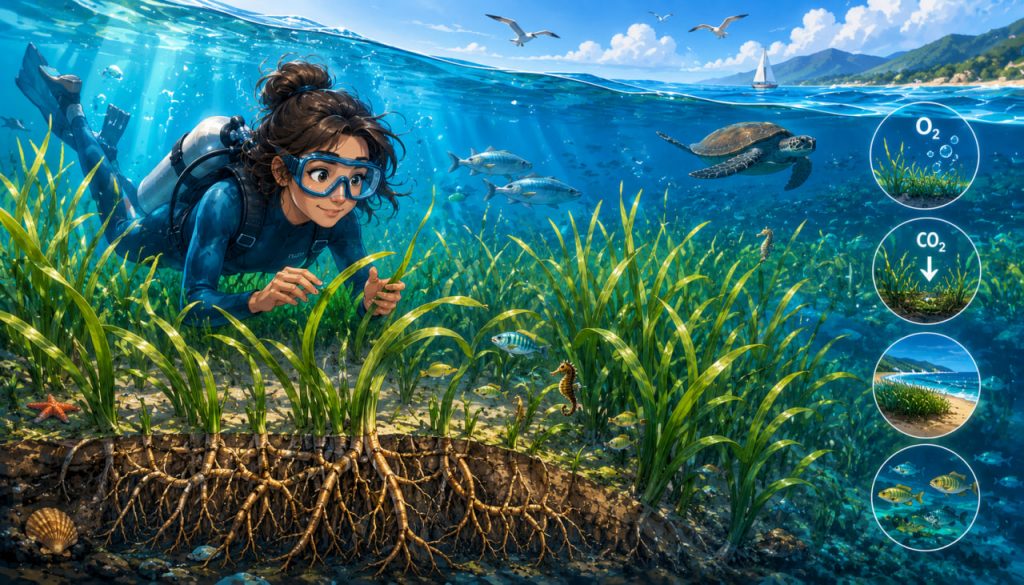
When people think about the most important marine ecosystems, coral reefs usually come to mind first. Often called the “rainforests of the sea,” coral reefs support enormous biodiversity and attract worldwide attention. However, another ecosystem quietly performs some of the ocean’s most vital functions while receiving far less recognition: seagrass meadows.
Among the most remarkable seagrasses is Posidonia, a group of marine flowering plants found primarily in the Mediterranean Sea and parts of Australia. These underwater meadows play a critical role in carbon storage, oxygen production, coastal protection, and marine biodiversity.
Many marine scientists now consider seagrass meadows among the most valuable ecosystems on Earth. In some respects, they may be even more important than coral reefs for maintaining environmental stability and combating climate change.
What Is Posidonia?
Posidonia is not a seaweed or algae.
It is a true flowering plant that evolved from terrestrial ancestors millions of years ago before returning to marine environments.
Like land plants, Posidonia possesses:
- Roots
- Leaves
- Vascular tissues
- Flowers
- Seeds
The most famous species is Posidonia oceanica, which forms extensive underwater meadows throughout the Mediterranean Sea.
These meadows can cover enormous areas of the seafloor and persist for thousands of years.
Some Posidonia colonies are considered among the oldest living organisms on Earth.
Why Seagrass Meadows Are Called the Ocean’s Lungs
Seagrasses perform photosynthesis just like terrestrial plants.
Using sunlight, carbon dioxide, and water, they produce oxygen while creating organic matter.
Large seagrass meadows generate significant amounts of oxygen and support countless marine organisms.
The phrase “lungs of the ocean” is often applied to phytoplankton, microscopic organisms that produce much of the Earth’s oxygen. However, seagrass ecosystems also make an important contribution while simultaneously providing numerous additional ecological benefits.
Unlike many marine habitats, seagrass meadows actively improve water quality and stabilize sediments.
Exceptional Carbon Storage
One of the most important functions of Posidonia meadows is carbon sequestration.
Carbon sequestration refers to the capture and long-term storage of carbon dioxide from the atmosphere.
Seagrasses are remarkably effective at this process.
Their roots trap organic material within sediments where carbon may remain stored for centuries or even millennia.
Marine scientists often refer to this stored carbon as blue carbon.
Blue carbon ecosystems include:
- Seagrass meadows
- Mangrove forests
- Salt marshes
Research suggests that seagrass habitats can store carbon much more efficiently per unit area than many terrestrial forests.
Some Posidonia meadows contain carbon deposits that have accumulated over thousands of years.
A Home for Marine Biodiversity
Seagrass meadows function as underwater cities.
Thousands of marine species depend upon them for:
- Shelter
- Food
- Reproduction
- Nursery habitats
Many commercially important fish species spend part of their life cycles within seagrass ecosystems.
Young fish often hide among the leaves where predators have difficulty reaching them.
The complex structure of a meadow creates countless microhabitats that support marine biodiversity.
Without these underwater grasslands, many coastal ecosystems would become significantly less productive.
Natural Coastal Protection
Healthy seagrass meadows provide an important service that many people never notice.
They help protect coastlines.
The leaves slow water movement and reduce wave energy before it reaches the shore.
This process helps:
- Reduce coastal erosion
- Stabilize sediments
- Improve water clarity
- Protect beaches
As sea levels rise and coastal populations grow, the protective role of seagrass ecosystems is becoming increasingly important.
In many locations, restoring seagrass may be more cost-effective than constructing artificial coastal defenses.
Why Posidonia Can Be More Important Than Coral Reefs
Coral reefs are undoubtedly valuable ecosystems.
However, Posidonia meadows provide several environmental services that reefs generally cannot match.
For example, seagrass meadows:
- Store larger amounts of carbon
- Stabilize sediments more effectively
- Improve water quality
- Protect shorelines directly
- Support important fisheries
Coral reefs excel at supporting biodiversity and protecting tropical coastlines, but seagrass ecosystems often deliver broader climate-related benefits.
This does not mean one ecosystem is more valuable than another in every respect.
Rather, it highlights the fact that seagrass meadows deserve far greater recognition and protection.
Ancient Living Ecosystems
One of the most fascinating aspects of Posidonia is its longevity.
Scientists studying genetic samples have discovered that some Posidonia meadows may be thousands of years old.
Certain clones expand slowly through underground growth while remaining genetically identical.
Some estimates suggest individual Posidonia colonies may have persisted for tens of thousands of years.
This extraordinary longevity allows massive stores of carbon to accumulate over time.
Few ecosystems on Earth can match such long-term environmental stability.
Threats Facing Seagrass Meadows
Despite their importance, seagrass habitats are declining worldwide.
Major threats include:
- Coastal development
- Pollution
- Boat anchoring
- Sediment disturbance
- Climate change
- Rising sea temperatures
Because Posidonia grows slowly, damaged meadows may require decades or even centuries to recover fully.
In some locations, conservation programs have begun restoring degraded habitats, but prevention remains far more effective than restoration.
Expert Perspective
Marine biologist Carlos Duarte has spent decades studying seagrass ecosystems and their role in global carbon cycles.
His research helped draw international attention to blue carbon habitats.
According to Duarte, seagrass meadows are among the planet’s most efficient natural carbon sinks and represent a critical tool in climate change mitigation.
His work has significantly influenced conservation policies aimed at protecting marine vegetation.
The Future of Seagrass Conservation
Awareness of seagrass importance is growing rapidly.
Scientists, governments, and environmental organizations increasingly recognize that protecting seagrass meadows provides multiple benefits simultaneously.
Conservation efforts often focus on:
- Habitat protection
- Water quality improvement
- Sustainable coastal management
- Marine protected areas
- Restoration projects
As understanding of blue carbon expands, seagrass ecosystems are likely to play a larger role in environmental policy and climate strategies.
Conclusion
Posidonia meadows are among the most valuable yet underappreciated ecosystems on Earth. These underwater flowering plants store enormous amounts of carbon, produce oxygen, support marine biodiversity, stabilize coastlines, and improve water quality. While coral reefs rightfully receive global attention, seagrass meadows often perform environmental functions that are equally important—and sometimes even more significant for climate regulation.
Protecting these ancient underwater grasslands is not merely a conservation goal. It is an investment in the health of oceans, coastlines, and the global climate system itself.
Interesting Facts
- Posidonia oceanica is a flowering plant, not an algae.
- Some Posidonia colonies may be among the oldest living organisms on Earth.
- Seagrass ecosystems are major components of global blue carbon storage.
- Many commercially important fish species depend on seagrass nurseries.
- Seagrass meadows can improve water clarity by trapping suspended sediments.
- Posidonia leaves often wash ashore and help reduce beach erosion.
Glossary
- Seagrass — A marine flowering plant that grows in shallow coastal waters.
- Posidonia — A genus of seagrass known for forming extensive underwater meadows.
- Photosynthesis — The process by which plants use sunlight to produce energy and oxygen.
- Carbon Sequestration — The capture and long-term storage of carbon dioxide.
- Blue Carbon — Carbon stored in coastal and marine ecosystems such as seagrass meadows and mangroves.
- Biodiversity — The variety of living organisms within an ecosystem.