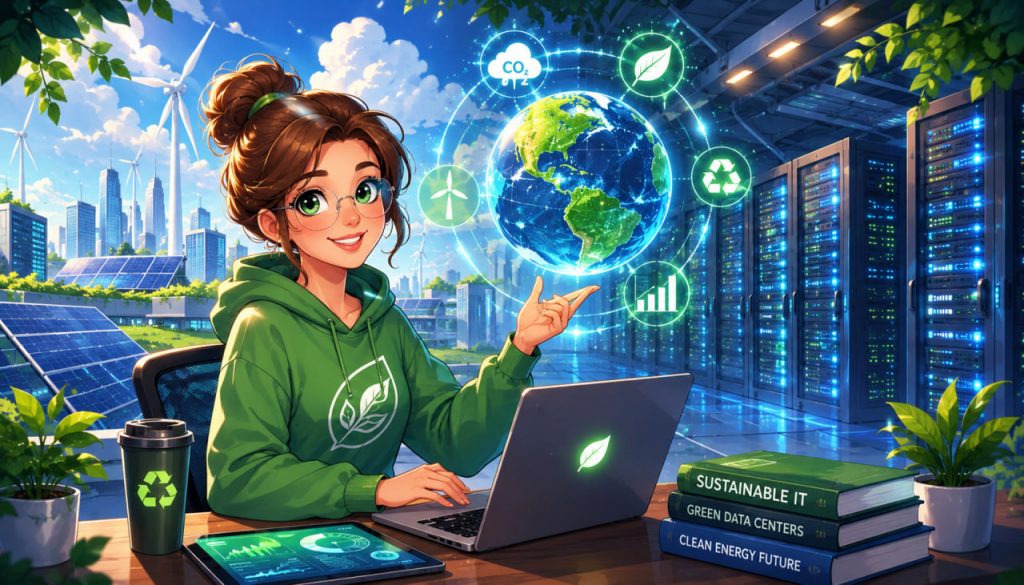
The digital world often feels invisible. Emails travel instantly across continents, videos stream with a click, cloud storage seems limitless, and cryptocurrencies operate entirely online. Because digital services lack the visible pollution of factories or power plants, many people assume that the internet has little environmental impact.
The reality is more complex. Every search query, video stream, AI request, online purchase, and blockchain transaction relies on physical infrastructure that consumes electricity and resources. Behind every website are servers, cooling systems, communication networks, and data centers operating around the clock.
As society becomes increasingly dependent on digital technology, understanding the environmental footprint of IT has become an important part of modern sustainability discussions.
The Hidden Physical Infrastructure of the Internet
The internet is not a cloud floating in the sky.
It consists of a vast network of physical components, including:
- Data centers
- Fiber-optic cables
- Network equipment
- Cellular towers
- Routers
- Personal devices
Every digital action requires information to be stored, processed, and transmitted.
Millions of servers worldwide perform these tasks continuously.
These systems consume large amounts of electricity, making the environmental impact of digital technologies impossible to ignore.
What Is a Carbon Footprint?
A carbon footprint measures greenhouse gas emissions associated with an activity, product, or service.
In IT, emissions may result from:
- Electricity generation
- Equipment manufacturing
- Data center operation
- Device production
- Hardware disposal
The environmental impact depends heavily on the energy source used.
A data center powered by renewable energy generally produces fewer emissions than one powered by coal-fired electricity.
This distinction is critical when evaluating the sustainability of digital infrastructure.
Data Centers: The Factories of the Digital Age
Modern data centers are enormous facilities filled with servers.
These facilities handle:
- Websites
- Streaming services
- Cloud computing
- Artificial intelligence
- Online gaming
- Financial transactions
Data centers require electricity not only for computing but also for cooling.
Servers generate substantial heat, and preventing overheating is essential.
Some of the world’s largest data centers consume as much electricity as small cities.
As demand for cloud services grows, energy efficiency has become a major priority for technology companies.
The Environmental Cost of Video Streaming
Video streaming represents one of the largest sources of internet traffic.
Every streamed movie, television show, or online video requires data transmission and processing.
Factors affecting energy use include:
- Video resolution
- Viewing duration
- Network efficiency
- Device type
Although a single video stream consumes relatively little energy, billions of daily viewing hours create significant cumulative demand.
High-definition and ultra-high-definition content generally require more data and more energy than lower-resolution formats.
Artificial Intelligence and Energy Consumption
Recent advances in artificial intelligence have introduced new environmental considerations.
Training large AI models often requires:
- Massive computing power
- Specialized processors
- Extended operation periods
AI systems can consume substantial amounts of electricity during both training and deployment.
At the same time, AI can also improve efficiency in areas such as:
- Energy management
- Transportation
- Agriculture
- Manufacturing
The environmental impact of AI therefore involves both costs and potential benefits.
Blockchain and Cryptocurrency
Few digital technologies have attracted as much environmental attention as blockchain networks.
Some cryptocurrencies rely on a system called Proof of Work.
This method requires computers to solve complex mathematical problems.
As a result, large numbers of machines operate continuously.
Critics argue that certain cryptocurrency systems consume excessive energy.
Supporters note that newer technologies are reducing energy requirements through alternative approaches such as:
- Proof of Stake
- Hybrid consensus systems
- Renewable-powered mining operations
The environmental impact of blockchain varies significantly depending on the technology used.
Manufacturing Computers and Servers
The carbon footprint of IT extends beyond electricity consumption.
Manufacturing digital devices requires:
- Metals
- Rare-earth elements
- Water
- Energy
Producing servers, smartphones, laptops, and networking equipment generates emissions long before the devices are switched on.
Mining raw materials can also create environmental challenges.
Consequently, extending hardware lifespan is often one of the most effective sustainability strategies available.
Electronic Waste: A Growing Problem
The rapid pace of technological change contributes to increasing volumes of electronic waste.
Common discarded items include:
- Smartphones
- Computers
- Tablets
- Networking equipment
- Storage devices
Improper disposal can release harmful substances into the environment.
Recycling programs help recover valuable materials, but global e-waste generation continues to grow.
Many experts argue that designing longer-lasting products should be a priority.
How Technology Companies Are Responding
Major technology companies have increasingly adopted sustainability goals.
Common initiatives include:
- Renewable energy investments
- Energy-efficient servers
- Advanced cooling systems
- Carbon-neutral commitments
- Hardware recycling programs
Some companies operate data centers powered primarily by solar, wind, or hydroelectric energy.
While challenges remain, the industry has become more aware of environmental responsibilities.
Expert Perspective
Climate scientist Mike Berners-Lee has extensively studied the carbon footprint of digital technologies and consumer behavior.
Berners-Lee emphasizes that digital activities do have environmental impacts, but these impacts should be understood within a broader context. He argues that improving energy efficiency, transitioning to low-carbon electricity, and making informed consumption choices can significantly reduce the environmental footprint of digital systems.
His work highlights the importance of focusing on measurable impacts rather than assumptions.
Should Individuals Worry About Their Internet Use?
This question often generates debate.
For most individuals, actions such as:
- Sending emails
- Browsing websites
- Using messaging apps
represent relatively small environmental impacts compared with transportation, heating, or food production.
However, collective behavior matters.
Billions of users performing energy-intensive activities can create substantial demand.
Reasonable strategies include:
- Extending device lifespan
- Using energy-efficient hardware
- Recycling electronics
- Avoiding unnecessary upgrades
These actions often provide greater benefits than obsessing over individual internet searches.
The Future of Sustainable IT
Researchers continue developing technologies that reduce environmental impacts.
Promising innovations include:
- More efficient processors
- Liquid cooling systems
- Renewable-powered data centers
- Advanced semiconductor designs
- Low-energy computing architectures
The growth of digital technology is unlikely to slow.
Instead, the challenge is ensuring that future expansion occurs in a sustainable manner.
As society becomes increasingly digital, balancing technological progress with environmental responsibility will remain one of the defining challenges of the twenty-first century.
Interesting Facts
- Thousands of data centers operate worldwide to support internet services.
- Some modern data centers use outside air cooling to reduce electricity consumption.
- Video streaming accounts for a significant portion of global internet traffic.
- Certain blockchain systems consume far less energy than early cryptocurrency networks.
- Electronic waste is one of the fastest-growing waste streams globally.
- Many large technology companies have committed to increasing renewable energy use.
Glossary
- Carbon Footprint — The total greenhouse gas emissions associated with an activity, product, or service.
- Data Center — A facility containing servers and networking equipment that process and store digital information.
- Blockchain — A distributed digital ledger used to record transactions across multiple computers.
- Proof of Work — A blockchain consensus mechanism that requires computational effort to validate transactions.
- Electronic Waste (E-Waste) — Discarded electronic devices and components.
- Renewable Energy — Energy generated from naturally replenishing sources such as sunlight, wind, or flowing water.