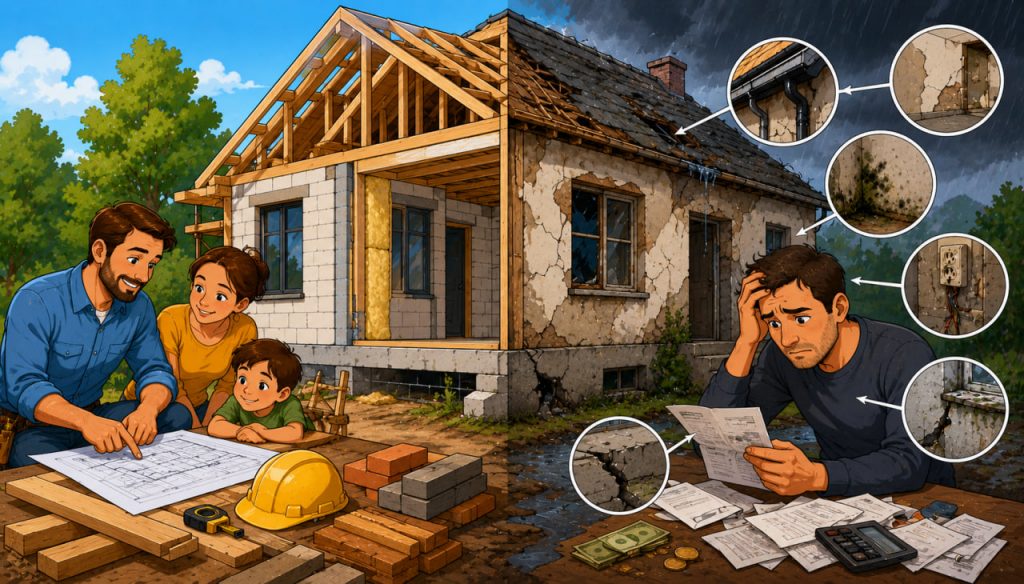
Building a house is one of the largest financial investments most people will ever make. Because construction costs can be substantial, many homeowners naturally look for opportunities to save money. Some cost-saving measures are reasonable and even beneficial. However, others can create serious problems that may not become apparent until years later.
A poorly chosen shortcut can transform a modest saving today into expensive repairs, reduced property value, health concerns, or even safety risks in the future. In construction, the true cost of a decision is often revealed long after the building is completed.
Understanding where savings are sensible—and where they can become dangerous—is essential for anyone planning to build a home.
Why Construction Shortcuts Are Tempting
Construction projects often exceed initial budgets.
Unexpected expenses may arise from:
- Material price increases
- Labor shortages
- Design changes
- Permit requirements
- Site preparation challenges
When costs rise, homeowners may feel pressure to reduce spending elsewhere.
Common targets include:
- Foundations
- Insulation
- Waterproofing
- Roofing
- Electrical systems
- Ventilation
Unfortunately, these are often the very components that determine a home’s long-term durability and safety.
The most expensive construction mistake is frequently the one that initially seemed like a bargain.
Saving Money on the Foundation
The foundation is literally the structure upon which everything else depends.
Attempts to reduce costs may include:
- Using lower-quality concrete
- Reducing reinforcement
- Skipping soil analysis
- Simplifying drainage systems
Problems resulting from foundation failures can include:
- Cracks in walls
- Uneven floors
- Structural instability
- Water infiltration
Foundation repairs are often among the most expensive residential repairs possible.
In severe cases, correcting foundation problems can cost many times more than the original savings.
Cheap Roofing Can Become Very Expensive
A roof protects the entire building from weather.
Inferior roofing materials may initially cost less but can lead to:
- Leaks
- Moisture damage
- Mold growth
- Reduced energy efficiency
Water is one of the most destructive forces affecting buildings.
Even small roof failures can cause damage to:
- Insulation
- Drywall
- Flooring
- Electrical systems
- Structural components
Replacing a roof prematurely is rarely an economical decision.
The Danger of Inadequate Waterproofing
Waterproofing is often invisible after construction is complete.
Because homeowners rarely see it, some builders may be tempted to reduce costs in this area.
However, waterproofing failures can produce:
- Basement flooding
- Mold problems
- Structural deterioration
- Indoor air quality issues
Moisture-related damage can continue unnoticed for years before becoming visible.
By the time problems are discovered, repair costs can be substantial.
Poor Insulation: A Lifetime of Higher Bills
Insulation may not seem exciting, but it plays a critical role in long-term operating costs.
Cutting corners on insulation often results in:
- Higher heating expenses
- Increased cooling costs
- Reduced comfort
- Greater environmental impact
Unlike decorative upgrades, insulation affects building performance every day.
Over decades, energy losses can easily exceed the amount originally saved during construction.
Electrical System Shortcuts
Electrical systems deserve particular attention.
Attempting to reduce costs through:
- Inferior wiring
- Overloaded circuits
- Poor workmanship
- Inadequate safety devices
can create serious hazards.
Electrical faults are a leading cause of residential fires worldwide.
Modern electrical codes exist for a reason.
Ignoring them may create risks far beyond simple financial losses.
Few construction shortcuts carry greater potential consequences than unsafe electrical work.
Ventilation and Indoor Air Quality
Modern homes are increasingly energy-efficient and airtight.
Without proper ventilation, indoor pollutants can accumulate.
Poor ventilation may contribute to:
- Excess humidity
- Condensation
- Mold growth
- Unpleasant odors
- Reduced indoor air quality
Ventilation systems are often overlooked because their benefits are not immediately visible.
However, healthy indoor environments depend heavily upon effective air exchange.
Cheap Windows and Doors
Windows and doors affect:
- Energy efficiency
- Comfort
- Noise control
- Security
Low-quality products may suffer from:
- Air leakage
- Water intrusion
- Condensation
- Premature wear
Replacing windows shortly after construction can eliminate any initial savings.
High-quality windows often provide benefits throughout the life of the building.
The Hidden Cost of Cheap Labor
Labor represents a major portion of construction costs.
Some homeowners seek unusually low bids to reduce expenses.
While many skilled contractors offer competitive pricing, extremely low bids sometimes indicate:
- Inexperienced workers
- Inadequate supervision
- Poor workmanship
- Unlicensed contractors
Construction quality depends heavily on execution.
Even excellent materials can fail when installed incorrectly.
The cheapest labor option is not always the least expensive choice in the long run.
Expert Perspective
Building scientist Joseph Lstiburek has spent decades studying building failures and construction performance.
His work consistently emphasizes that moisture management, insulation, air sealing, and durability are among the most important factors influencing building longevity.
According to Lstiburek, many costly building failures occur not because of advanced technical problems but because fundamental construction principles were ignored in pursuit of short-term savings.
His research highlights the importance of prioritizing quality in critical building systems.
When Saving Money Makes Sense
Not all cost reductions are harmful.
Responsible ways to reduce expenses may include:
- Simplifying architectural designs
- Reducing unnecessary square footage
- Choosing standard dimensions
- Purchasing materials during promotions
- Avoiding luxury finishes
These strategies can lower costs without compromising structural integrity or safety.
The key difference is that they reduce complexity rather than quality.
Thinking in Terms of Lifetime Cost
Many homeowners focus on initial construction expenses.
A more useful perspective is lifetime cost.
A material or system that costs more initially may ultimately save money through:
- Lower maintenance
- Greater durability
- Improved efficiency
- Reduced repair needs
This concept is often called life-cycle costing.
Evaluating long-term performance frequently leads to better decisions than focusing solely on upfront price.
The Psychology of False Savings
Humans naturally seek bargains.
However, construction differs from many other purchases.
When a building component is hidden behind walls, beneath floors, or under foundations, replacement becomes difficult and expensive.
A low price can sometimes conceal future costs.
The most successful construction projects typically balance affordability with durability rather than pursuing the lowest possible initial budget.
P.S. Looking at the consequences of the devastating earthquake in Turkey and Syria, I am once again convinced of how harmful our economy is and how it can lead to the death of many people. Do not save on safety and life – life is a gift from God that we must cherish, and when disaster strikes, everyone understands this…
Interesting Facts
- Water damage is among the most common causes of expensive home repairs.
- Foundation repairs can sometimes cost tens of thousands of dollars.
- Proper insulation can significantly reduce energy consumption throughout a building’s life.
- Roofing systems are often considered one of the most critical building components.
- Many construction defects remain hidden for years before becoming visible.
- Building scientists frequently emphasize moisture control as a top priority in durable construction.
Glossary
- Foundation — The structural base that supports a building.
- Waterproofing — Methods used to prevent water from entering a structure.
- Insulation — Materials that reduce heat transfer through walls, roofs, and floors.
- Ventilation — The process of supplying fresh air and removing stale indoor air.
- Life-Cycle Cost — The total cost of owning, operating, and maintaining a product over its lifespan.
- Structural Integrity — The ability of a building to safely withstand intended loads and environmental conditions.