As cities grow and global consumption increases, the amount of waste generated by humanity continues to rise. Traditional landfills occupy valuable land, produce greenhouse gases, and can create long-term environmental challenges. Incineration has long been used to reduce waste volume, but concerns about emissions have led researchers and policymakers to explore alternative technologies.
Among the most discussed solutions are pyrolysis and gasification. Supporters argue that these technologies can transform waste into valuable fuels, chemicals, and energy while reducing landfill use. Critics, however, warn that some projects have failed to meet expectations and may introduce new environmental and economic risks.
The debate raises an important question: are pyrolysis and gasification the future of waste management, or are they simply a more complex way of burning garbage?
What Is Pyrolysis?
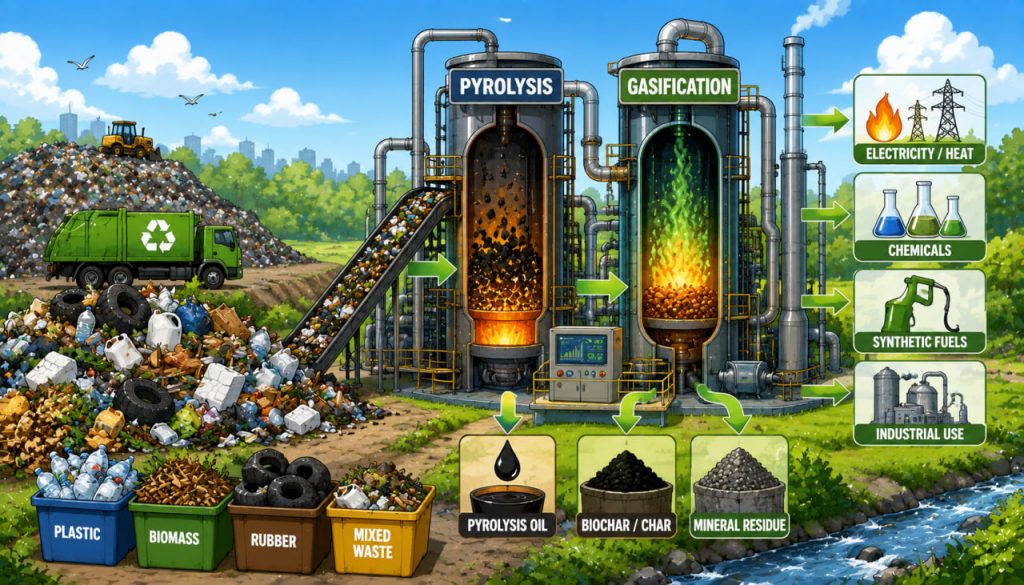
Pyrolysis is a thermal process that breaks down organic materials at high temperatures in the absence of oxygen.
Unlike traditional combustion, pyrolysis does not involve direct burning.
Instead, heat causes complex materials to decompose into:
- Pyrolysis gas
- Liquid oils
- Solid carbon-rich residue (char)
The exact products depend on:
- Temperature
- Feedstock composition
- Processing conditions
Materials commonly processed through pyrolysis include:
- Plastic waste
- Biomass
- Agricultural residues
- Tires
- Certain industrial wastes
The key feature of pyrolysis is that materials are chemically transformed rather than directly combusted.
What Is Gasification?
Gasification is closely related but operates differently.
In gasification, materials are heated with a limited supply of oxygen, steam, or other oxidizing agents.
Instead of producing large amounts of liquid products, gasification primarily generates synthesis gas, often called syngas.
Syngas typically contains:
- Carbon monoxide
- Hydrogen
- Carbon dioxide
- Small amounts of methane
This gas can be used to:
- Generate electricity
- Produce heat
- Manufacture chemicals
- Create synthetic fuels
Gasification has been used for more than a century, although modern systems are considerably more sophisticated than early designs.
Why These Technologies Attract Attention
Landfills create several environmental problems.
These include:
- Methane emissions
- Long-term land use
- Groundwater concerns
- Resource loss
Pyrolysis and gasification promise several potential advantages.
Supporters claim they can:
- Reduce landfill volumes
- Recover useful energy
- Recover valuable materials
- Reduce dependence on fossil fuels
- Process difficult waste streams
Because many waste materials contain stored chemical energy, recovering that energy appears attractive from both economic and environmental perspectives.
The Promise of Plastic Waste Conversion
Plastic pollution is one of the major environmental challenges of the twenty-first century.
Many plastics are difficult to recycle mechanically.
Pyrolysis has gained attention because it can convert certain plastic wastes into liquid hydrocarbons.
These products may potentially be used as:
- Industrial feedstocks
- Chemical raw materials
- Fuel components
This approach is sometimes described as chemical recycling.
However, its effectiveness depends heavily on waste composition, processing efficiency, and economic conditions.
Not all plastics are equally suitable for pyrolysis.
Environmental Benefits
Under appropriate operating conditions, these technologies may offer environmental advantages.
Potential benefits include:
- Reduced landfill dependence
- Lower methane generation
- Material recovery opportunities
- Energy production from waste
- Volume reduction of residual materials
In some cases, biomass gasification can contribute to renewable energy production.
Agricultural residues that might otherwise decompose or be burned openly can be converted into useful energy products.
The Emissions Question
One of the most controversial aspects of pyrolysis and gasification involves emissions.
Because these processes occur at high temperatures, pollutants can potentially be generated.
Possible concerns include:
- Particulate matter
- Nitrogen oxides
- Sulfur compounds
- Volatile organic compounds
- Heavy metals from contaminated feedstocks
Modern facilities often incorporate advanced emission-control systems.
However, environmental performance depends heavily on:
- Plant design
- Operational quality
- Feedstock management
- Regulatory oversight
Poorly operated facilities may produce environmental impacts similar to those associated with traditional waste combustion.
Economic Challenges
Although pyrolysis and gasification are technically impressive, economics remain a major challenge.
Many projects around the world have struggled due to:
- High construction costs
- Complex operation
- Feedstock variability
- Market fluctuations
- Maintenance expenses
Waste is rarely a uniform material.
A facility designed for one waste composition may encounter difficulties when feedstocks change.
Several highly publicized projects have faced delays, cost overruns, or closure because of these challenges.
Are They Better Than Recycling?
A common misconception is that pyrolysis and gasification automatically replace recycling.
In reality, many waste-management experts view them as complementary technologies.
Generally speaking:
- Reduction comes first.
- Reuse comes second.
- Recycling comes third.
- Energy recovery comes afterward.
High-quality recycling often preserves more material value than thermal conversion.
For this reason, many experts argue that pyrolysis and gasification should focus on wastes that cannot be effectively recycled by conventional methods.
Expert Perspective
Chemical engineer Paul T. Williams has extensively studied thermal waste-conversion technologies, including pyrolysis and gasification.
His research highlights both the potential and the limitations of these systems.
According to Williams, successful implementation depends on careful process control, appropriate feedstock selection, and realistic economic planning. He emphasizes that while these technologies can recover valuable resources from waste, they are not universal solutions to the global waste problem.
His work reflects a growing scientific consensus that technology alone cannot solve waste challenges without broader improvements in consumption and recycling practices.
The Role of Biomass Gasification
One area where gasification has shown particular promise involves biomass.
Biomass sources include:
- Wood residues
- Agricultural waste
- Forestry by-products
- Energy crops
Because plants absorb carbon dioxide during growth, biomass-based energy systems may offer lower net carbon emissions compared with fossil fuels.
In some regions, biomass gasification contributes to local energy production while reducing agricultural waste disposal problems.
Future Developments
Researchers continue improving these technologies through:
- Better catalysts
- Advanced reactors
- Improved emission controls
- Enhanced product recovery systems
- Artificial intelligence-assisted process optimization
Future facilities may become more efficient, more reliable, and more environmentally friendly.
However, widespread adoption will likely depend on both technological advances and supportive economic conditions.
Interesting Facts
- Gasification technology was used to produce fuel gas for cities before widespread natural gas distribution.
- Pyrolysis can convert certain plastic wastes into oil-like products.
- Some forms of biochar produced during pyrolysis can improve soil quality.
- Syngas can serve as a building block for synthetic fuels and chemicals.
- Modern gasification systems operate at temperatures exceeding 1,000°C in some applications.
- Waste-to-energy technologies can reduce the volume of waste requiring landfill disposal by up to 90% in certain cases.
Glossary
- Pyrolysis — The thermal decomposition of materials at high temperatures without oxygen.
- Gasification — A process that converts carbon-containing materials into synthesis gas using limited oxygen or steam.
- Syngas — A mixture primarily composed of hydrogen and carbon monoxide produced during gasification.
- Biomass — Organic material derived from plants or biological sources.
- Biochar — A carbon-rich solid produced during biomass pyrolysis.
- Feedstock — The raw material supplied to an industrial process.