Plastic has become one of the defining materials of modern civilization. It is lightweight, durable, inexpensive, and incredibly versatile. From food packaging and medical equipment to electronics and automobiles, plastic is found almost everywhere. However, its durability has also become a major environmental problem. Millions of tons of plastic waste enter landfills, rivers, and oceans every year, where it can persist for decades or even centuries.
As concerns about pollution continue to grow, scientists, governments, and industries have increasingly turned their attention to bioplastics. These materials are often presented as environmentally friendly alternatives to conventional petroleum-based plastics. But are bioplastics truly the solution many hope for, or is the reality more complicated?
Understanding what bioplastics are—and what they are not—is essential for evaluating their role in a sustainable future.
What Are Bioplastics?
The term “bioplastic” can be confusing because it describes several different categories of materials.
Generally, bioplastics fall into two groups:
- Bio-based plastics
- Biodegradable plastics
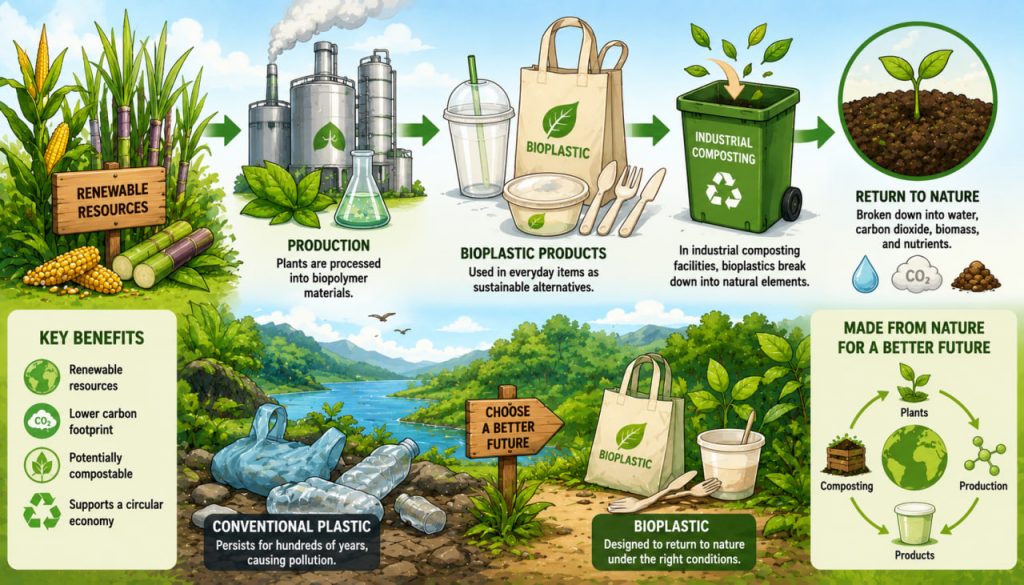
Bio-based plastics are produced partially or entirely from renewable biological resources such as:
- Corn
- Sugarcane
- Potatoes
- Vegetable oils
- Agricultural waste
Biodegradable plastics, on the other hand, are designed to break down under certain environmental conditions.
Importantly, a plastic can be bio-based without being biodegradable, and biodegradable without being bio-based.
Not all bioplastics naturally decompose in the environment, despite common public assumptions.
Why Conventional Plastics Are a Problem
Traditional plastics are primarily produced from fossil fuels.
Their environmental challenges include:
- Long persistence in nature
- Microplastic generation
- Fossil fuel consumption
- Waste accumulation
- Wildlife impacts
Many plastic products are used for only a short period but remain in the environment for decades.
Single-use packaging represents one of the largest contributors to plastic waste streams worldwide.
This has motivated researchers to seek alternative materials with lower environmental impacts.
How Bioplastics Are Made
Bioplastics can be manufactured from a variety of biological sources.
Common feedstocks include:
- Corn starch
- Sugarcane
- Cellulose
- Algae
- Agricultural residues
One of the best-known bioplastics is PLA (polylactic acid).
PLA is typically produced from plant sugars that undergo fermentation to create lactic acid, which is then converted into plastic polymers.
Another important material is PHA (polyhydroxyalkanoate), which can be produced directly by certain microorganisms.
These production methods reduce dependence on petroleum resources.
Potential Environmental Benefits
Bioplastics offer several possible advantages.
These may include:
- Reduced fossil fuel use
- Lower greenhouse gas emissions
- Renewable feedstocks
- Potential biodegradability
- Reduced carbon footprint
Plants absorb carbon dioxide during growth.
As a result, some bio-based plastics may have a lower net carbon impact than petroleum-derived materials.
In addition, renewable raw materials can help diversify industrial supply chains.
The Biodegradability Misconception
One of the biggest misunderstandings surrounding bioplastics involves biodegradation.
Many consumers assume that all bioplastics quickly disappear when discarded.
In reality, biodegradation often depends on specific conditions.
Some biodegradable plastics require:
- Industrial composting facilities
- Controlled temperatures
- High humidity
- Specialized microorganisms
A biodegradable cup thrown into the ocean may not break down nearly as quickly as many people expect.
This distinction is crucial because improper disposal can still create environmental problems.
Industrial Composting vs. Natural Environments
Industrial composting facilities provide carefully controlled conditions that accelerate decomposition.
These facilities maintain:
- Elevated temperatures
- Moisture control
- Active microbial populations
Outside these environments, decomposition rates may be much slower.
This means that compostable plastics are not necessarily suitable replacements for proper waste management systems.
Without adequate infrastructure, their environmental benefits may be limited.
Competition with Agriculture
Bioplastics are often derived from crops that could otherwise be used for food production.
This raises important questions about land use.
Potential concerns include:
- Agricultural expansion
- Water consumption
- Fertilizer use
- Competition with food crops
Researchers are actively exploring alternative feedstocks such as:
- Agricultural waste
- Forestry residues
- Algae
- Industrial by-products
These sources may reduce pressure on agricultural land while improving sustainability.
Can Bioplastics Reduce Ocean Pollution?
Bioplastics are frequently promoted as tools for reducing marine pollution.
However, scientists caution that material substitution alone cannot solve the problem.
Ocean pollution is largely driven by:
- Poor waste management
- Littering
- Inadequate recycling systems
- Excessive consumption
Even biodegradable materials can create environmental impacts if improperly discarded.
Reducing waste generation remains one of the most effective strategies.
Challenges in Recycling
Bioplastics can complicate existing recycling systems.
Certain bioplastics are incompatible with conventional plastic recycling streams.
If mixed improperly, they may reduce recycling efficiency.
This creates additional challenges for waste management facilities.
Improved labeling and consumer education are often necessary to ensure proper disposal.
Developing efficient collection and processing systems remains a critical component of successful bioplastic adoption.
Expert Perspective
Environmental scientist Martin K. Patel has extensively studied the environmental impacts of plastics and bioplastics.
His research emphasizes that the sustainability of bioplastics depends heavily on factors such as feedstock selection, production methods, waste management systems, and end-of-life treatment.
Patel’s work highlights an important reality: no material is inherently sustainable in every context. The overall environmental performance depends on the entire lifecycle of the product.
Emerging Innovations
Bioplastic research continues to advance rapidly.
Scientists are exploring:
- Algae-based plastics
- Bacterial biopolymers
- Agricultural waste feedstocks
- Improved compostable materials
- Marine-degradable polymers
Future generations of bioplastics may offer better performance while reducing environmental trade-offs.
Researchers are particularly interested in materials that combine durability during use with efficient degradation after disposal.
The Future of Bioplastics
Most experts agree that bioplastics alone will not eliminate plastic pollution.
Instead, they are likely to become one component of a broader solution that includes:
- Waste reduction
- Product redesign
- Recycling improvements
- Circular economy strategies
- Sustainable material innovation
The ultimate goal is not simply replacing one plastic with another but creating systems that use resources more efficiently and generate less waste.
Interesting Facts
- Some bioplastics are produced by bacteria as natural energy-storage compounds.
- PLA is one of the most widely used commercial bioplastics today.
- Not all bioplastics are biodegradable.
- Certain algae species are being investigated as future feedstocks for plastic production.
- Industrial composting facilities can accelerate the decomposition of compostable plastics.
- Global bioplastic production represents only a small fraction of total plastic production.
Glossary
- Bioplastic — A plastic that is bio-based, biodegradable, or both.
- PLA (Polylactic Acid) — A common plant-based plastic produced from fermented sugars.
- PHA (Polyhydroxyalkanoate) — A biodegradable plastic produced by microorganisms.
- Feedstock — The raw material used to manufacture a product.
- Industrial Composting — Controlled composting under specific conditions that accelerate decomposition.
- Microplastic — A small plastic particle typically less than five millimeters in size.