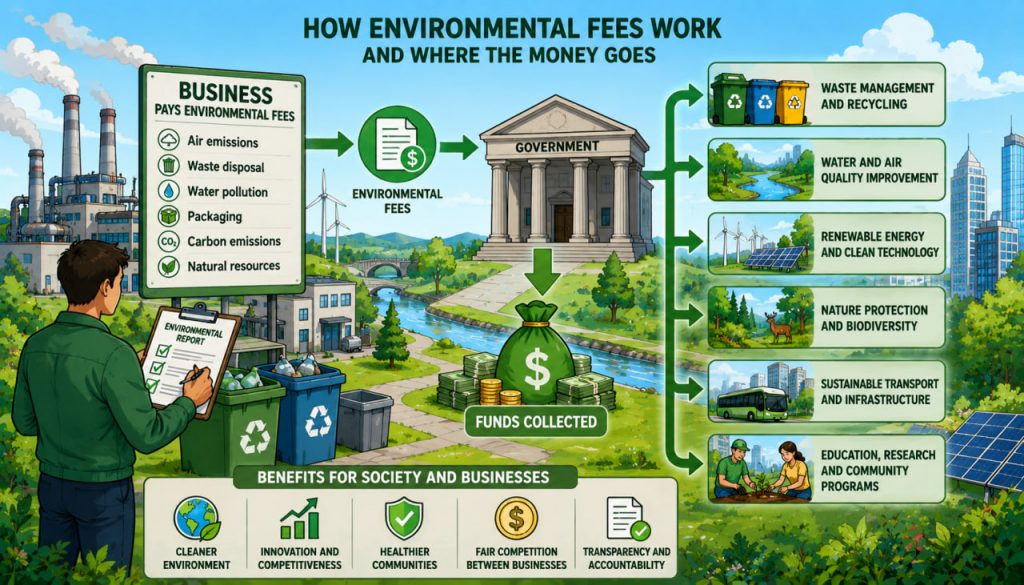
Environmental fees are payments that businesses make for pollution, waste, emissions, resource use, or products that create environmental costs. Their purpose is not simply to punish companies. A well-designed environmental fee encourages businesses to reduce harm, modernize production, recycle more, and use resources more efficiently.
The basic idea is known as the polluter pays principle: those who create environmental damage should help cover the cost of preventing, reducing, or repairing it. The European Commission describes this principle as a core part of environmental policy: polluters should pay for measures needed to prevent, control, and remedy pollution, as well as the social costs caused by environmental damage.
What Are Environmental Fees?
Environmental fees are economic instruments used by governments to make pollution and resource consumption financially visible.
They may apply to:
- Air emissions
- Waste disposal
- Packaging
- Plastic products
- Water pollution
- Carbon dioxide emissions
- Extraction of natural resources
- Hazardous substances
- Products that require recycling after use
Unlike ordinary business taxes, environmental fees are usually connected to a specific environmental impact.
The more a company pollutes, wastes, or consumes, the more it may have to pay.
This creates a financial incentive to reduce harmful activity.
Why Governments Charge Environmental Fees
Environmental damage often creates costs that are not reflected in market prices.
For example, if a factory pollutes air, the company may profit from production while society pays through medical expenses, ecosystem damage, reduced agricultural productivity, and climate risks.
Economists call these costs externalities.
Environmental fees help internalize these externalities, meaning they move part of the hidden cost back to the source of pollution.
The OECD states that taxing pollution and greenhouse gas emissions can be an efficient and effective way to address climate change, biodiversity loss, and pollution while also supporting public revenue and redistribution.
Main Types of Environmental Fees for Business
Environmental payments differ by country, but most systems include several common categories.
Pollution Charges
These apply to emissions released into air, water, or soil.
A company may pay based on:
- Tons of pollutants emitted
- Concentration of harmful substances
- Type of pollutant
- Environmental risk level
The goal is to encourage cleaner technology and better filtration systems.
Waste Disposal Fees
Businesses may pay for sending waste to landfills or incinerators.
Higher fees often encourage recycling, reuse, composting, and waste reduction.
Packaging and Recycling Fees
Many countries require producers to pay for the collection and recycling of packaging.
This is often connected to extended producer responsibility, where producers remain financially responsible for products or packaging after sale.
Carbon Pricing
Carbon pricing is one of the most important environmental fee systems.
It places a cost on greenhouse gas emissions, usually through a carbon tax or emissions trading system.
The World Bank explains that carbon pricing captures the external costs of greenhouse gas emissions and connects those costs to their sources through a price on carbon dioxide emissions.
How Businesses Calculate Environmental Payments
Environmental fees are usually calculated according to official formulas.
These formulas may consider:
- Volume of emissions
- Type of waste
- Toxicity level
- Quantity of packaging placed on the market
- Fuel use
- Carbon intensity
- Compliance with environmental permits
- Recycling targets
For example, a packaging fee may depend on whether the material is paper, glass, plastic, aluminum, or mixed packaging.
A carbon fee may depend on how many tons of CO₂ equivalent a company emits.
Better environmental reporting leads to more accurate payments and fewer regulatory risks.
This is why many companies now invest in environmental accounting, emissions monitoring, and sustainability reporting systems.
Where Does the Money Go?
The answer depends on the country and the specific fee system.
Environmental fee revenue usually goes in one of three directions.
General Government Budget
Some environmental taxes go into the general budget.
In this case, money may support healthcare, infrastructure, education, social programs, or debt reduction rather than being directly tied to environmental projects.
This approach gives governments flexibility, but it can reduce public trust if people expect the money to go only to ecological goals.
Dedicated Environmental Funds
Some systems direct money into special environmental funds.
These funds may finance:
- Waste recycling infrastructure
- River and lake restoration
- Air quality programs
- Forest protection
- Renewable energy projects
- Climate adaptation
- Pollution cleanup
- Biodiversity conservation
This approach is more transparent when funds are well-managed.
Compensation and Transition Support
Environmental revenues can also support households and businesses during the transition to cleaner systems.
This may include:
- Energy-efficiency grants
- Support for small businesses
- Subsidies for cleaner equipment
- Training for workers
- Assistance for low-income households
The World Bank reported that carbon pricing mobilized more than $100 billion for public budgets in 2024, and over half of that revenue was earmarked for environment, infrastructure, and development projects.
Do Environmental Fees Really Work?
Environmental fees can work well when they are properly designed.
They are most effective when:
- Rates are high enough to change behavior
- Rules are predictable
- Reporting is accurate
- Revenue use is transparent
- Companies have access to cleaner alternatives
- Enforcement is consistent
If fees are too low, large companies may simply pay them and continue polluting.
If fees are too complicated, businesses may struggle with compliance.
If revenue is mismanaged, public support declines.
Environmental fees are not magic by themselves. They work best as part of a wider policy system that includes regulation, monitoring, innovation, and public accountability.
Expert Perspective
The OECD has long supported the idea that environmental taxation can help align business decisions with environmental costs.
Its policy position is that green taxes should encourage environmentally friendly choices while supporting fair and sustainable economic growth.
“Environmental fees work best when they make pollution more expensive than prevention.”
This principle is central to modern environmental economics.
A company should not find it cheaper to pollute than to install filters, redesign packaging, recycle materials, or improve energy efficiency.
Benefits for Responsible Businesses
Although environmental fees are often seen as a burden, they can also create advantages for responsible companies.
Businesses that invest early in cleaner production may benefit from:
- Lower future payments
- Stronger brand reputation
- Better investor confidence
- Easier regulatory approval
- Reduced waste costs
- Improved energy efficiency
- Access to green financing
Environmental fees can also make competition fairer.
If one company spends money on pollution control while another avoids responsibility, fees help reduce that unfair advantage.
Common Problems and Criticism
Environmental fee systems often face criticism.
Common problems include:
- Lack of transparency
- Weak enforcement
- Corruption risks
- Excessive bureaucracy
- Unequal pressure on small businesses
- Revenue not used for environmental goals
- Greenwashing by companies
Small and medium-sized businesses may need special support, because they often lack the staff and technology needed for complex reporting.
A good system should be strict enough to discourage pollution but practical enough for honest businesses to comply.
How Businesses Can Reduce Environmental Fees
Companies can often reduce payments by changing operations.
Effective strategies include:
- Reducing waste at the source
- Switching to recyclable packaging
- Installing emission filters
- Improving energy efficiency
- Using renewable electricity
- Reusing water
- Modernizing equipment
- Auditing supply chains
- Tracking environmental data
The best way to reduce environmental fees is not to avoid reporting, but to reduce the environmental impact that creates the fee.
P.S. Unfortunately, the current state of the planet’s ecology is very poor, and in order to make a change, it is crucial for every individual to understand that their actions have a significant impact and take responsibility for their own lives.
Interesting Facts
- Environmental fees are based on the idea that pollution has real economic costs.
- Carbon pricing is one of the fastest-growing environmental payment systems in the world.
- Some countries use environmental revenue to fund renewable energy and public transport.
- Packaging fees can encourage companies to redesign products with less plastic.
- Low environmental fees may fail because companies simply treat them as a normal operating cost.
- Transparent use of environmental revenue increases public trust.
- Environmental taxation can support both ecological goals and broader public budgets.
Glossary
- Environmental Fee — A payment charged for pollution, waste, emissions, packaging, or resource use.
- Polluter Pays Principle — The idea that those responsible for pollution should pay for prevention, control, or cleanup.
- Externality — A cost or benefit of business activity that affects society but is not reflected in the market price.
- Carbon Pricing — A system that puts a financial cost on greenhouse gas emissions.
- Carbon Tax — A direct tax on carbon emissions or carbon-intensive fuels.
- Emissions Trading System — A market-based system where companies trade permits to emit greenhouse gases.
- Extended Producer Responsibility — A policy requiring producers to help manage products or packaging after use.
- Greenwashing — Misleading claims that make a company appear more environmentally responsible than it really is.
- Environmental Fund — A dedicated public fund used to finance ecological projects.
- Circular Economy — An economic model focused on reducing waste through reuse, repair, recycling, and efficient design.