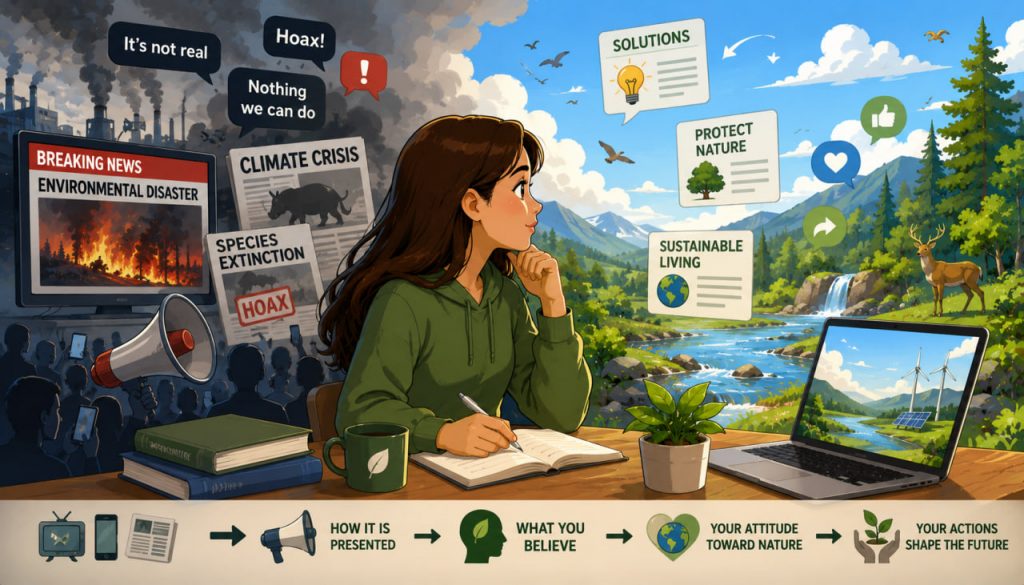
Environmental problems are often viewed as issues of science, technology, or policy. Climate change, biodiversity loss, pollution, and resource depletion are usually discussed through statistics, regulations, and scientific research. However, there is another powerful factor that influences how society responds to environmental challenges: communication.
The words people use, the stories they hear, and the information they consume all shape their understanding of nature. Media organizations, social networks, educational systems, and public discourse influence how environmental issues are perceived, discussed, and prioritized.
This relationship is sometimes described as the ecology of language and information—the study of how communication environments affect public awareness, attitudes, and behavior toward the natural world.
Understanding this connection is increasingly important in an era where information travels globally within seconds and public opinion can significantly influence environmental policy.
What Is the Ecology of Information?
The concept of information ecology refers to the environment in which information is produced, distributed, and consumed.
Just as natural ecosystems contain organisms interacting with one another, information ecosystems contain:
- Journalists
- Scientists
- Governments
- Social media users
- Educational institutions
- News organizations
- Artificial intelligence systems
These actors influence which environmental topics receive attention and how those topics are interpreted.
The information environment can shape public understanding as powerfully as direct personal experience.
Many people learn about environmental issues not through firsthand observation but through media coverage.
Why Language Matters in Environmental Communication
Language does more than describe reality.
It also frames how reality is understood.
Consider the difference between these phrases:
- Climate change
- Climate crisis
- Climate emergency
Each term refers to a similar phenomenon but evokes different emotional responses.
Similarly:
- Forest management
- Logging
- Deforestation
may describe related activities while carrying different connotations.
The words chosen by journalists, politicians, activists, and scientists influence public perception.
This phenomenon is known as framing.
Framing affects how people evaluate risks, assign responsibility, and support potential solutions.
Media as a Lens on Nature
Most environmental issues occur beyond the immediate experience of individuals.
People rarely witness:
- Melting glaciers
- Coral reef degradation
- Deforestation in distant regions
- Atmospheric changes
- Ocean pollution on a global scale
Instead, media serve as a lens through which these issues become visible.
News reports, documentaries, photographs, and social media posts help translate complex environmental processes into stories that people can understand.
However, media coverage is selective.
Editors and content creators decide:
- Which stories receive attention
- Which experts are interviewed
- Which images are shown
- Which data are highlighted
As a result, public awareness often reflects media priorities.
The Power of Visual Communication
Images can be particularly influential in environmental communication.
Photographs of:
- Wildfires
- Oil spills
- Endangered animals
- Plastic pollution
- Drought-stricken landscapes
often generate strong emotional responses.
Visual content can make abstract problems feel immediate and personal.
Research consistently shows that emotionally engaging imagery increases public attention and information retention.
However, visuals can also oversimplify complex issues.
A single dramatic image may fail to represent broader scientific realities.
Powerful images can increase awareness, but they do not always provide complete understanding.
Social Media and Environmental Narratives
Social media has transformed environmental communication.
Information can now spread globally without traditional gatekeepers.
Benefits include:
- Rapid dissemination of scientific findings
- Increased public engagement
- Greater visibility for environmental movements
- Citizen journalism
At the same time, challenges have emerged.
Social media platforms can amplify:
- Misinformation
- Emotional reactions
- Conspiracy theories
- Oversimplified narratives
Algorithms often prioritize content that generates engagement.
As a result, emotionally charged environmental stories may receive more visibility than nuanced scientific explanations.
This can distort public understanding of environmental issues.
How Media Influence Environmental Behavior
Media do not simply inform people.
They can also influence behavior.
Examples include:
- Recycling campaigns
- Water conservation initiatives
- Wildlife protection efforts
- Energy-saving programs
Repeated exposure to environmental messages can gradually shape social norms.
When environmentally responsible behavior becomes socially visible and widely discussed, people are more likely to adopt it.
Behavioral scientists refer to this as the influence of perceived social norms.
People often adjust their actions based on what they believe others consider normal or desirable.
The Risk of Information Overload
Modern societies generate enormous quantities of information.
Environmental topics compete with:
- Politics
- Entertainment
- Sports
- Economic news
- Celebrity culture
As a result, audiences may experience information fatigue.
Constant exposure to alarming environmental headlines can sometimes lead to:
- Anxiety
- Desensitization
- Disengagement
- Feelings of helplessness
This phenomenon is sometimes called eco-fatigue or climate fatigue.
Effective environmental communication must balance awareness with practical solutions.
Messages that only emphasize problems may discourage action rather than inspire it.
Misinformation and Environmental Issues
Environmental topics are particularly vulnerable to misinformation.
Scientific findings can be:
- Misinterpreted
- Oversimplified
- Politicized
- Deliberately distorted
False information may spread faster than accurate information because it often appeals to emotions or existing beliefs.
Examples include misconceptions about:
- Climate science
- Renewable energy
- Wildlife conservation
- Pollution risks
- Environmental regulations
Media literacy therefore plays an increasingly important role in environmental decision-making.
The ability to evaluate sources critically has become an essential skill.
Expert Perspective
Communication scholar George Lakoff, known for his work on framing and public discourse, has argued that the way issues are presented can profoundly influence public understanding and political responses.
His research demonstrates that facts alone are often insufficient to change attitudes.
People interpret information through existing mental frameworks and narratives.
“Frames shape the way we see the world.”
This insight helps explain why environmental communication involves more than presenting scientific data.
How information is communicated can be nearly as important as the information itself.
Building a Healthier Information Ecosystem
Improving environmental communication requires cooperation among scientists, journalists, educators, and media platforms.
Effective strategies include:
- Promoting media literacy
- Encouraging fact-checking
- Supporting science journalism
- Increasing transparency
- Highlighting practical solutions
- Providing context for complex issues
Healthy information ecosystems help societies make informed decisions about environmental challenges.
Without accurate communication, even the best scientific knowledge may fail to influence public action.
The future of environmental protection depends not only on technology and policy but also on the quality of the information environments in which people form their beliefs and make decisions.
Interesting Facts
- Most people learn about climate change primarily through media rather than direct observation.
- Emotional images are often remembered longer than scientific statistics.
- Social media can spread information globally within minutes.
- The concept of “framing” is widely studied in communication science and psychology.
- Environmental documentaries have influenced public attitudes toward conservation worldwide.
- False information often spreads faster than corrections on social media platforms.
- Media literacy is increasingly considered an important component of environmental education.
Glossary
- Information Ecology — The environment in which information is created, shared, and consumed.
- Framing — The way information is presented to influence interpretation and understanding.
- Media Literacy — The ability to critically evaluate information and media sources.
- Misinformation — False or inaccurate information shared without necessarily intending harm.
- Narrative — A story or framework used to organize and communicate information.
- Social Norm — A behavior or belief considered acceptable within a group or society.
- Science Communication — The practice of explaining scientific concepts to non-specialist audiences.
- Information Overload — Difficulty processing information due to excessive volume.
- Algorithm — A set of rules used by digital platforms to organize and prioritize content.
- Environmental Communication — The exchange of information related to environmental issues, risks, and solutions.