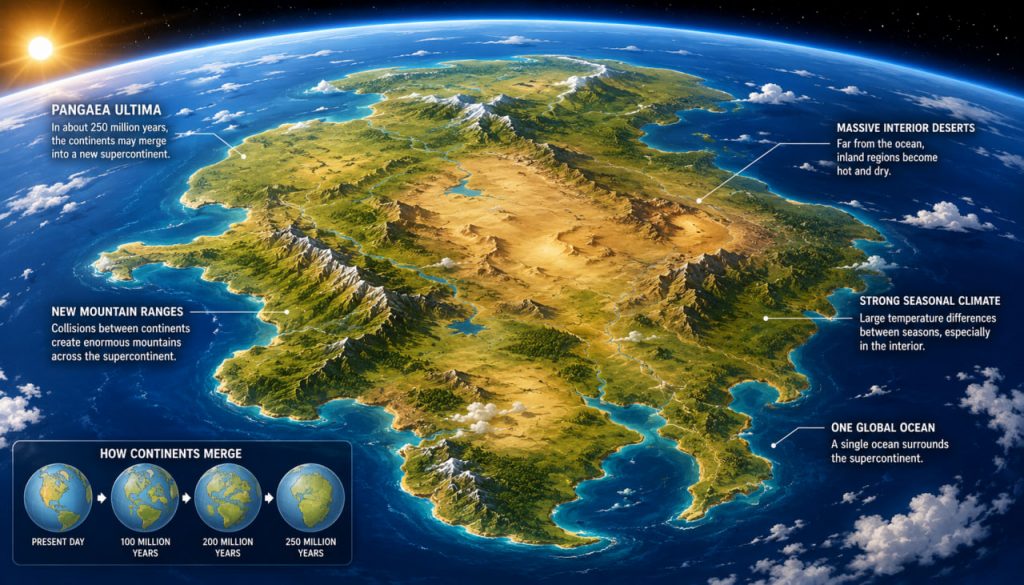
Earth’s continents have never remained fixed in place. Over hundreds of millions of years, they slowly drift across the planet’s surface, driven by powerful geological forces deep within the mantle. This process, known as plate tectonics, has repeatedly assembled and broken apart enormous landmasses called supercontinents. The most famous of these was Pangaea, which existed about 335 to 175 million years ago before gradually splitting into today’s continents.
Scientists believe this cycle is far from over. If plate movements continue as expected, the continents may once again merge into a single massive landmass in approximately 200 to 300 million years. One of the leading scientific models describing this future world is called Pangaea Ultima.
Although no one can predict the future with complete certainty, computer simulations suggest that Earth’s distant descendants—if any exist—may inhabit a dramatically different planet dominated by one enormous supercontinent surrounded by a vast global ocean.
The Supercontinent Cycle
Earth’s continents constantly move because they rest on slowly shifting tectonic plates.
These plates move only a few centimeters each year, roughly as fast as human fingernails grow.
Over millions of years, this seemingly tiny movement becomes enormous.
Geologists have identified several ancient supercontinents throughout Earth’s history, including:
- Columbia (Nuna)
- Rodinia
- Pannotia
- Pangaea
This repeating process of assembly and breakup is known as the supercontinent cycle.
Current evidence suggests that Earth forms a new supercontinent approximately every 400 to 600 million years.
Pangaea Ultima would represent the next chapter in this ongoing geological cycle.
What Is Pangaea Ultima?
Pangaea Ultima is a scientific hypothesis describing one possible future arrangement of Earth’s continents.
The concept was proposed by geologist Dr. Christopher Scotese, whose computer models simulate long-term plate tectonic movement.
In this scenario:
- The Atlantic Ocean gradually closes.
- North and South America reconnect with Africa and Europe.
- Australia collides with Southeast Asia.
- Antarctica moves northward.
- Most continental land merges into one enormous supercontinent.
A single giant ocean would surround this immense landmass.
The exact geography remains uncertain because tectonic processes over hundreds of millions of years cannot be predicted perfectly.
How Will the Continents Move?
Plate tectonics continuously reshapes Earth’s surface.
Current measurements show:
Africa Is Moving North
Africa continues colliding with Europe.
This process is already helping form new mountain ranges around the Mediterranean region.
Australia Is Moving North
Australia is slowly approaching Southeast Asia.
This collision is expected to continue for millions of years.
The Atlantic May Eventually Close
Although the Atlantic Ocean is currently widening, geological models suggest that future changes in subduction zones could eventually reverse this trend.
The Pacific Ocean Is Shrinking
Subduction around the Pacific “Ring of Fire” is gradually consuming oceanic crust.
Its long-term evolution remains one of the largest uncertainties in supercontinent models.
What Would the Climate Be Like?
A giant supercontinent would dramatically alter Earth’s climate.
Large inland regions would be located thousands of kilometers from the nearest ocean.
As a result:
- Rainfall could become much lower.
- Deserts could expand.
- Seasonal temperature extremes would increase.
- Interior regions might become extremely hot.
Some climate simulations suggest average summer temperatures across large portions of Pangaea Ultima could exceed levels that many modern mammals can comfortably tolerate.
The interior of the future supercontinent may become one of the hottest naturally occurring environments Earth has ever experienced.
Oceans and Weather
The formation of a supercontinent would also transform global ocean circulation.
Ocean currents help regulate Earth’s climate today.
A different continental arrangement would likely alter:
- Heat transport
- Rainfall patterns
- Hurricane formation
- Marine ecosystems
Scientists expect stronger seasonal contrasts in many regions.
Some coastal areas could experience powerful monsoon systems, while vast interior regions become increasingly arid.
Changes in ocean circulation would also affect nutrient distribution, influencing marine biodiversity.
What Could Happen to Life?
Life has survived every previous supercontinent cycle.
However, each major continental rearrangement has influenced evolution.
Future ecosystems on Pangaea Ultima might experience:
- New mountain ranges
- Isolated inland deserts
- Large coastal ecosystems
- Changing ocean habitats
- Altered migration routes
Some researchers have suggested that increasingly warm climates combined with high humidity could create environmental conditions challenging for many large mammals.
Evolution would likely produce entirely new species adapted to future environments.
Could Humans Ever See Pangaea Ultima?
Almost certainly not.
Modern humans have existed for roughly 300,000 years, while Pangaea Ultima is expected to form approximately 250 million years in the future.
For comparison:
- Dinosaurs became extinct about 66 million years ago.
- The first mammals appeared over 200 million years ago.
The time separating modern civilization from Pangaea Ultima is far greater than the entire history of humanity.
Whether humans—or any descendants—will still exist at that time remains entirely unknown.
Other Supercontinent Models
Pangaea Ultima is not the only scientific prediction.
Several alternative models exist.
Novopangaea
Assumes continued expansion of the Atlantic Ocean while the Pacific continues shrinking.
Aurica
Suggests both the Atlantic and Pacific oceans eventually close while a new ocean basin forms.
Amasia
Proposes that North America and Asia merge near the Arctic region.
Each model is based on different assumptions regarding future plate movements.
Because Earth’s tectonic behavior over hundreds of millions of years is difficult to predict, all remain plausible scientific hypotheses.
Expert Perspective
Geologist Dr. Christopher Scotese, whose paleogeographic reconstructions have become widely used in Earth sciences, emphasizes that supercontinent models are based on current tectonic trends rather than precise predictions.
His work demonstrates how plate tectonics allows scientists to make scientifically grounded projections far into Earth’s future, while recognizing that uncertainties naturally increase over immense timescales.
“The future geography of Earth depends on how plate motions evolve over hundreds of millions of years.”
His research continues to improve our understanding of Earth’s dynamic geological history.
Why Studying Future Supercontinents Matters
Although Pangaea Ultima will not form for hundreds of millions of years, studying it helps scientists better understand:
- Plate tectonics
- Mountain building
- Ocean evolution
- Climate change
- Biodiversity
- Earth’s internal dynamics
Computer models developed for future supercontinents also improve reconstructions of Earth’s ancient past.
By understanding how continents move, researchers gain insights into volcanic activity, earthquake zones, natural resources, and long-term planetary evolution.
Pangaea Ultima reminds us that Earth is not a static world but a constantly changing planet whose continents, oceans, and climates continue evolving over geological time.
Interesting Facts
- Earth’s tectonic plates move at rates similar to the growth of human fingernails.
- Pangaea existed from about 335 to 175 million years ago.
- Scientists believe several supercontinents have formed and broken apart throughout Earth’s history.
- The Pacific Ocean is currently shrinking because of active subduction zones.
- Australia moves north by approximately 7 centimeters per year, making it one of the fastest-moving continents.
- Supercontinent formation influences global climate, ocean circulation, and biodiversity.
- Computer simulations allow scientists to model continental movement hundreds of millions of years into the future.
Glossary
- Pangaea Ultima — A proposed future supercontinent that may form in about 200–300 million years.
- Supercontinent — A massive landmass formed when most or all continents merge together.
- Plate Tectonics — The scientific theory describing the movement of Earth’s lithospheric plates.
- Subduction — The process in which one tectonic plate sinks beneath another.
- Mantle — The thick layer of hot rock beneath Earth’s crust that drives plate movement.
- Continental Drift — The gradual movement of Earth’s continents over geological time.
- Paleogeography — The study of Earth’s past geographic configurations.
- Ocean Circulation — The large-scale movement of ocean water that distributes heat around the planet.
- Ring of Fire — A zone of frequent earthquakes and volcanic activity surrounding much of the Pacific Ocean.
- Geological Timescale — The system used by scientists to describe Earth’s history over billions of years.