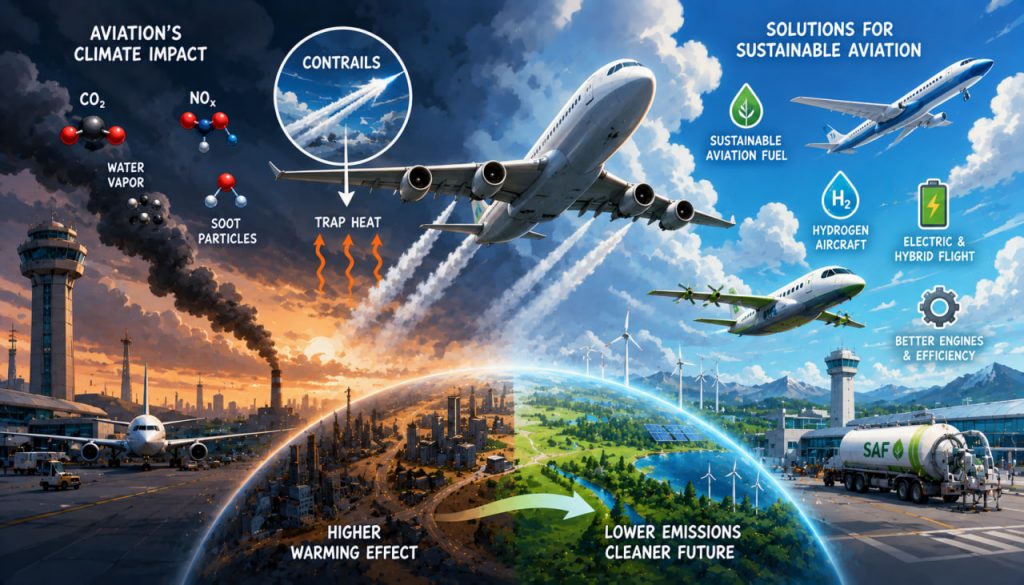
Modern aviation has transformed the world, making international travel, global trade, and rapid transportation possible on an unprecedented scale. Every day, tens of thousands of aircraft connect continents, transport millions of passengers, and deliver critical cargo. However, this remarkable achievement comes with an environmental cost. Aviation contributes significantly to climate change, not only through carbon dioxide emissions but also through several less visible atmospheric effects.
While electric aircraft are often presented as a future solution, most climate scientists and aerospace engineers agree that electrification alone cannot eliminate aviation’s climate impact, especially for long-distance flights. Understanding why requires examining both the physics of flight and the complexity of Earth’s atmosphere.
How Does Aviation Affect the Climate?
Aircraft burn large quantities of aviation fuel, releasing carbon dioxide (CO₂) into the atmosphere.
Carbon dioxide is the best-known greenhouse gas, trapping heat and contributing to global warming.
However, aircraft also emit:
- Water vapor
- Nitrogen oxides (NOₓ)
- Sulfur compounds
- Soot particles
- Aerosols
At high cruising altitudes—typically between 9 and 12 kilometers (30,000–39,000 feet)—these emissions interact differently with the atmosphere than they would near the ground.
The total climate impact of aviation is therefore greater than carbon dioxide emissions alone.
Contrails: More Than Just White Lines
One of aviation’s most visible climate effects comes from contrails.
Contrails form when hot exhaust gases mix with cold, humid air at high altitude.
Under suitable atmospheric conditions, these ice-crystal clouds may persist for hours and gradually spread into thin cirrus-like cloud layers.
Persistent contrails can:
- Reflect some incoming sunlight
- Trap outgoing infrared heat
- Influence local cloud cover
- Alter Earth’s energy balance
Current scientific research indicates that persistent contrails are among the largest contributors to aviation’s total warming effect, although their influence varies depending on weather conditions, flight altitude, and location.
Why High-Altitude Emissions Matter
Aircraft operate in the upper troposphere, where atmospheric chemistry differs from conditions near Earth’s surface.
Nitrogen oxides released by jet engines contribute to complex chemical reactions.
These reactions can:
- Increase ozone formation, which has a warming effect.
- Reduce atmospheric methane, which has a partial cooling effect.
Because these effects occur simultaneously, scientists evaluate aviation using comprehensive climate models that account for multiple interacting processes.
The overall result remains a net warming influence on the climate.
How Large Is Aviation’s Climate Impact?
According to assessments by international scientific organizations, aviation currently accounts for roughly 2–3% of global carbon dioxide emissions from human activities.
When non-CO₂ effects such as contrails and atmospheric chemistry are included, aviation’s total contribution to human-induced warming is estimated to be significantly larger than its CO₂ emissions alone.
Although aviation represents a smaller share of total global emissions than sectors such as electricity generation or road transport, demand for air travel has grown steadily over recent decades, making it an increasingly important part of climate discussions.
Can Electric Airliners Solve the Problem?
Electric aircraft generate considerable excitement because they produce no direct exhaust emissions during flight.
For short regional routes, battery-powered aircraft may become practical in the coming decades.
However, major technological challenges remain.
The biggest obstacle is energy density.
Jet fuel stores vastly more energy per kilogram than today’s rechargeable batteries.
As a result:
- Batteries are much heavier.
- Large aircraft would require enormous battery packs.
- Long-distance flights become impractical with current battery technology.
- Payload capacity would be greatly reduced.
Today’s batteries simply cannot match the energy required for long-haul commercial aviation.
Hydrogen and Sustainable Aviation Fuel
Because fully electric aircraft are unlikely to replace long-range airliners in the foreseeable future, researchers are exploring additional solutions.
These include:
- Sustainable Aviation Fuel (SAF)
- Hydrogen-powered aircraft
- More efficient jet engines
- Improved aircraft aerodynamics
- Optimized flight routes
- Reduced contrail formation
Sustainable Aviation Fuel, produced from biological or synthetic sources, can lower lifecycle carbon emissions under certain production pathways. However, availability remains limited, production costs are high, and sustainability depends on how the fuel is made.
Hydrogen offers the advantage of producing no carbon dioxide during use, but it requires entirely new aircraft designs, cryogenic storage systems, and major airport infrastructure changes.
Improving Efficiency Still Matters
Modern commercial aircraft are significantly more fuel-efficient than those built several decades ago.
Manufacturers continue improving efficiency through:
- Lightweight composite materials
- Advanced wing designs
- More efficient turbofan engines
- Improved flight management software
- Better air traffic coordination
Even relatively small efficiency improvements can reduce fuel consumption across millions of flights each year.
Nevertheless, efficiency gains alone may not fully offset increasing global demand for air travel.
Expert Perspective
Climate scientist Professor David S. Lee, lead author of several major international assessments on aviation and climate, has emphasized that aviation’s warming influence extends well beyond carbon dioxide emissions. His research demonstrates that non-CO₂ effects—particularly persistent contrails and nitrogen oxide emissions—make aviation’s overall climate impact substantially greater than considering fuel emissions alone.
Similarly, assessments by the Intergovernmental Panel on Climate Change (IPCC) conclude that reducing aviation’s climate impact will require a combination of technological innovation, operational improvements, lower-carbon fuels, and continued scientific research rather than reliance on a single solution.
The Future of Sustainable Aviation
The aviation industry is investing heavily in cleaner technologies.
Future developments may include:
- Hybrid-electric regional aircraft
- Hydrogen-powered commercial aircraft
- Greater use of Sustainable Aviation Fuel
- AI-assisted flight optimization
- Improved contrail avoidance strategies
- More efficient air traffic management
Scientists believe that meaningful reductions in aviation’s climate impact will likely require multiple complementary approaches rather than a single breakthrough technology.
As aerospace engineering continues advancing, balancing the benefits of global air travel with the need to reduce greenhouse gas emissions will remain one of the industry’s greatest challenges.
Interesting Facts
- Modern jet aircraft typically cruise at altitudes between 9 and 12 kilometers (30,000–39,000 feet).
- Contrails form only under specific combinations of temperature and humidity.
- Some modern passenger aircraft consume 20–30% less fuel per passenger than comparable aircraft built several decades ago.
- Battery-powered aircraft are already flying experimentally on short routes, but current battery technology limits their range.
- Sustainable Aviation Fuel can be produced from waste materials, biomass, or synthetic processes using captured carbon and renewable electricity.
- Researchers are investigating flight-route adjustments that could reduce the formation of long-lasting contrails.
- Aviation contributes a relatively modest share of global CO₂ emissions compared with some other sectors, but its non-CO₂ effects increase its overall contribution to climate warming.
Glossary
- Carbon Dioxide (CO₂) — A greenhouse gas released during the combustion of fossil fuels that contributes to global warming.
- Contrail — A condensation trail formed by ice crystals in aircraft exhaust under suitable atmospheric conditions.
- Greenhouse Gas — A gas that traps heat within Earth’s atmosphere.
- Nitrogen Oxides (NOₓ) — Reactive gases produced during high-temperature combustion that influence atmospheric chemistry.
- Sustainable Aviation Fuel (SAF) — Aviation fuel produced from renewable or non-fossil sources that can reduce lifecycle greenhouse gas emissions depending on its production pathway.
- Energy Density — The amount of energy stored per unit of mass or volume, a key factor determining aircraft range.
- Hybrid-Electric Aircraft — An aircraft that combines conventional propulsion with electric power systems.
- Lifecycle Emissions — The total greenhouse gas emissions associated with a product or technology, from production through operation and disposal.