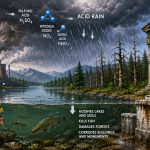
Climate change is usually associated with cyclical climate changes and rising temperatures caused by greenhouse gases such as carbon dioxide and methane. However, for much of the twentieth century, another atmospheric phenomenon partially offset this warming. Known as global dimming, it refers to the reduction of sunlight reaching Earth’s surface due to tiny airborne particles called aerosols.
For decades, industrial pollution unintentionally cooled parts of the planet by reflecting sunlight back into space and altering cloud formation. This temporary masking effect meant that the full warming influence of greenhouse gases was hidden to some extent. As air quality regulations reduced aerosol pollution in many countries, scientists observed that this hidden warming began to emerge more clearly.
Today, global dimming is recognized as one of the most important—and often misunderstood—factors in climate science. Understanding its role helps explain why Earth’s climate has changed the way it has over the past century.
What Is Global Dimming?
Global dimming is the decrease in the amount of solar radiation reaching Earth’s surface.
It occurs primarily because tiny particles suspended in the atmosphere scatter and absorb sunlight before it reaches the ground.
Major sources of aerosols include:
- Industrial emissions
- Coal-fired power plants
- Vehicle exhaust
- Biomass burning
- Wildfires
- Volcanic eruptions
- Dust storms
- Sea salt from oceans
Unlike greenhouse gases, which trap heat, many aerosols primarily reduce the amount of incoming sunlight, creating a cooling effect.
Global dimming temporarily counteracted part of the warming caused by greenhouse gases, but it did not eliminate climate change.
What Are Aerosols?
Aerosols are microscopic solid particles or liquid droplets suspended in the atmosphere.
They vary greatly in size, composition, and origin.
Some aerosols occur naturally, while others result from human activities.
Common aerosol types include:
- Sulfate particles
- Black carbon (soot)
- Organic carbon
- Mineral dust
- Sea salt
- Volcanic ash
Not all aerosols influence climate in the same way.
For example:
- Sulfate aerosols generally cool the atmosphere by reflecting sunlight.
- Black carbon absorbs sunlight and contributes to warming.
The overall climate effect depends on the mixture of different aerosol types.
How Aerosols Reduce Sunlight
Aerosols influence sunlight through two main mechanisms.
First, they scatter incoming sunlight, sending part of it back into space before it reaches Earth’s surface.
Second, many aerosols act as cloud condensation nuclei, helping clouds form with larger numbers of smaller droplets.
These modified clouds often become:
- Brighter
- More reflective
- Longer lasting
As a result, even more sunlight is reflected away from Earth.
Scientists refer to this as the indirect aerosol effect.
Cloud changes caused by aerosols are one of the most complex processes in climate science.
How Scientists Discovered Global Dimming
The idea of global dimming emerged from multiple independent observations.
Researchers noticed that from roughly the 1950s through the 1980s, many regions experienced declining surface sunlight despite increasing solar output remaining essentially unchanged.
Evidence came from:
- Ground-based solar radiation measurements
- Weather station records
- Satellite observations
- Evaporation studies
- Cloud measurements
One intriguing clue came from measurements showing reduced evaporation from open water despite rising air temperatures.
This phenomenon became known as the “pan evaporation paradox.”
Together, these observations helped scientists identify the widespread influence of atmospheric aerosols.
Why the Masking Effect Could Not Last
Unlike carbon dioxide, aerosols remain in the atmosphere for only days to weeks.
Greenhouse gases, by contrast, can persist for decades to centuries.
As countries introduced cleaner technologies and stricter air pollution regulations, aerosol concentrations declined in many regions.
This improved:
- Public health
- Air quality
- Visibility
- Acid rain conditions
However, it also reduced the cooling effect that aerosols had been providing.
As a result, the warming influence of greenhouse gases became increasingly apparent.
Cleaner air revealed more of the warming that had already been accumulating beneath the aerosol “shield.”
Regional Differences Around the World
Global dimming has never affected every region equally.
Industrialized regions with heavy emissions experienced stronger dimming during much of the twentieth century.
Examples included:
- Europe
- North America
- Parts of East Asia
As pollution controls improved in Europe and North America, some regions experienced global brightening, meaning that more sunlight once again reached Earth’s surface.
Meanwhile, rapidly industrializing regions have shown different aerosol trends depending on local emissions and environmental policies.
This regional variation makes aerosol research especially challenging.
Why Aerosols Cannot Solve Climate Change
Because aerosols produce cooling, some people mistakenly assume they could be used as a substitute for reducing greenhouse gas emissions.
Scientists strongly caution against this interpretation.
Aerosols also create serious problems, including:
- Respiratory disease
- Cardiovascular illness
- Reduced visibility
- Acid rain
- Environmental damage
- Premature deaths linked to air pollution
Furthermore, because aerosols disappear quickly from the atmosphere, continuously maintaining high pollution levels would be necessary to sustain their cooling effect.
This would have unacceptable health and environmental consequences.
Reducing greenhouse gas emissions remains the one of the solutions for limiting global warming.
The Connection to Climate Models
Modern climate models include detailed simulations of aerosol behavior.
Researchers study:
- Particle size
- Chemical composition
- Cloud interactions
- Atmospheric circulation
- Regional emissions
- Natural aerosol sources
Although aerosol processes remain one of the largest sources of uncertainty in climate projections, models have become increasingly accurate as observations improve.
Understanding aerosols allows scientists to better estimate both past and future climate change.
Expert Perspective
Climate scientist Dr. James Hansen, former director of NASA’s Goddard Institute for Space Studies, has long emphasized that human-produced aerosols have significantly offset part of the warming caused by greenhouse gases during the industrial era. At the same time, he has noted that this cooling effect is temporary because aerosols remain in the atmosphere for only a short time, whereas carbon dioxide persists for much longer.
Similarly, assessments by the Intergovernmental Panel on Climate Change (IPCC) conclude that aerosols exert an overall cooling influence on Earth’s climate while also representing one of the largest remaining uncertainties in estimating the exact magnitude of human-caused climate change.
The scientific consensus is clear: aerosol cooling has masked part of global warming, but it cannot prevent or reverse long-term climate change driven by greenhouse gases.
Why Global Dimming Matters Today
Global dimming illustrates the remarkable complexity of Earth’s climate system.
Human activities have influenced climate in multiple ways simultaneously.
Greenhouse gases warmed the planet.
Certain aerosols temporarily cooled parts of it.
As cleaner air regulations reduced aerosol pollution, the underlying warming became increasingly visible.
Understanding this balance helps explain historical temperature trends while improving future climate predictions.
Global dimming reminds us that solving one environmental problem can reveal another, highlighting the importance of addressing climate change through comprehensive, science-based solutions.
P.S. Unfortunately, the planet is undergoing cyclical changes that we can only adapt to and survive together. Therefore, the more people who approach their lives consciously, the more each person strives to improve themselves and help those in need and society, the closer we will be to a golden age for our planet.
Interesting Facts
- The term global dimming became widely known in the early 2000s, although scientists had been studying declining surface sunlight for decades.
- Sulfate aerosols released by volcanic eruptions can temporarily cool Earth’s climate, as observed after major eruptions such as Mount Pinatubo in 1991.
- Aerosols typically remain in the atmosphere for only days to weeks, while carbon dioxide can remain for centuries.
- Some regions have experienced global brightening since the 1980s as air pollution controls reduced aerosol concentrations.
- Aerosols influence not only sunlight but also cloud formation, rainfall patterns, and regional weather.
- Air pollution controls have improved human health while simultaneously reducing the temporary cooling effect of industrial aerosols.
Glossary
- Global Dimming – A reduction in the amount of sunlight reaching Earth’s surface due primarily to atmospheric aerosols.
- Aerosol – Tiny solid particles or liquid droplets suspended in the atmosphere.
- Greenhouse Gas – A gas such as carbon dioxide or methane that traps heat in Earth’s atmosphere.
- Sulfate Aerosol – Fine particles formed mainly from sulfur dioxide emissions that generally reflect sunlight and produce cooling.
- Black Carbon – Soot particles produced by incomplete combustion that absorb sunlight and contribute to atmospheric warming.
- Cloud Condensation Nucleus (CCN) – A microscopic particle around which water vapor condenses to form cloud droplets.
- Global Brightening – An increase in surface sunlight observed in some regions following reductions in aerosol pollution.
- Radiative Forcing – A measure of how a factor such as greenhouse gases or aerosols changes Earth’s energy balance.