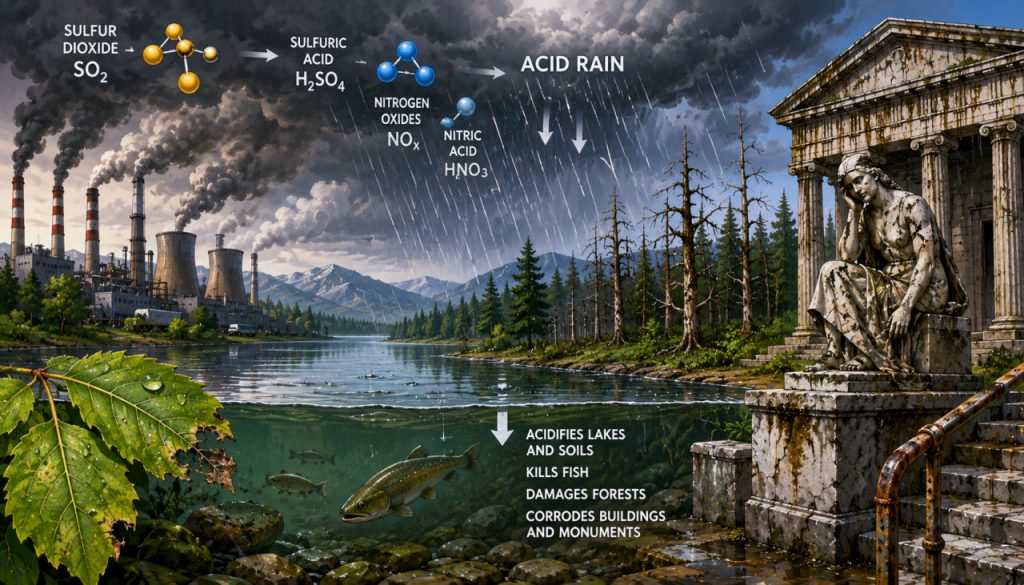
Acid rain may sound like an environmental problem from the past, but it remains an important topic in air pollution, climate policy, public health, and ecosystem protection. In many countries, strict pollution controls have significantly reduced acid rain compared with the late twentieth century. However, the processes that create it have not disappeared completely.
Acid rain forms when certain air pollutants react with water, oxygen, and other chemicals in the atmosphere. These reactions produce acidic compounds that return to Earth through rain, snow, fog, dust, or dry particles. Over time, acid deposition can damage forests, lakes, rivers, soils, buildings, monuments, and sensitive wildlife habitats.
Understanding acid rain helps explain how industrial activity, energy production, transportation, and atmospheric chemistry are connected.
Acid rain is not just “dirty rain” — it is a chemical chain reaction that begins with air pollution and ends with environmental damage.
What Is Acid Rain?
Acid rain is precipitation that contains unusually high levels of acidic compounds.
Normal rain is naturally slightly acidic because carbon dioxide in the air dissolves in water and forms weak carbonic acid.
However, acid rain is much more acidic because it contains stronger acids, mainly:
- Sulfuric acid
- Nitric acid
These acids form when pollutants such as sulfur dioxide and nitrogen oxides enter the atmosphere and react with moisture.
Acid rain can fall as:
- Rain
- Snow
- Fog
- Hail
- Mist
It can also occur as dry deposition, when acidic particles settle on surfaces without precipitation.
Acid rain includes both wet and dry forms of acidic pollution.
What Causes Acid Rain?
The main causes of acid rain are emissions of sulfur dioxide and nitrogen oxides.
Major sources include:
- Coal-fired power plants
- Industrial factories
- Metal smelting
- Oil refining
- Vehicle exhaust
- Ships
- Heavy machinery
- Some natural sources, such as volcanoes
Coal combustion has historically been one of the largest contributors because some coal contains sulfur. When burned, sulfur is released as sulfur dioxide.
Nitrogen oxides are produced when fuel burns at high temperatures, especially in engines and industrial processes.
The more sulfur dioxide and nitrogen oxides enter the air, the greater the risk of acid deposition.
How Acid Rain Forms in the Atmosphere
Acid rain begins with invisible gases.
Sulfur dioxide and nitrogen oxides rise into the atmosphere, where they react with:
- Water vapor
- Oxygen
- Ozone
- Other atmospheric chemicals
These reactions produce sulfuric and nitric acids.
Winds can carry these pollutants hundreds or even thousands of kilometers before they fall back to Earth.
This means acid rain can affect regions far from the original pollution source.
A power plant in one area may contribute to acid rain in another country or distant ecosystem.
Air pollution does not stay politely within political borders.
How Acid Rain Damages Lakes and Rivers
Aquatic ecosystems are especially vulnerable to acid rain.
When acidic precipitation enters lakes, rivers, and streams, it can lower the water’s pH.
This affects fish, amphibians, insects, and aquatic plants.
Some species are more sensitive than others.
Acidic water can interfere with:
- Fish reproduction
- Egg development
- Gill function
- Food chains
- Biodiversity
Acid rain also releases aluminum from soils into waterways. Dissolved aluminum can be toxic to fish and other aquatic organisms.
Even small changes in water chemistry can disrupt entire freshwater ecosystems.
Effects on Forests and Soil
Acid rain can weaken forests over time.
It damages ecosystems by altering soil chemistry.
Important nutrients such as calcium, magnesium, and potassium may be washed away from the soil.
At the same time, toxic metals like aluminum may become more available to plant roots.
This can make trees more vulnerable to:
- Drought
- Frost
- Insects
- Disease
- Poor growth
- Root damage
High-elevation forests are often especially sensitive because they may be exposed to acidic clouds and fog in addition to rain.
Acid rain rarely kills forests overnight, but it can weaken them gradually for decades.
Damage to Buildings and Monuments
Acid rain also affects human-made structures.
It can damage materials such as:
- Limestone
- Marble
- Sandstone
- Concrete
- Metal
- Paint
Historic monuments, statues, churches, bridges, and public buildings can slowly erode when exposed to acidic deposition.
This happens because acids react with minerals in stone, especially calcium carbonate.
Famous historical structures in industrial regions have required restoration partly because of acid rain damage.
Acid rain can erase cultural heritage one chemical reaction at a time.
Does Acid Rain Harm Human Health?
Acid rain itself does not usually burn skin like strong laboratory acid.
Walking in acid rain is not the main health concern.
The bigger health risk comes from the pollutants that cause acid rain.
Sulfur dioxide and nitrogen oxides can contribute to fine particle pollution, which may worsen:
- Asthma
- Bronchitis
- Heart disease
- Lung irritation
- Respiratory symptoms
Fine particles can enter deep into the lungs and affect vulnerable groups such as children, older adults, and people with existing heart or lung conditions.
Reducing acid rain pollution also improves air quality and public health.
How Countries Reduced Acid Rain
Acid rain became a major environmental issue in the second half of the twentieth century.
In response, many governments introduced policies to reduce sulfur dioxide and nitrogen oxide emissions.
Successful strategies included:
- Installing scrubbers at power plants
- Switching to low-sulfur fuels
- Improving vehicle emission standards
- Using catalytic converters
- Expanding renewable energy
- Monitoring air pollution
- Creating emissions trading programs
These measures significantly reduced acid rain in many regions, especially in North America and Europe.
This is one of the clearest examples of environmental regulation producing measurable improvement.
Acid rain shows that science-based policy can successfully reduce large-scale pollution.
Is Acid Rain Still a Problem Today?
Yes, but its severity varies by region.
In many developed countries, acid rain has decreased dramatically.
However, some regions still face acid deposition because of:
- Coal use
- Rapid industrialization
- Weak pollution controls
- Heavy traffic emissions
- Shipping emissions
- Regional atmospheric transport
Acidified lakes and soils may also take many years to recover, even after pollution declines.
Ecosystem recovery is often slower than emission reduction.
Reducing pollution is the first step; restoring damaged ecosystems can take much longer.
Expert Perspective
Environmental scientist Gene E. Likens, one of the researchers who helped identify and document acid rain in North America, played a major role in showing how air pollution could change the chemistry of rain, soils, forests, and freshwater ecosystems. His long-term research at the Hubbard Brook Experimental Forest demonstrated that acid deposition was not a local curiosity, but a serious regional environmental problem.
Likens and his colleagues showed the importance of long-term ecological monitoring. Without decades of careful measurements, the hidden damage caused by acid rain would have been much harder to prove.
Their work remains a powerful example of how patient science can reveal environmental problems before they become impossible to ignore.
What Individuals Can Do
Acid rain is mainly controlled through industrial and government policy, but individual choices still matter.
Helpful actions include:
- Saving electricity
- Using public transportation when possible
- Choosing energy-efficient appliances
- Supporting cleaner energy sources
- Maintaining vehicles properly
- Reducing unnecessary fuel use
- Supporting strong air quality standards
Individual action becomes most powerful when combined with public policy and cleaner technology.
Cleaner air depends on both better systems and smarter everyday choices.
Interesting Facts
- Normal rain is naturally slightly acidic, but acid rain is significantly more acidic due to sulfuric and nitric acids.
- Acid rain can travel long distances because pollutants are carried by wind before returning to Earth.
- Some lakes became so acidic in the twentieth century that fish populations disappeared completely.
- The term acid rain was first used in the nineteenth century by Scottish chemist Robert Angus Smith.
- Power plant scrubbers can remove large amounts of sulfur dioxide from industrial emissions.
- Acid rain can damage marble statues because marble contains calcium carbonate, which reacts with acid.
- Environmental policies in North America and Europe greatly reduced acid rain compared with levels recorded decades ago.
Glossary
- Acid Rain – Rain, snow, fog, or dry particles containing unusually high levels of acidic compounds.
- pH – A scale that measures how acidic or alkaline a substance is.
- Sulfur Dioxide (SO₂) – A gas produced mainly by burning sulfur-containing fuels such as coal and oil.
- Nitrogen Oxides (NOₓ) – Gases produced during high-temperature fuel combustion, especially in vehicles and power plants.
- Sulfuric Acid – A strong acid formed in the atmosphere from sulfur dioxide reactions.
- Nitric Acid – An acid formed when nitrogen oxides react with atmospheric chemicals and moisture.
- Wet Deposition – Acidic substances returning to Earth through rain, snow, fog, or mist.
- Dry Deposition – Acidic particles or gases settling on surfaces without precipitation.