Remote communities, mining sites, research stations, military facilities, and isolated industrial projects often depend on diesel fuel transported across enormous distances. This electricity can be expensive, vulnerable to supply disruptions, and responsible for substantial emissions.
Small modular reactors and even smaller microreactors are being developed as a possible alternative. Unlike conventional nuclear plants designed to supply large national grids, these compact systems could provide reliable electricity and heat close to the point of use.
Small nuclear power plants could transform energy access in remote regions, but their safety and economic value will depend on proven designs, strong regulation, secure fuel management, and realistic local operating conditions.
What Is a Small Modular Reactor?
A small modular reactor, or SMR, is a nuclear reactor with a lower electrical output than a conventional large reactor. The International Atomic Energy Agency generally defines SMRs as advanced reactors producing up to 300 megawatts of electricity per module. Their components may be manufactured in factories and transported to the installation site.
Microreactors are smaller still. Many proposed designs would generate between approximately 1 and 50 megawatts, making them potentially suitable for isolated communities, military bases, mines, disaster-response operations, and industrial facilities.
Several modules could operate together, or a single unit could serve a small local grid.
Why Remote Regions Need a Different Energy Solution
Large power plants are rarely practical for settlements with limited electricity demand. Extending transmission lines across mountains, forests, islands, or Arctic territory can also be prohibitively expensive.
As a result, many remote locations rely on diesel generators. Diesel systems are relatively simple, but fuel must be delivered repeatedly by truck, ship, aircraft, or seasonal ice roads.
A microreactor could potentially operate for years between refuelling cycles while providing:
- Continuous electricity
- District heating
- Industrial process heat
- Water desalination
- Hydrogen production
- Backup power for renewable microgrids
The U.S. Department of Energy describes microreactors as transportable, factory-built systems intended partly for remote and off-grid applications where conventional plants are unsuitable.
The Main Advantage: Reliable Power Around the Clock
Solar and wind can work extremely well in remote regions, particularly when combined with batteries. However, output changes with weather, daylight, and season.
This challenge can be especially serious in northern regions with long winter nights or at isolated industrial sites that require continuous power.
A small reactor could provide stable electricity regardless of weather. It could also complement renewable generation by supplying the constant minimum demand while wind, solar, and batteries handle variable loads.
The strongest case for remote nuclear power is not that it must replace renewables, but that it could reduce diesel dependence within a diversified microgrid.
Are Small Reactors Inherently Safer?
Smaller size can create important safety advantages, but it does not make a reactor automatically safe.
Many advanced designs include passive safety systems. These systems use natural forces such as gravity, convection, and heat conduction rather than depending entirely on powered pumps or immediate operator action.
The U.S. Nuclear Regulatory Commission notes that advanced reactors may incorporate passive safety features, alternative coolants, new fuel types, and smaller reactor cores.
Some designs are intended to shut down and remove residual heat without external electricity. Smaller fuel inventories and underground containment structures may also reduce certain accident risks.
However, every design must still demonstrate that it can control the nuclear chain reaction, remove heat, contain radioactive material, withstand external hazards, and remain secure throughout its operating life.
A smaller reactor may offer a simpler safety case, but safety must be established through testing, licensing, construction quality, and competent operation.
Passive Safety Does Not Eliminate Every Risk
Even a highly automated reactor requires oversight.
Remote environments create their own challenges:
- Limited access to specialist technicians
- Severe weather
- Communication interruptions
- Difficult emergency transport
- Permafrost or unstable ground
- Flood, wildfire, or coastal hazards
- Delays in receiving replacement components
Physical security must also be considered. A remote reactor requires protection against unauthorized access, sabotage, theft of nuclear material, and cyberattacks.
Automation may reduce the number of permanent staff, but fully unattended commercial operation remains a demanding technical and regulatory objective.
What Happens to the Nuclear Waste?
Small reactors do not eliminate radioactive waste.
Used nuclear fuel must be cooled, protected, monitored, transported, and eventually stored or disposed of through an approved national system. Other radioactive materials from maintenance and decommissioning also require management.
Some developers propose sealed reactor cores that would be returned to a centralized facility after years of operation. This could reduce the need to handle fuel at a remote site, although transportation and long-term disposal would still be necessary.
The OECD Nuclear Energy Agency has emphasized that estimating waste-management and decommissioning costs for new reactor technologies is an essential part of evaluating their true economics.
Remote communities should not receive a reactor without a clear, funded plan for removing fuel and restoring the site.
The Economic Question Is Complicated
Factory production could eventually lower costs by standardizing components and repeating the same design. Smaller individual projects may also require less initial capital than conventional nuclear stations.
Modules could theoretically be added as electricity demand grows rather than constructing one enormous plant at the beginning. The OECD Nuclear Energy Agency identifies standardized manufacturing and incremental deployment as potential financial advantages of SMRs.
Yet small reactors lose some of the economies of scale enjoyed by larger plants. Each unit still requires licensing, security, control systems, fuel, maintenance, and waste management.
First-of-a-kind projects may be especially expensive because factories, supply chains, training systems, and regulatory processes must be created before mass production becomes possible.
For remote regions, the relevant comparison is not always the price of electricity on a large national grid. It may be the much higher local cost of delivered diesel, fuel storage, generator maintenance, emissions, and supply interruptions.
Factory Construction Could Improve Quality
One of the most important promises of modular nuclear technology is that major components can be manufactured under controlled factory conditions.
Factory production may improve quality assurance, reduce weather-related construction delays, and allow teams to repeat standardized processes. Completed modules could then be transported by road, rail, ship, or aircraft, depending on their size.
The benefit will appear only if manufacturers receive enough orders to maintain production lines. Without repeat deployment, every project risks becoming a costly custom construction exercise.
The OECD Nuclear Energy Agency has therefore noted that the economic case for SMRs depends partly on developing a sufficiently large commercial market.
The Technology Is Still Entering Its Demonstration Phase
A limited number of small reactor projects are operating or under construction internationally, while many Western microreactor concepts remain in development, licensing, or testing.
The U.S. Department of Energy’s DOME facility is intended to support fueled microreactor experiments, with initial tests planned from 2026 as a step toward possible commercialization later in the decade.
In the United States, regulators are also developing more technology-inclusive and risk-informed approaches for reviewing advanced reactor applications.
These developments are significant, but demonstration is not the same as widespread commercial readiness. Real projects must prove construction schedules, operating costs, reliability, maintenance requirements, and fuel performance.
Local Communities Must Be Part of the Decision
A technically suitable reactor can still fail as a project when local people are excluded.
Remote and Indigenous communities may have concerns about land rights, environmental monitoring, emergency planning, transportation routes, employment, and long-term waste responsibility.
Meaningful participation should begin before a location is selected. Communities need access to independent expertise, understandable safety information, and a genuine ability to influence the decision.
Social acceptance cannot be manufactured after construction has already been approved.
Expert Perspective
The IAEA presents SMRs as a potentially flexible option for electricity production and non-electric applications, particularly where large reactors or extensive grids are unsuitable. At the same time, it continues international work on safety standards, licensing harmonization, security, safeguards, and waste management.
The Nuclear Energy Agency tracks commercial readiness across licensing, financing, siting, fuel supply, manufacturing, and public engagement. This broader approach reflects an important reality: a successful small reactor requires an entire support system, not merely a compact reactor vessel.
Safe Alternative or Expensive Experiment?
Small nuclear power plants could be a valuable option for locations where diesel is costly, energy demand is steady, renewable resources are difficult to balance, and reliable power has exceptional strategic importance.
They are less convincing where efficient buildings, grid connections, solar, wind, batteries, hydropower, or demand management can meet local needs more cheaply and simply.
Small reactors should be evaluated as one possible component of a remote energy system—not as an automatic solution for every isolated community.
Their success will depend on demonstrated safety, predictable costs, trained personnel, secure fuel transport, responsible waste management, and informed community consent.
Interesting Facts
- Some microreactor concepts are designed to be transported by truck, rail, ship, or aircraft.
- Microreactors may provide both electricity and useful heat.
- Several proposed designs use passive cooling that does not require safety-related electric pumps during shutdown.
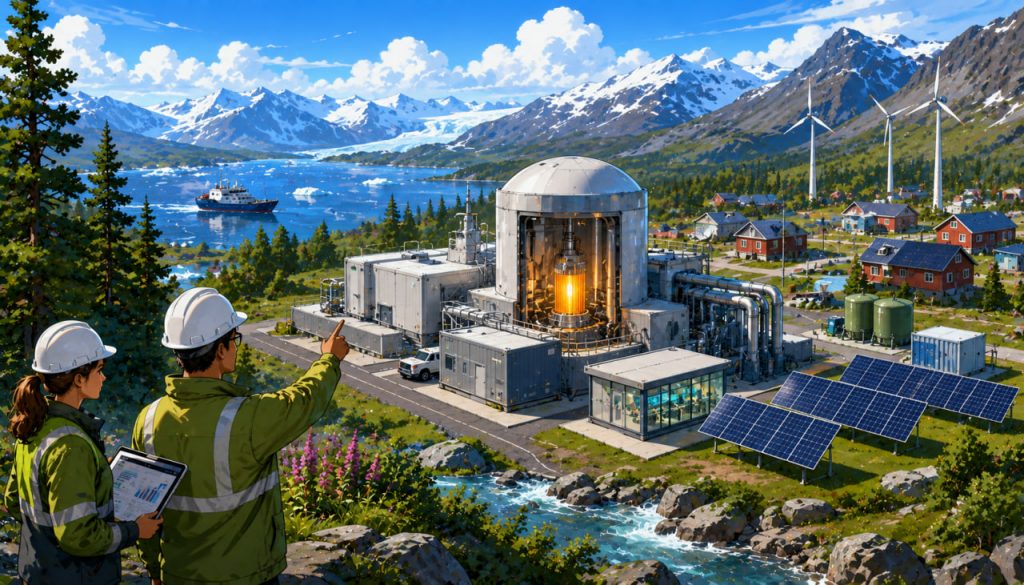
- A reactor could operate alongside solar panels, wind turbines, and batteries within a local microgrid.
- Smaller reactors can be installed as individual modules and expanded when demand increases.
- Remote deployment may reduce fuel deliveries but creates additional maintenance and security challenges.
- As of 2026, many proposed microreactors remain at the experimental, demonstration, or licensing stage rather than routine commercial operation.
Glossary
- Small Modular Reactor — A nuclear reactor producing up to about 300 megawatts of electricity and designed for modular manufacturing and installation.
- Microreactor — A very small nuclear reactor generally intended to produce limited amounts of electricity or heat.
- Passive Safety — Safety features that rely on natural physical processes rather than powered equipment or immediate human intervention.
- Microgrid — A local electricity network that can operate with or independently from a larger grid.
- Nuclear Fission — The splitting of atomic nuclei, releasing energy used to produce heat and electricity.
- Spent Nuclear Fuel — Nuclear fuel removed from a reactor after it can no longer be used efficiently.
- Decommissioning — The controlled shutdown, dismantling, and cleanup of a nuclear facility.
- First-of-a-Kind Project — The first commercial or demonstration installation of a new technological design.