Floating offshore wind farms are among the most ambitious renewable energy technologies of 2026. Instead of attaching turbines directly to the seabed, developers install them on buoyant platforms secured by anchors and mooring lines.
Supporters argue that floating wind can unlock enormous areas of deep ocean with powerful, consistent winds. Critics point to expensive platforms, complex maintenance, difficult grid connections, and the continued need for public financial support.
So, are floating wind farms a genuine energy revolution or an engineering experiment that costs too much? The most accurate answer is that they offer major long-term potential, but today they remain significantly more expensive and less mature than fixed-bottom offshore wind.
How Floating Wind Turbines Work
Conventional offshore turbines stand on foundations fixed to the seabed. This approach works best in relatively shallow water, where monopiles or jacket structures can be installed economically.
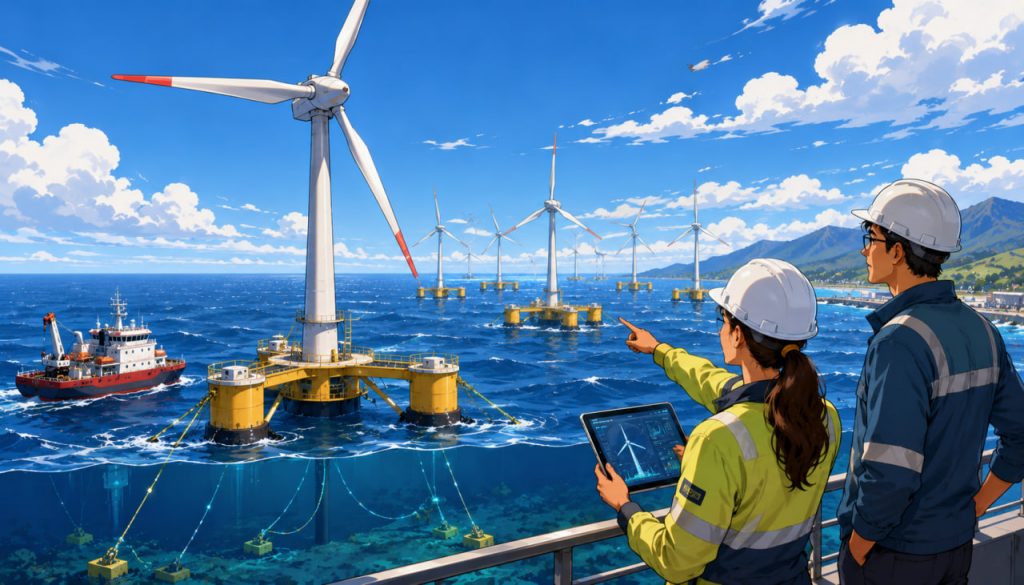
Floating turbines use buoyant foundations similar in principle to structures developed by the offshore oil and gas industry. The main designs include:
- Semi-submersible platforms
- Spar-buoy platforms
- Tension-leg platforms
- Barge-style foundations
Mooring lines connect each platform to anchors on the seabed. A dynamic electrical cable moves with the structure while carrying power to an offshore substation or directly toward shore.
The turbine does not remain perfectly motionless. Its platform responds to waves, currents, and wind, so engineers must control movement carefully to protect the turbine, mooring system, and power cable.
Why Put Wind Turbines on Floating Platforms?
The main advantage is access to deeper water.
A large share of attractive offshore wind resources lies in locations where the seabed is too deep for conventional foundations. Floating platforms allow turbines to operate farther from shore, where winds may be stronger and more consistent.
They may also reduce visual impact from coastlines and open new development areas around countries with steep continental shelves, including Japan, Norway, South Korea, Portugal, France, Spain, and parts of the United States.
By late 2025, approximately 221 GW of floating wind capacity was listed across projects at different stages of development worldwide, although only a small fraction was fully operational. RenewableUK reported 16 operating projects across seven countries, with Norway holding the largest operational capacity.
The resource opportunity is enormous, but the commercial industry remains small.
The Strongest Argument in Favor: Better Wind Resources
Offshore wind generally benefits from fewer buildings, trees, and terrain obstacles than onshore wind. Farther offshore, wind can be faster and steadier.
Higher-quality wind resources may increase a turbine’s capacity factor, meaning it produces closer to its maximum potential output across the year.
Floating projects can also allow developers to select sites based on wind quality rather than being restricted mainly by shallow seabed conditions.
This flexibility could become increasingly valuable as the best fixed-bottom locations are occupied or face conflicts with shipping, fishing, military activity, conservation zones, and coastal communities.
The Biggest Problem: High Costs
Floating wind remains considerably more expensive than established fixed-bottom offshore wind.
The platform requires large amounts of steel or concrete. Mooring systems, anchors, dynamic cables, specialized ports, towing vessels, and offshore maintenance add further expense.
A clear illustration appeared in the United Kingdom’s January 2026 offshore wind auction. Fixed-bottom projects received guaranteed prices of roughly £89–£91 per megawatt-hour, while floating wind projects received approximately £216 per megawatt-hour. These figures are not direct production-cost measurements, but the gap demonstrates how much more financial support floating projects currently require.
High interest rates and supply-chain inflation can make the difference even larger because offshore projects require substantial capital before producing any electricity.
Floating wind is not currently a cheap alternative to fixed-bottom turbines. It is an investment in accessing resources that conventional foundations cannot reach.
Can Costs Fall With Scale?
Almost every major energy technology was expensive during its early commercial phase.
Fixed-bottom offshore wind became more competitive through larger turbines, standardized foundations, better installation vessels, manufacturing scale, improved financing, and experience gained across many projects.
Floating wind may follow a similar pathway. Potential cost reductions could come from:
- Standardized platform designs
- Larger turbines
- Automated manufacturing
- Assembly in ports
- Towing completed turbines to sea
- Improved mooring and anchor systems
- Robotic inspection
- Better weather forecasting
- Shared offshore transmission infrastructure
NREL modelling has examined pathways for floating offshore wind costs to fall as deployment and manufacturing expand. However, it also indicates that substantial innovation and scale are necessary to reach ambitious cost targets.
Cost reductions are possible, but they are not guaranteed. Projects must reach sufficient scale without creating shortages of ports, vessels, cables, steel, and skilled workers.
Easier Installation, Harder Engineering
Floating turbines offer one practical advantage: much of the structure can be assembled in a port and then towed offshore.
This may reduce dependence on enormous specialized installation ships. A turbine can potentially be returned to port for major repairs rather than repaired entirely at sea.
However, floating systems introduce new engineering difficulties.
The turbine, platform, tower, blades, mooring lines, cables, waves, and control software interact continuously. Repeated motion can cause fatigue damage over decades. Dynamic cables must survive bending and tension while remaining electrically reliable.
Recent research continues to focus on fatigue-resistant tower design for larger floating turbines because combined wind-and-wave loading becomes more demanding as machines grow.
Maintenance May Decide Whether Projects Succeed
The ocean is a harsh workplace.
Saltwater corrosion, high waves, strong winds, limited access windows, and long distances from port can make even routine maintenance expensive. A technician cannot always reach a turbine exactly when a fault occurs.
Floating projects may be built farther from shore than conventional wind farms, increasing travel time and weather exposure. Research published in 2026 emphasizes that offshore accessibility varies significantly by location and season, directly affecting maintenance costs and operational reliability.
Predictive maintenance, drones, autonomous vessels, remote sensors, and robotic inspection may reduce these costs. Nevertheless, real-world operating experience remains limited compared with mature wind technologies.
Environmental Benefits and Uncertainties
Floating foundations may disturb less seabed area than large fixed structures, although anchors, cables, and mooring lines still affect the marine environment.
Possible concerns include:
- Underwater noise during installation
- Bird and bat collisions
- Changes to fish habitats
- Entanglement risks
- Electromagnetic fields around cables
- Conflicts with fishing and shipping
- Effects of large arrays on local ecosystems
Some structures may act as artificial reefs, but this does not automatically mean their environmental impact is positive.
Careful site selection, wildlife monitoring, seasonal construction limits, cable protection, and consultation with coastal communities are essential.
Why Governments Continue Supporting Floating Wind
Governments are not supporting floating wind solely because it is novel.
The technology may provide access to domestic energy resources, reduce fossil-fuel imports, create industrial jobs, and help regions with deep coastal waters develop offshore wind sectors.
The United Kingdom is advancing floating projects in the Celtic Sea, while France announced a 2026 offshore wind tender that includes 5 GW of floating capacity alongside 5 GW of fixed-bottom projects.
Public support can help early projects build ports, supply chains, engineering knowledge, and manufacturing capacity. The risk is that poorly designed subsidies may finance projects that never become competitive or deliver insufficient local economic value.
Expert Perspective
The International Energy Agency describes wind power as a central component of renewable electricity expansion, but emerging technologies require coordinated progress in infrastructure, permitting, manufacturing, grids, and investment.
NREL analysis similarly suggests that floating wind’s future depends on achieving cost reductions across the entire system—not merely improving the turbine itself. Platforms, ports, installation, cables, maintenance, and financing all matter.
Experts generally view floating wind as a strategically important technology, but not yet a universally economical one.
Revolutionary Innovation or Waste of Money?
Floating wind is revolutionary in one important sense: it allows large-scale wind generation in ocean areas that fixed foundations cannot economically reach.
It is not yet revolutionary in price.
Projects make the most sense where deep water, excellent wind resources, limited land, strong electricity demand, suitable ports, and supportive grid infrastructure exist together. They make less sense where cheaper onshore wind, solar, fixed-bottom wind, grid upgrades, or energy efficiency can deliver the same benefits more quickly.
Floating wind is neither a miracle nor a pointless expense. It is an early-stage infrastructure technology whose value depends heavily on location, engineering execution, and the speed of cost reduction.
Interesting Facts
- Floating turbines are held in position by mooring lines rather than rigid seabed foundations.
- Some floating turbines can be assembled near shore and towed to their operating location.
- By late 2025, only 16 floating wind projects were fully operational worldwide, despite a development pipeline exceeding 200 GW.
- Norway was the leading country by operational floating wind capacity at that time.
- Floating wind can reach deep-water sites where fixed-bottom foundations are impractical.
- France’s 2026 offshore wind tender included equal planned volumes of floating and fixed-bottom capacity.
- Dynamic subsea cables must carry electricity while repeatedly bending with platform motion.
- The cost of maintaining a floating turbine depends heavily on waves, wind, distance from port, and vessel availability.
Glossary
- Floating Offshore Wind — Wind power generated by turbines installed on buoyant platforms anchored to the seabed.
- Fixed-Bottom Turbine — An offshore turbine mounted on a foundation rigidly attached to the seabed.
- Mooring Line — A cable, chain, or rope that holds a floating platform in position.
- Dynamic Cable — A flexible subsea power cable designed to move with a floating structure.
- Capacity Factor — The amount of electricity a generator produces compared with its theoretical maximum output.
- Semi-Submersible Platform — A floating foundation supported by several partially submerged columns.
- Spar Platform — A tall, deep-floating cylindrical structure stabilized by its low center of gravity.
- Levelized Cost of Energy — The estimated average lifetime cost of producing one unit of electricity.
- Fatigue Damage — Structural weakening caused by repeated loading over time.