Agribusiness is entering one of the most important transformations in its history. Climate pressure, population growth, labor shortages, changing diets, rising production costs, and rapid technological development are reshaping the way food is grown, processed, transported, and sold.
The future will not be defined by a single invention. Instead, agriculture will become a more connected system combining artificial intelligence, robotics, biotechnology, precision farming, climate-resilient crops, cleaner energy, and better supply-chain management.
According to the OECD–FAO Agricultural Outlook 2026–2035, global agricultural and aquatic food production is projected to grow by about 13% over the next decade. Most of that growth is expected to come from higher productivity and more intensive use of existing resources rather than unlimited expansion of farmland.
Precision Agriculture Will Become the New Standard
Traditional farming often treats an entire field in the same way. Precision agriculture takes a different approach by measuring variations in soil, moisture, crop health, weeds, and nutrient levels.
Farmers can already use satellites, GPS systems, drones, field sensors, and yield maps to decide exactly where water, fertilizer, seeds, or crop-protection products are needed.
This allows resources to be applied more accurately.
The result can include:
- Lower fertilizer consumption
- Reduced pesticide use
- Less fuel waste
- More efficient irrigation
- Better crop monitoring
- Higher and more predictable yields
USDA researchers describe precision agriculture as the observation and management of differences within individual fields. Technologies such as automated steering and variable-rate application can reduce overlaps and prevent areas from being missed during planting, spraying, and fertilizing.
Future farms will increasingly manage individual zones, plants, and animals rather than treating every hectare or herd as identical.
Artificial Intelligence Will Support Daily Decisions
Artificial intelligence will become a practical decision-making assistant for farmers rather than a distant experimental technology.
AI systems can combine weather forecasts, satellite images, soil data, machinery records, market prices, and information from previous harvests. They may then recommend when to plant, irrigate, fertilize, treat disease, or harvest.
Computer vision can identify weeds, pests, fruit maturity, animal illness, and nutrient deficiencies from images.
AI can also help predict:
- Crop yields
- Disease outbreaks
- Irrigation demand
- Equipment failures
- Market fluctuations
- Storage and transport requirements
The U.S. National Institute of Food and Agriculture already supports the use of machine learning, remote sensing, drones, intelligent decision systems, and autonomous equipment throughout agriculture and food production.
However, AI will not replace agricultural knowledge. The most effective systems will combine digital analysis with the experience of farmers, agronomists, veterinarians, and food specialists.
Robots Will Handle More Repetitive Work
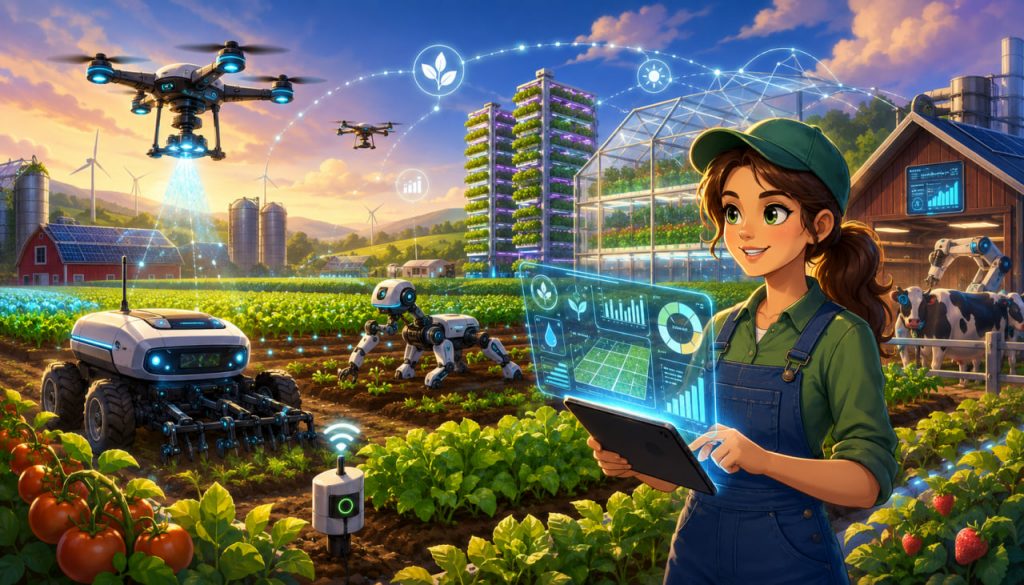
Agriculture in many regions faces a shortage of seasonal and skilled labor. Robotic systems are therefore likely to become more common in fields, orchards, greenhouses, livestock buildings, and food-processing facilities.
Future agricultural robots may perform tasks such as:
- Harvesting fruits and vegetables
- Removing weeds mechanically
- Applying treatments to individual plants
- Monitoring livestock
- Sorting produce
- Cleaning barns
- Transporting materials
- Inspecting crops at night
Small robots may gradually replace some extremely heavy machinery. A group of lightweight autonomous machines could plant, monitor, and treat crops with less soil compaction than a large tractor.
Fully autonomous farms will not appear everywhere at once. Expensive equipment, difficult terrain, safety requirements, maintenance, and unreliable rural connectivity will slow adoption.
Large commercial farms may introduce robotics quickly, while smaller producers may rely on rental services, cooperatives, or contractors that provide advanced machinery only when required.
Climate-Resilient Agriculture Will Become Essential
Agriculture is directly exposed to droughts, floods, heat waves, unpredictable rainfall, new pests, and changing growing seasons.
For this reason, the future of agribusiness will depend heavily on climate adaptation.
Farmers will increasingly use drought-tolerant and heat-resistant crop varieties. Improved irrigation, water recycling, soil-moisture monitoring, shade systems, wind protection, and adjusted planting dates will become more important.
Plant breeders will continue developing crops that:
- Require less water
- Resist diseases
- Tolerate heat or salinity
- Mature more quickly
- Use nutrients efficiently
- Survive unstable weather
FAO emphasizes that climate technologies can support adaptation, reduce greenhouse gas emissions, increase carbon storage, and improve food security. These technologies include not only equipment but also skills, agricultural practices, financing, and institutional capacity.
The future farm will need to produce food efficiently while remaining capable of recovering from extreme conditions.
Soil Health Will Receive Greater Attention
For decades, agricultural productivity was often measured primarily by the size of the harvest. In the future, soil condition will become a more important business indicator.
Healthy soil stores water, supports beneficial microorganisms, cycles nutrients, and reduces vulnerability to erosion.
More farms are likely to adopt practices such as:
- Crop rotation
- Cover crops
- Reduced tillage
- Compost application
- Managed grazing
- Agroforestry
- Improved residue management
These practices are often associated with regenerative agriculture. The term does not have one universal definition, but it generally describes farming methods intended to restore soil and ecosystem functions.
Digital monitoring will make it easier to measure soil carbon, biological activity, moisture, and nutrient movement. This may support new environmental payment systems, although reliable measurement and verification will remain difficult.
Greenhouses and Controlled Environments Will Expand
Controlled-environment agriculture includes greenhouses, vertical farms, hydroponic systems, and indoor growing facilities.
These systems allow producers to control temperature, lighting, humidity, water, and nutrients. They can reduce dependence on seasonal weather and place production closer to cities.
High-value leafy vegetables, herbs, seedlings, berries, and some specialty crops are especially suitable for controlled environments.
However, indoor farming is not a universal replacement for fields. Producing wheat, corn, rice, or other large commodity crops under artificial lighting would usually require enormous amounts of energy.
The strongest growth is likely to occur where controlled production offers a clear advantage: limited land, harsh climates, expensive imports, strict quality requirements, or demand for year-round fresh produce.
Biotechnology Will Accelerate Crop Improvement
Modern biotechnology can shorten the time required to develop useful plant and animal traits.
Gene editing tools can make precise changes in genetic material without necessarily introducing genes from unrelated species. Researchers are studying crops with improved nutrition, longer shelf life, disease resistance, and greater tolerance to environmental stress.
Biological products will also become more important. These include beneficial microorganisms, natural pest-control agents, biostimulants, and microbial fertilizers.
Such products may reduce dependence on some synthetic chemicals, but their effectiveness can vary with climate, soil, storage conditions, and application methods.
Biotechnology will be most valuable when it solves specific agricultural problems rather than being adopted simply because it is new.
Livestock Production Will Become More Data-Driven
Sensors attached to animals can already measure movement, feeding behavior, body temperature, rumination, and milk production.
Future livestock systems will use this information to detect illness earlier, improve breeding, optimize diets, and monitor animal welfare.
Automated milking, robotic feeding, camera-based weight estimation, and digital identification will become more widespread.
The environmental footprint of livestock will also receive greater attention. Researchers and businesses are developing improved feeds, manure-management systems, methane-reduction technologies, and more efficient breeding programs.
The OECD–FAO Outlook projects that livestock will account for much of the expected increase in direct agricultural greenhouse gas emissions over the coming decade, making efficiency and emission reduction especially important.
Food Supply Chains Will Become More Transparent
The future of agribusiness extends far beyond the farm.
Digital traceability systems will record where food was produced, how it was processed, when it was transported, and under what conditions it was stored.
Sensors can monitor temperature and humidity during delivery. Artificial intelligence can forecast demand and reduce overproduction. Improved packaging may extend shelf life, while automated inspection systems can detect defects and contamination.
Consumers and regulators are also demanding more information about sustainability, animal welfare, ingredients, labor conditions, and geographic origin.
Better traceability can help companies respond rapidly to food-safety problems and reduce unnecessary product recalls.
Expert Perspective
The OECD describes innovation and digitalization as transformative forces capable of improving productivity, sustainability, market access, and agricultural policy. At the same time, it warns that high initial costs, weak connectivity, limited training, privacy concerns, and the digital divide can prevent many farmers from benefiting.
This highlights a critical point: the future of agribusiness will depend not only on developing advanced technology but also on making it affordable, understandable, and accessible.
Without financing, reliable internet access, technical education, repair services, and clear data-ownership rules, technological progress could increase the gap between large agricultural corporations and small family farms.
Farmers Will Become Technology Managers
The role of the farmer will continue to evolve.
Future agricultural professionals may need to understand biology, climate science, machinery, software, finance, data analysis, and environmental regulation.
Manual work will remain important, but decision-making will increasingly involve digital dashboards, sensor alerts, robotic equipment, and predictive models.
This does not mean farming will become easy. Agricultural businesses will still face weather uncertainty, volatile prices, disease outbreaks, geopolitical disruption, and changing consumer demand.
The most successful producers will be those able to combine technology with flexibility, local knowledge, and careful financial management.
Interesting Facts
- Global agricultural and aquatic food production is projected to increase by approximately 13% between the mid-2020s and 2035.
- Agricultural robots can use computer vision to distinguish crops from weeds.
- Some precision planting systems can operate with accuracy measured in centimeters.
- Sensors can identify changes in animal behavior before visible symptoms of illness appear.
- Vertical farms may use significantly less land than conventional cultivation, although they often require substantial electricity.
- Gene editing can help researchers develop new crop traits faster than traditional breeding alone.
- Small autonomous machines may reduce soil compaction caused by heavy tractors.
- Agricultural data may become as commercially important as machinery, seeds, and fertilizer.
Glossary
- Agribusiness — The network of businesses involved in farming, agricultural supplies, food processing, transportation, and distribution.
- Precision Agriculture — Farming based on measuring and responding to variations within fields, crops, or livestock.
- Artificial Intelligence — Computer systems designed to perform tasks such as prediction, image recognition, and decision support.
- Remote Sensing — Collecting information from a distance through satellites, aircraft, drones, or sensors.
- Variable-Rate Technology — Equipment that changes the amount of seed, fertilizer, or crop treatment applied in different locations.
- Controlled-Environment Agriculture — Crop production in spaces where temperature, light, water, and other conditions are managed.
- Hydroponics — Growing plants without soil, usually in a nutrient-rich water solution.
- Vertical Farming — Producing crops in stacked indoor or greenhouse growing layers.
- Gene Editing — A group of technologies used to make targeted changes to genetic material.
- Biostimulant — A substance or microorganism intended to improve plant growth, nutrient use, or stress tolerance.
- Regenerative Agriculture — Farming approaches focused on improving soil health and restoring ecosystem functions.
- Traceability — The ability to track a product and its history through the supply chain.
- Soil Compaction — Compression of soil that reduces pore space and can restrict water movement and root growth.
- Agricultural Intensification — Increasing production from existing farmland through higher productivity or more efficient resource use.