Scrap metal is not simply unwanted waste. Old vehicles, broken appliances, construction steel, damaged machinery, electrical cables, aluminum cans, and manufacturing offcuts all contain materials that can return to industrial production.
Unlike many disposable products, metals can often be recovered repeatedly. Their value depends on the type of metal, purity, condition, local demand, and the cost of collection and processing.
The most responsible destination for usable scrap metal is a licensed recycling facility, not a landfill, roadside dumping site, or ordinary household waste bin.
What Is Scrap Metal?
Scrap metal includes metallic material left over from manufacturing or recovered from products that are damaged, obsolete, or no longer needed.
It generally falls into two main categories:
- Ferrous metals, which contain iron
- Non-ferrous metals, which contain little or no iron
Ferrous scrap includes carbon steel, cast iron, structural beams, vehicle bodies, pipes, tools, and many household appliances.
Non-ferrous scrap includes aluminum, copper, brass, bronze, zinc, lead, nickel, titanium, and various specialty alloys.
Iron and steel account for most of the world’s metal production by weight. USGS notes that the steel industry recycles large quantities of automobiles, cans, appliances, construction materials, and other products every year.
Why Scrap Metal Has Economic Value
Metal production begins with valuable raw materials and consumes energy, labor, transportation, and industrial equipment. When metal has already been extracted and processed, much of that embedded value remains inside the discarded product.
Recyclers purchase scrap because it can replace part of the virgin raw material needed by steel mills, foundries, smelters, and manufacturers.
Copper is usually worth more per kilogram than ordinary steel because it is more valuable and occurs in smaller quantities. Clean aluminum, brass, stainless steel, electric motors, and insulated cables may also have significant resale value.
Prices change according to:
- Global commodity markets
- Local industrial demand
- Metal purity
- Transportation costs
- Quantity
- Contamination
- Alloy composition
Correct sorting can substantially increase the value of scrap because mixed or contaminated metal requires more processing.
What Should You Do With Scrap Metal?
Small household items should be taken to an authorized recycling center, municipal collection site, or licensed scrap dealer.
Large objects such as vehicles, boilers, industrial equipment, and structural steel may require professional collection. Some recyclers provide containers or pickup services when the quantity is large enough.
Before delivering scrap, separate metals where possible. Remove ordinary household rubbish, soil, concrete, rubber, and plastic unless the recycler specifically accepts mixed products.
Useful preparation may include:
- Keeping steel separate from aluminum and copper
- Draining permitted machinery fluids safely
- Removing batteries where required
- Keeping cables and electronic components separate
- Protecting sharp edges
- Retaining proof of ownership for valuable items
Do not burn insulation from electrical wires. Open burning can release harmful pollutants and may violate environmental law.
Refrigerators, air conditioners, batteries, gas cylinders, electronic devices, and vehicles may contain refrigerants, oils, fuels, hazardous chemicals, or pressurized components. They should be handled through approved collection systems rather than dismantled casually.
How Ferrous and Non-Ferrous Metals Are Identified
A simple magnet can help with initial sorting.
Ordinary carbon steel and cast iron are usually magnetic. Aluminum, copper, brass, zinc, and lead are generally not attracted to a household magnet.
However, this test is not perfect. Some stainless steels are magnetic, while others are not. Coatings and mixed construction can also make identification difficult.
Professional recyclers use additional methods, including:
- Visual inspection
- Density testing
- Spark testing
- Electrical conductivity
- X-ray fluorescence analyzers
- Laser-based composition analysis
Accurate alloy identification is increasingly important because modern products may contain carefully engineered combinations of chromium, nickel, molybdenum, manganese, and other elements.
What Happens at a Scrap Yard?
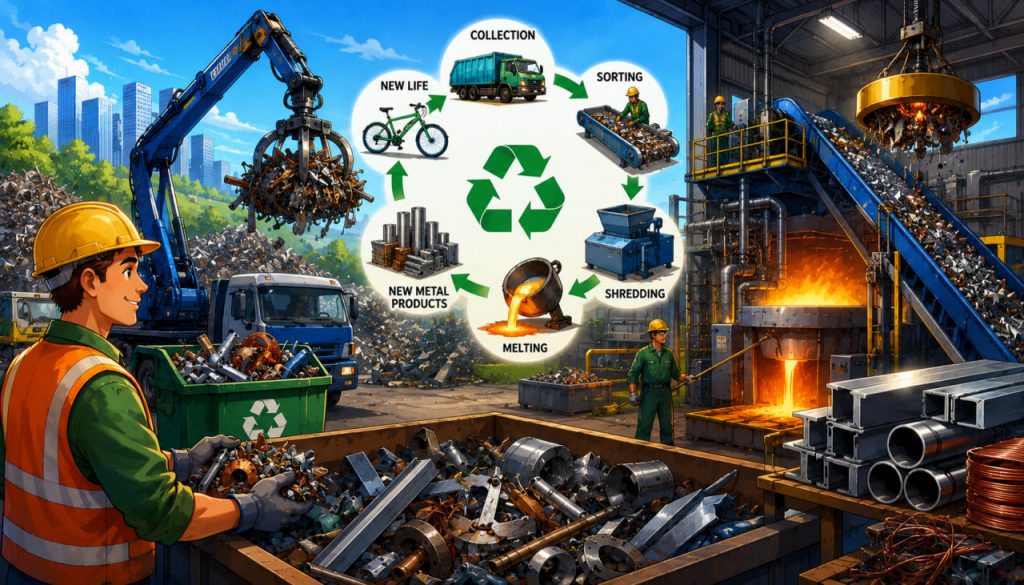
After delivery, the material is weighed, inspected, classified, and checked for unacceptable or dangerous contents.
Large steel objects may be cut with hydraulic shears or torches. Vehicles and appliances can be processed in powerful shredders that break them into smaller pieces.
The resulting mixture may pass through several separation systems.
Magnets lift ferrous metal from the processing line. Eddy-current separators repel conductive non-ferrous metals such as aluminum. Screens, air systems, sensors, and manual sorting remove plastics, glass, foam, dirt, and other materials.
EPA documents describe cutting, crushing, flattening, and sorting as common processes used to prepare scrap metal for recycling and improve its handling or value.
The prepared metal is then compressed into bales, cut into furnace-ready pieces, or loaded in bulk for transportation.
How Scrap Becomes New Metal
Sorted scrap is delivered to a steel mill, foundry, or secondary smelter.
Steel scrap is commonly melted in an electric arc furnace, where powerful electrical energy produces the temperatures required to create molten steel. Scrap may also be used with other iron-bearing materials in different steelmaking routes.
Aluminum, copper, and other non-ferrous metals are melted in specialized furnaces. Before casting, operators remove impurities and adjust the chemical composition to meet a specific alloy standard.
The molten metal is then cast into forms such as:
- Billets
- Slabs
- Ingots
- Rods
- Sheets
- New components
These products return to manufacturing and may become vehicles, buildings, packaging, machinery, cables, household products, or infrastructure.
Why Recycling Metal Matters
Metal recycling reduces the need to extract and process some virgin ores. It can also conserve energy, reduce landfill use, and limit the accumulation of abandoned metal products.
USGS states that remelting steel scrap requires considerably less energy than producing iron and steel from ore.
World Steel Association data indicate that around 680 million tonnes of steel were recycled globally in 2021. The organization estimates that this avoided more than one billion tonnes of carbon dioxide that would otherwise have been associated with virgin steel production.
Recycling one tonne of steel scrap can also avoid the use of substantial quantities of iron ore, coal, and limestone, although exact savings depend on production technology and the material being replaced.
Scrap is therefore both a waste-management resource and an important industrial raw material.
Can Metal Be Recycled Forever?
Metals do not decompose in the same way as paper fibers or many plastics. In principle, steel, aluminum, copper, and several other metals can be melted and reused repeatedly.
However, recycling is not automatically lossless.
Some metal is lost through corrosion, oxidation, fine particles, collection failures, and processing residues. Products may also combine several materials so tightly that complete separation becomes difficult.
Another major problem is contamination between alloys. For example, unwanted copper in certain steel grades can affect surface quality, while mixed aluminum alloys may be unsuitable for high-performance applications without careful sorting.
This is why modern recycling increasingly depends on sensor-based identification and design for disassembly, in which products are created so that valuable parts can be separated more easily at the end of their service life.
Scrap Metal From Cars, Buildings, and Electronics
The fate of scrap depends strongly on its source.
Old vehicles are drained of fluids and stripped of reusable or regulated components before shredding. Steel and non-ferrous metals are recovered, while the remaining mixture requires further treatment.
Buildings produce large quantities of beams, reinforcing steel, pipes, roofing, cables, and aluminum frames. Selective demolition can preserve longer sections for direct reuse instead of immediately melting them.
Electronic waste contains copper, aluminum, steel, gold, silver, palladium, and other valuable materials. It may also contain batteries, leaded components, flame retardants, and substances requiring controlled processing.
EPA recognizes specialized systems for recovering precious metals such as gold, silver, platinum, palladium, and rhodium from recyclable materials.
When Scrap Metal Becomes Dangerous
Not every metallic object is safe to place in an ordinary scrap container.
Sealed cylinders may explode when cut or shredded. Batteries can cause fires. Closed tanks may contain fuel or chemicals. Military items, ammunition, medical devices, and industrial instruments may present additional risks.
Radioactive sources occasionally enter scrap streams through improperly discarded industrial or medical equipment. If one is melted, it can contaminate equipment and newly produced metal. EPA therefore warns that radioactive material in scrap requires specialized detection and control.
Anyone who discovers an unidentified sealed device, radiation symbol, suspicious cylinder, or potentially explosive object should leave it undisturbed and contact the appropriate local authority.
Reuse Can Be Better Than Melting
Recycling is valuable, but it is not always the first choice.
EPA’s waste-management hierarchy places reduction and reuse ahead of recycling where they are practical.
A functional machine, steel beam, motor, tool, railway component, or architectural element may retain more value when repaired and reused than when sold by weight and melted.
Direct reuse preserves the energy and work already invested in manufacturing the finished product. It can also reduce demand for newly manufactured replacements.
The best options generally follow this order:
Use longer, repair, reuse, recover components, recycle the metal, and dispose only of material that cannot be safely recovered.
Expert Perspective
The World Steel Association describes steel as the world’s most recycled material and emphasizes that scrap is essential to lower-emission steelmaking. However, it also explains that available scrap cannot currently satisfy all global steel demand because much of the steel produced today remains locked inside buildings, vehicles, and infrastructure for decades.
This highlights the real future of scrap metal: its role will grow as more existing products reach the end of their useful lives, but primary metal production will still be required while global demand exceeds the supply of recoverable scrap.
Better collection, cleaner sorting, product traceability, and easier disassembly will determine how efficiently that expanding resource is used.
Interesting Facts
- Steel is separated easily from many waste mixtures because powerful magnets can attract it.
- Copper recovered from electrical wiring is often more valuable than ordinary steel scrap.
- The automobile is a major source of obsolete ferrous scrap in the United States.
- In 2024, metals represented more than half of the recyclable raw materials exported from the European Union by weight.
- Some recycling facilities use handheld X-ray instruments to identify an alloy within seconds.
- Aluminum does not rust like ordinary steel, but it forms a protective oxide layer.
- A demolished steel component may be reused directly if its condition and structural history can be verified.
- Scrap prices can change daily because they are linked to industrial demand and global commodity markets.
- Tiny quantities of copper, tin, nickel, or chromium can significantly change the properties of a metal alloy.
- Modern shredding plants can process complete vehicles after hazardous fluids and regulated parts have been removed.
Glossary
- Scrap Metal — Discarded or surplus metal suitable for reuse, processing, or recycling.
- Ferrous Metal — Metal containing iron, particularly steel and cast iron.
- Non-Ferrous Metal — Metal containing little or no iron, such as aluminum, copper, brass, or zinc.
- Alloy — A metallic material made by combining a metal with one or more additional elements.
- Smelter — An industrial facility that extracts or recovers metal through high-temperature processing.
- Electric Arc Furnace — A furnace that uses powerful electric arcs to melt steel and other metallic materials.
- Eddy-Current Separator — A machine that uses changing magnetic fields to separate conductive non-ferrous metals.
- Bale — A compact block of scrap compressed to simplify storage and transportation.
- Shredding — Mechanical breaking of large products into smaller pieces for separation and processing.
- Secondary Metal — Metal produced from recycled material rather than directly from mined ore.
- Contamination — Unwanted materials or alloying elements that reduce scrap quality.
- Design for Disassembly — Designing a product so its components can be separated easily for repair, reuse, or recycling.
- Obsolete Scrap — Metal recovered from products that have reached the end of their useful life.
- Industrial Scrap — Metal offcuts, rejects, and residues created during manufacturing.
- Circular Economy — A system intended to keep products and materials in use while minimizing waste and resource extraction.