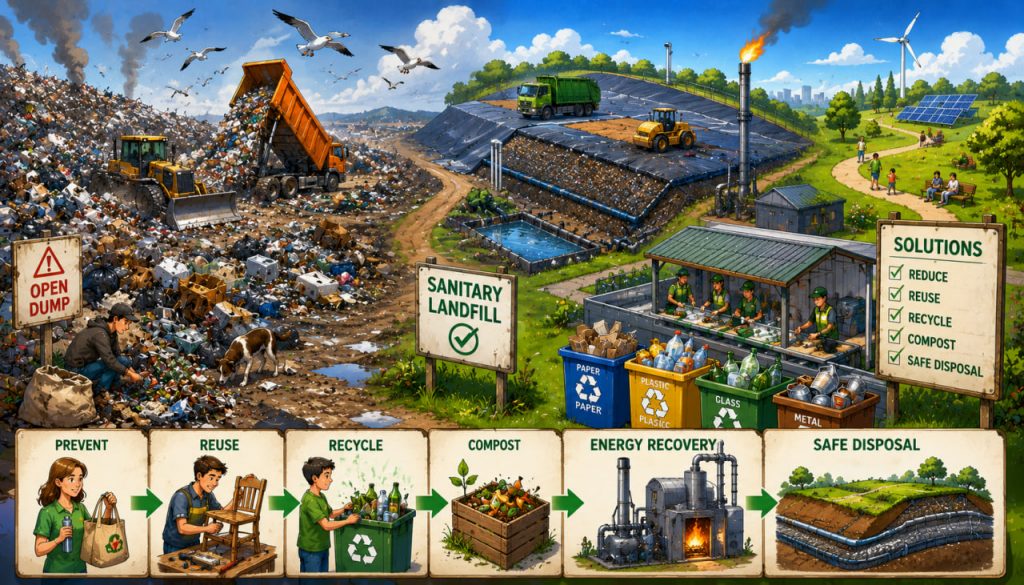
Landfills are often imagined as chaotic mountains of rubbish surrounded by birds, smoke, and unpleasant odors. Some waste sites really do look like this, especially uncontrolled open dumps where garbage is deposited without environmental protection.
A modern sanitary landfill is different. It is an engineered facility designed to isolate residual waste, collect contaminated liquid, control gas, reduce pests, and monitor environmental conditions for many years.
However, even a well-managed landfill remains the final destination for materials that were not prevented, reused, composted, or recycled. The best long-term strategy is not simply to build better landfills, but to reduce how much valuable and biodegradable material enters them.
What Does a Landfill Look Like?
An active landfill usually resembles a large industrial earthworks site rather than a single permanent pile of exposed rubbish.
Trucks arrive through a controlled entrance and are often weighed before unloading. Waste is deposited in a designated working area, spread by heavy machinery, and compressed into dense layers.
Only a limited section may remain uncovered during normal operation. The rest is covered with soil or another approved material to reduce odors, windblown litter, insects, rodents, and fire risk. The U.S. Environmental Protection Agency identifies frequent compaction and covering as standard operating practices at regulated municipal solid-waste landfills.
A large site may also contain:
- Access roads and weighing stations
- Waste-inspection areas
- Stormwater channels
- Leachate-storage tanks
- Gas-collection pipes
- Monitoring wells
- Flares or energy-generation equipment
- Workshops and maintenance buildings
- Completed sections covered with vegetation
From a distance, a closed landfill can resemble an artificial hill. Beneath the grass, however, several layers of waste, drainage materials, barriers, pipes, and monitoring equipment may remain active.
Open Dump or Sanitary Landfill?
An open dump is an uncontrolled disposal site where waste may be deposited directly on the ground without adequate liners, daily cover, leachate treatment, gas control, or security.
Open dumps can contain burning waste, scavenging animals, hazardous materials, unstable slopes, polluted runoff, and people recovering recyclables under dangerous conditions.
The World Bank reports that almost one-third of global waste is either openly dumped or not collected at all. The problem is particularly severe in lower-income regions where collection and treatment systems have not kept pace with population growth and urbanization.
A sanitary landfill is carefully located, engineered, operated, and monitored. Modern facilities are intended to reduce the movement of contaminants into soil, groundwater, and surrounding communities.
A sanitary landfill manages waste risks; an open dump largely transfers those risks to the environment and nearby population.
What Is Hidden Under the Waste?
A modern landfill is constructed in sections called cells.
At the bottom, a liner system creates a barrier between the waste and the surrounding ground. It may include compacted clay, synthetic geomembranes, or a combination of materials.
Above the liner is a drainage layer containing perforated pipes. These pipes collect leachate, the contaminated liquid created when rainwater and moisture pass through waste and dissolve organic matter, chemicals, and fine particles.
The leachate is pumped out and transported or directed to an appropriate treatment system. EPA guidance explains that leachate-collection systems are positioned above the liner and remove liquid for treatment and disposal.
Without effective containment, leachate can contaminate groundwater and surface water. This is one of the most serious risks associated with poorly designed or unmanaged disposal sites.
Why Landfills Produce Methane
Food scraps, paper, wood, garden waste, and other biodegradable materials decompose in the oxygen-poor environment inside a landfill.
Microorganisms gradually break them down, generating landfill gas composed mainly of methane and carbon dioxide, along with smaller amounts of other compounds.
Methane is combustible and contributes strongly to near-term climate warming. If gas accumulates without control, it can migrate through the ground, create odors, increase fire risk, or enter nearby structures.
Modern landfills may collect gas through horizontal and vertical wells connected to a pipe network. The collected gas can be:
- Burned in a flare
- Used to generate electricity
- Used directly as industrial fuel
- Upgraded into pipeline-quality renewable gas
- Processed for vehicle fuel
EPA describes these energy uses but also emphasizes that collection systems require proper monitoring and maintenance.
Capturing methane is beneficial, but preventing food and other organic waste from entering landfills is often more effective than trying to capture every molecule after decomposition begins.
What Problems Can Landfills Cause?
Even engineered facilities can affect surrounding areas if they are badly located, poorly managed, overloaded, or inadequately maintained.
Potential problems include:
- Odors
- Litter carried by wind
- Noise and truck traffic
- Dust
- Birds, insects, and rodents
- Landfill fires
- Methane leakage
- Leachate escape
- Slope instability
- Long-term land-use restrictions
Communities may also raise concerns about property values, environmental justice, and the concentration of waste infrastructure in disadvantaged areas.
Landfills require management long after they stop accepting waste. European landfill rules, for example, require post-closure monitoring and aftercare that may continue for at least 30 years, depending on the site and national implementation.
How Is a Landfill Closed?
When a landfill cell reaches its approved capacity, operators reshape and seal the surface.
A final cover usually includes a low-permeability barrier designed to reduce rainwater entering the waste. Additional layers provide drainage, protect the barrier, support vegetation, and control erosion.
Gas and leachate systems continue operating after closure. Groundwater, settlement, surface conditions, and emissions may also require regular monitoring.
The waste mass gradually compresses as materials decompose and voids collapse. This process can cause uneven settlement, which limits what can safely be built on the site.
Closed landfills have been converted into:
- Public parks
- Walking and cycling areas
- Solar-energy sites
- Wildlife habitats
- Golf courses
- Storage or light industrial land
- Viewpoints and landscaped hills
Buildings with deep foundations are more difficult because the ground may continue moving and producing gas.
Can an Old Dump Be Cleaned Up?
Yes, but the best method depends on the site.
An uncontrolled dump may first need to be fenced, mapped, stabilized, and prevented from receiving more waste. Fires must be extinguished, dangerous materials isolated, drainage controlled, and informal workers protected or integrated into safer employment.
The waste can then be managed in several ways.
Closure in place involves reshaping the dump, adding a cover, controlling water, collecting gas where practical, and monitoring the site.
Excavation and relocation involves digging up the waste and moving it to a properly engineered facility. This may provide stronger environmental protection but can be extremely expensive and disruptive.
Landfill mining involves excavating old waste to recover metals, soil-like material, or combustible fractions while reclaiming landfill space. Results vary because old waste is often wet, degraded, contaminated, and difficult to separate economically.
World Bank waste programs commonly combine dump closure with better collection, sanitary disposal, organic-waste diversion, recycling, and stronger local governance.
What Should Be Done Before Waste Reaches a Landfill?
Landfills should receive only the residual material that cannot be managed safely and reasonably through better options.
A stronger waste system follows a hierarchy:
- Prevent unnecessary waste.
- Repair and reuse products.
- Separate recyclable materials.
- Compost or digest organic waste.
- Recover useful energy where appropriate.
- Landfill the remaining residue safely.
Food and garden waste should be separated because they create much of the methane and leachate associated with mixed municipal waste.
Metals, clean paper, cardboard, glass, and suitable plastics should be recovered when functioning markets and processing systems exist.
Hazardous waste, batteries, electronic equipment, chemicals, medical waste, and pressurized containers require specialized handling. Mixing them with ordinary municipal rubbish increases risks for workers, machinery, fires, emissions, and groundwater.
Expert Perspective
The United Nations Environment Programme’s Global Waste Management Outlook 2024 examines waste as both an environmental burden and a resource-management failure. Its analysis emphasizes that moving toward waste prevention and circular systems can reduce pollution while creating wider economic and social benefits.
World Bank waste specialist Silpa Kaza has similarly argued that environmentally sound waste management is fundamental to healthy, sustainable, and inclusive communities, yet it is frequently overlooked in urban planning.
These perspectives point to the same principle: a landfill can be engineered more safely, but it cannot replace a complete waste-management system.
What Is the Future of Landfills?
Future landfills will probably contain fewer recyclable and biodegradable materials.
Digital weighing, vehicle tracking, methane sensors, drones, thermal cameras, and automated monitoring can make operations more transparent. Improved gas systems may recover more energy, while better covers can reduce water infiltration and emissions.
Some sites may operate as resource-recovery hubs where reusable goods, construction materials, metals, green waste, and hazardous items are separated before residual waste is buried.
Bioreactor landfills represent another approach. They intentionally add controlled liquids, and sometimes air, to accelerate microbial activity and stabilize waste more quickly than conventional “dry tomb” landfills.
Yet technology cannot solve unlimited waste generation. The most successful cities will measure progress not only by how safely they bury rubbish, but by how little material they need to bury at all.
Interesting Facts
- An active landfill is usually divided into separate cells rather than filled as one enormous open pit.
- Heavy compactors repeatedly drive over waste to reduce its volume.
- A closed landfill may continue producing gas and leachate for decades.
- Some landfill gas is upgraded and injected into natural-gas pipelines.
- Modern sites use groundwater wells to detect possible contamination.
- Old landfills can settle unevenly because buried waste continues decomposing.
- Solar panels are sometimes installed on closed landfill surfaces.
- Landfill fires can burn underground and may be difficult to extinguish.
- Almost one-third of global waste is openly dumped or remains uncollected.
- Preventing organic waste from entering landfills can reduce methane generation.
Glossary
- Landfill — A designated facility where residual waste is placed and permanently contained.
- Open Dump — An uncontrolled waste-disposal site lacking adequate environmental protection.
- Sanitary Landfill — An engineered and regulated landfill with systems for containment, operation, and monitoring.
- Landfill Cell — A defined section in which waste is placed, compacted, and covered.
- Liner — A low-permeability barrier installed beneath waste to reduce contaminant movement.
- Leachate — Polluted liquid that forms when water passes through waste.
- Landfill Gas — Gas produced during waste decomposition, composed mainly of methane and carbon dioxide.
- Methane — A combustible greenhouse gas generated when organic waste decomposes without oxygen.
- Daily Cover — Soil or another approved material placed over recently deposited waste.
- Final Cover — The protective multilayer cap installed when a landfill closes.
- Aftercare — Monitoring and management performed after a landfill stops accepting waste.
- Waste Diversion — Keeping materials away from landfill through prevention, reuse, recycling, or biological treatment.
- Landfill Mining — Excavating buried waste to recover materials, reclaim space, or remediate a site.
- Anaerobic Digestion — Controlled decomposition of organic material without oxygen to produce biogas and digestate.
- Circular Economy — A system designed to preserve the value of products and materials while minimizing waste.