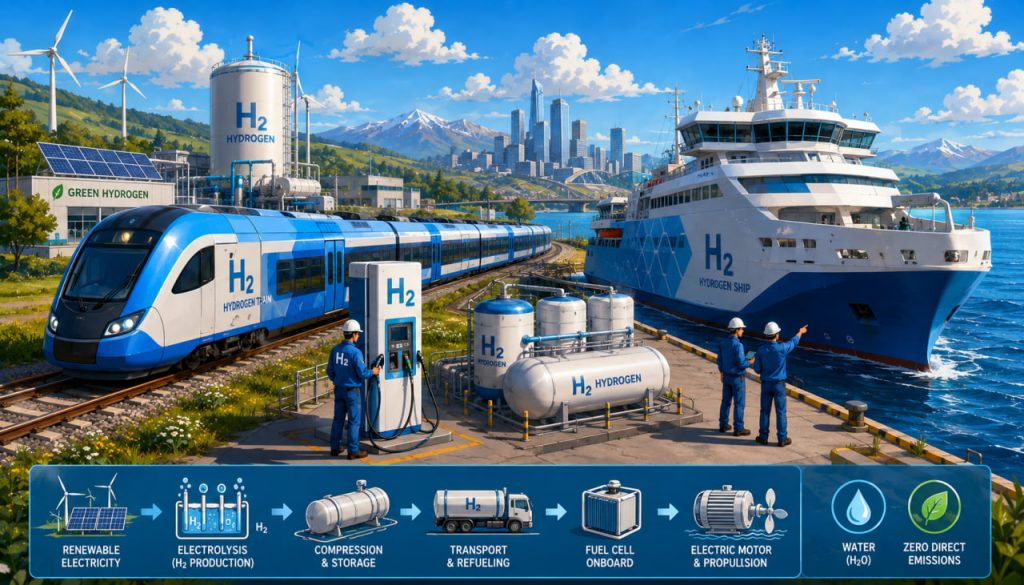
Battery-electric cars are becoming common, but heavy transport presents a more difficult engineering challenge. Ships and trains must sometimes travel long distances, carry substantial loads, and operate where charging infrastructure or overhead power lines are unavailable.
Hydrogen offers one possible solution. It can power electric motors through fuel cells, provide longer operating ranges than some battery systems, and be refuelled relatively quickly.
However, hydrogen is not automatically cleaner or more efficient than direct electrification. Its strongest role is likely to be in selected routes where batteries or continuous electrical connections are technically difficult or prohibitively expensive.
How Hydrogen Propulsion Works
Hydrogen vehicles are usually electric vehicles in a broader technical sense.
In a fuel-cell train or ship, hydrogen is stored in pressurized or cryogenic tanks. It enters a fuel-cell stack, where an electrochemical reaction combines it with oxygen from the air.
This process generates:
- Electricity
- Water
- Heat
The electricity powers motors that turn the wheels or propellers. A battery is commonly added to provide extra power during acceleration and recover energy through regenerative braking or variable vessel operation.
Unlike an internal-combustion engine, a fuel cell does not burn hydrogen. When pure hydrogen is used, its direct exhaust contains no carbon dioxide and mainly consists of water vapor.
The environmental impact still depends on how the hydrogen was produced.
Why Heavy Transport Is Hard to Electrify
Direct electrification is usually the most energy-efficient option because electricity travels from the grid to a motor with relatively few conversion steps.
Hydrogen requires additional stages:
- Electricity powers an electrolyser.
- The electrolyser produces hydrogen from water.
- Hydrogen is compressed, liquefied, or chemically converted.
- It is transported and stored.
- A fuel cell converts it back into electricity.
Energy is lost at every stage.
Nevertheless, batteries become heavy and bulky when a vehicle requires very long range. Ships also have limited space for energy storage, while some railway lines carry too little traffic to justify installing overhead electrical equipment.
Hydrogen may therefore be useful where range, payload, rapid refuelling, and infrastructure constraints outweigh its lower overall efficiency.
Hydrogen Trains for Non-Electrified Railways
Much of the world’s rail network is not electrified. Diesel trains remain common on regional lines, freight routes, industrial branches, and remote railway sections.
A hydrogen train can replace a diesel multiple unit without requiring overhead wires along the entire route. It carries its fuel and electricity-generating equipment onboard.
Fuel-cell trains are particularly suited to:
- Regional passenger routes
- Long non-electrified lines
- Routes with infrequent services
- Areas where overhead electrification is unusually expensive
- Industrial and maintenance operations
- Some freight and shunting applications
Hydrogen trains can provide quieter operation and eliminate diesel exhaust along the route. They can also reuse much of the operational structure of conventional railways, including established timetables and depots.
Europe’s Rail is developing hydrogen hybrid systems for passenger, freight, inspection, and maintenance vehicles, while battery trains under the same research programme are targeting progressively longer autonomous ranges.
Why Hydrogen Is Not the Best Choice for Every Train
When a railway is busy, permanent electrification usually makes more sense. Overhead wires deliver electricity directly to trains without carrying large fuel tanks or repeatedly converting energy.
Battery trains may also be preferable on shorter non-electrified sections. A train can charge under overhead wires, at stations, or at dedicated charging points and then continue on battery power.
A 2025 European rail analysis found that battery-electric trains are generally expected to cost less than hydrogen trains while producing very low emissions.
Hydrogen becomes more attractive when routes exceed practical battery range and are not busy enough to justify full electrification.
This creates a likely hierarchy:
Overhead electrification for heavily used routes, batteries for shorter gaps, and hydrogen for selected long or operationally demanding non-electrified lines.
Hydrogen Ships and Maritime Fuel Cells
Ships range from small ferries to enormous container vessels crossing oceans. Their energy requirements differ so dramatically that no single clean technology can replace marine fuel everywhere.
Hydrogen fuel cells are already most practical for:
- Passenger ferries
- Harbour vessels
- Tugboats
- River craft
- Research ships
- Offshore-support vessels
- Short-sea shipping
These ships often follow predictable routes and return regularly to the same port. This makes centralized hydrogen production, storage, and refuelling more manageable.
Fuel cells also offer quiet operation with reduced vibration, which can improve passenger comfort and benefit research vessels using sensitive acoustic equipment.
Batteries may handle short journeys, manoeuvring, and peak power, while hydrogen extends the range. Hybrid battery–fuel-cell systems are therefore more likely than hydrogen-only propulsion in many early vessels.
The Storage Challenge at Sea
Hydrogen contains substantial energy per kilogram but very little energy per unit of volume.
Compressed hydrogen requires strong, bulky tanks. Liquid hydrogen occupies less space but must be cooled to approximately −253°C. Maintaining this temperature requires highly insulated cryogenic equipment, and some hydrogen may gradually evaporate.
Space is extremely valuable aboard cargo ships. Larger fuel tanks reduce the room available for passengers or freight.
Hydrogen molecules are also extremely small. They can leak through some seals and affect certain metals, so equipment must be designed specifically for hydrogen service.
The International Maritime Organization approved interim safety guidelines for ships using hydrogen as fuel in 2026. These address the special design, ventilation, detection, storage, fire-protection, and operational requirements associated with hydrogen.
Can Hydrogen Power Ocean-Going Ships?
Technically, hydrogen can power large ships. Economically and practically, direct hydrogen storage becomes difficult on long ocean voyages.
For this reason, the maritime industry is also studying hydrogen-derived fuels such as ammonia and methanol. These fuels are easier to store than pure hydrogen, although they introduce their own efficiency losses, toxicity risks, emissions, and safety requirements.
Large ships may eventually use combinations of:
- Fuel cells
- Hydrogen-capable engines
- Ammonia or methanol
- Batteries
- Wind-assisted propulsion
- More efficient hulls and operations
DNV reports that hydrogen, ammonia, and onboard carbon capture have entered early maritime trials, while fuel availability and infrastructure remain major barriers to wider adoption.
Direct hydrogen is therefore more likely to develop first in coastal and short-distance shipping than in the largest intercontinental vessels.
Green, Blue, and Fossil-Based Hydrogen
Hydrogen is an energy carrier, not a primary energy source. It must be manufactured.
Most hydrogen is currently produced from natural gas or coal. Without effective carbon management, this process creates substantial greenhouse gas emissions.
The International Energy Agency reported that low-emissions hydrogen still represented less than 1% of global hydrogen production in 2025.
Renewable hydrogen is produced through electrolysis powered by low-carbon electricity. Its climate performance can be strong when additional wind, solar, hydroelectric, or nuclear generation supplies the electrolyser.
Hydrogen produced from fossil gas with carbon capture is often described as blue hydrogen. Its actual emissions depend on methane leakage, carbon-capture performance, energy use, and the complete supply chain.
A hydrogen train or ship is only genuinely low-carbon when its fuel is produced with very low lifecycle emissions.
Refuelling Infrastructure and Cost
Hydrogen transport requires more than new vehicles. Operators need production plants, compressors or liquefaction systems, storage tanks, delivery equipment, refuelling stations, trained staff, and emergency procedures.
This infrastructure can be expensive when only a few vehicles use it. Projects become more attractive when several trains, ships, buses, trucks, or industrial facilities share a hydrogen hub.
Ports are promising locations because they already handle fuels and serve multiple industries. Railway depots offer a similar advantage: fleets return to a controlled location where one refuelling installation can serve many trains.
Hydrogen prices remain a major challenge. Electrolysers, renewable electricity, storage, transport, and low equipment utilization can make renewable hydrogen substantially more expensive than diesel or grid electricity.
Safety: Manageable but Different
Hydrogen is highly flammable and ignites easily. Its flame can be difficult to see, and gas escaping into an enclosed space may create a dangerous mixture with air.
At the same time, hydrogen is lighter than air and disperses rapidly outdoors when ventilation is good.
Safe operation requires:
- Leak detection
- Strong ventilation
- Carefully positioned tanks
- Pressure-relief systems
- Fire-resistant separation
- Suitable materials
- Staff training
- Emergency shutdown procedures
Hydrogen is not uniquely impossible to manage. Diesel, liquefied natural gas, batteries, ammonia, and methanol all have distinct hazards. The essential requirement is designing the vehicle and infrastructure around the properties of the chosen fuel.
Expert Perspective
The International Energy Agency identifies hydrogen as potentially valuable in sectors that are difficult to electrify directly. It also emphasizes that low-emissions production must expand rapidly, because today’s hydrogen supply remains overwhelmingly fossil-based.
European rail research points toward a technology mix rather than a single winner. Continuous electrification remains attractive on busy lines, batteries can bridge shorter gaps, and hydrogen may support longer non-electrified routes and specialized heavy-duty vehicles.
Hydrogen ships and trains should not be viewed as universal replacements for battery-electric transport. They are specialized electric transport systems designed for routes where direct grid power or batteries alone are insufficient.
Interesting Facts
- A hydrogen fuel-cell vehicle uses an electric motor rather than relying solely on a traditional combustion engine.
- Fuel cells produce electricity continuously while hydrogen and oxygen are supplied.
- Most hydrogen trains include batteries to capture braking energy and provide additional power.
- Hydrogen trains can operate on railway lines without overhead wires.
- Liquid hydrogen must be stored at temperatures close to absolute zero.
- Almost invisible hydrogen flames require specialized detection systems.
- Ports may become hydrogen hubs serving ships, trucks, industry, and power generation.
- Fuel cells are quieter and create less vibration than large diesel engines.
- Hydrogen occupies much more space than diesel for an equivalent amount of usable energy.
- A busy railway is generally easier to decarbonize through direct electrification than through hydrogen.
- Renewable hydrogen can store electricity produced when wind or solar output exceeds immediate demand.
- Hydrogen-derived ammonia contains no carbon, but its toxicity and possible nitrogen-oxide emissions require careful management.
Glossary
- Hydrogen — A light chemical element that can carry and deliver energy.
- Fuel Cell — An electrochemical device that converts hydrogen and oxygen into electricity, heat, and water.
- Electrolyser — Equipment that uses electricity to split water into hydrogen and oxygen.
- Renewable Hydrogen — Hydrogen produced using renewable electricity, usually through electrolysis.
- Fuel-Cell Electric Vehicle — A vehicle whose electric motor receives power from a hydrogen fuel cell.
- Battery Hybrid — A system combining a fuel cell or engine with an electrical battery.
- Regenerative Braking — Recovery of motion energy during braking and its conversion into electricity.
- Railway Electrification — Supply of electricity to trains through overhead wires or conductor rails.
- Catenary — The overhead wire system that delivers electricity to a train.
- Cryogenic Storage — Storage of a substance at an extremely low temperature.
- Energy Density — The quantity of energy stored per unit of mass or volume.
- Hydrogen Embrittlement — Weakening of certain metals after hydrogen enters their structure.
- Lifecycle Emissions — Emissions generated across fuel production, transport, storage, and use.
- Hydrogen Hub — A location where several producers and consumers share hydrogen infrastructure.
- Short-Sea Shipping — Maritime transport over relatively short coastal or regional routes.
- Shunting Locomotive — A locomotive used to move railway vehicles within yards, terminals, or industrial sites.
- Ammonia — A nitrogen-and-hydrogen compound that can serve as a fuel or hydrogen carrier.
- Bunkering — Supplying fuel to a ship.
- Direct Electrification — Powering transport directly with electricity rather than converting it into another fuel.
- Well-to-Wake Emissions — The full emissions produced from marine-fuel creation through final use aboard a vessel.