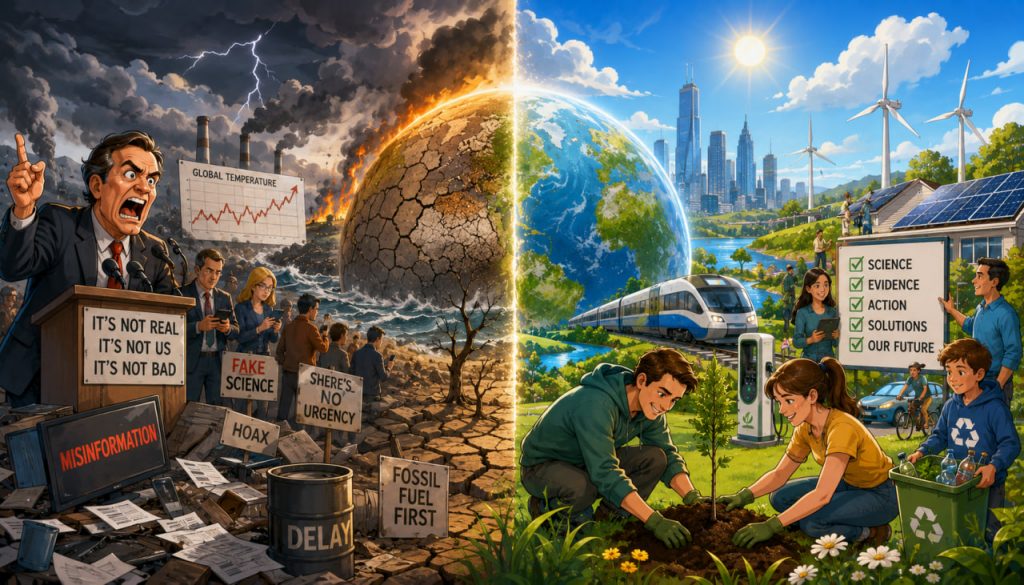
Climate skepticism ranges from reasonable questions about specific forecasts or policies to organized efforts that reject well-established evidence about human-caused global warming.
Scientific questioning is essential. Researchers constantly test measurements, improve climate models, and debate the effectiveness of different solutions. The danger begins when legitimate uncertainty is used to imply that scientists know nothing, climate change is imaginary, or action should be postponed indefinitely.
Climate denial does not merely distort an academic discussion. It delays decisions about energy, infrastructure, agriculture, public health, disaster preparation, and the safety of future generations.
What Is Climate Skepticism?
In its constructive form, skepticism means asking whether evidence is reliable, methods are transparent, and conclusions are justified.
That is already part of climate science. Temperature records are checked against independent datasets, satellite observations are compared with ground measurements, and climate models are tested against past and present conditions.
Problematic climate skepticism works differently. It often begins with a predetermined conclusion and dismisses any evidence that contradicts it.
Common claims include:
- The climate has always changed, so current warming must be natural.
- Scientists disagree about whether humans are causing warming.
- Cold weather disproves global warming.
- Carbon dioxide is too small a part of the atmosphere to matter.
- Climate models are imperfect, so they are useless.
- Reducing emissions would be more dangerous than climate change itself.
These statements typically mix a small element of truth with a misleading conclusion.
What Climate Science Actually Shows
Earth’s climate has changed naturally throughout its history. However, the causes of past changes do not explain the speed and pattern of modern warming.
The Intergovernmental Panel on Climate Change states that human activities, principally greenhouse gas emissions, have unequivocally caused global warming. Global surface temperature in 2011–2020 was approximately 1.1°C above the 1850–1900 average.
The evidence does not come from one thermometer or one computer model. It includes:
- Surface-temperature measurements
- Satellite observations
- Ocean heat records
- Melting glaciers and ice sheets
- Rising sea levels
- Changes in seasons and ecosystems
- Atmospheric greenhouse gas measurements
- Paleoclimate records from ice cores, corals, and sediments
NASA describes the evidence that Earth is warming as unequivocal and identifies human activity as the principal cause. It also notes that the heat-trapping properties of carbon dioxide have been understood experimentally since the nineteenth century.
Weather Does Not Disprove Climate Change
Weather describes short-term atmospheric conditions. Climate describes patterns measured across much longer periods.
A cold day, heavy snowfall, or unusually cool season can occur in a warming world. Global warming does not eliminate natural variability or local winter weather.
Imagine walking up a hill while repeatedly stepping up and down. Individual downward steps do not change the overall upward direction.
Climate change affects probabilities and long-term averages. It can increase the frequency or intensity of some heatwaves, heavy rainfall events, drought conditions, and coastal flooding without causing every individual disaster.
One local weather event cannot establish or disprove a global climate trend.
Scientific Uncertainty Is Not Scientific Ignorance
Climate scientists do not know every future detail. They cannot predict the exact temperature or rainfall in every city decades in advance.
However, uncertainty about magnitude, location, or timing does not erase knowledge about the underlying risk.
Doctors may not know exactly when a smoker will develop disease, but that uncertainty does not make smoking harmless. Engineers may not know exactly when a weakened structure will fail, but they still manage the risk.
Climate models use different assumptions about population, energy use, technology, economic development, and emissions. This creates a range of possible outcomes rather than one perfectly fixed future.
The IPCC reports that risks, losses, and damages increase with every additional increment of warming.
Uncertainty is a reason to manage danger carefully, not a reason to ignore it.
Why Climate Denial Delays Essential Action
Energy systems, buildings, transport networks, and industrial facilities often remain in service for decades.
When a city builds new fossil-fuel-dependent infrastructure, it may lock in emissions and operating costs long into the future. Delayed action can therefore make later reductions faster, more disruptive, and more expensive.
Climate skepticism can also delay adaptation. Communities may postpone:
- Flood defenses
- Heat-response plans
- Wildfire management
- Water-security measures
- Resilient electricity networks
- Climate-conscious building standards
- Protection for hospitals and vulnerable populations
NASA emphasizes that every avoided increment of future warming reduces impacts. The situation is serious, but the amount of future damage still depends on human choices.
The dangerous message is not only “climate change is false.” Another harmful message is “nothing can be done,” because fatalism produces the same practical result: inaction.
The Health Consequences Are Already Serious
Climate change is not only an environmental issue. It is a public-health threat.
Higher temperatures increase the risk of heat exhaustion, heatstroke, dehydration, cardiovascular stress, kidney problems, and complications of existing diseases. Heat is already a leading cause of weather-related mortality.
Changing climate conditions can also affect:
- Air quality
- Food production
- Drinking-water security
- Infectious-disease transmission
- Mental health
- Workplace safety
- Housing and displacement
The World Health Organization estimates that climate change could cause approximately 250,000 additional deaths per year between 2030 and 2050 from heat stress, malaria, diarrheal disease, and undernutrition alone.
The burden is not distributed equally. Older people, infants, outdoor workers, people with chronic illnesses, low-income communities, and populations with weak health infrastructure face greater risks.
Climate Skepticism Can Undermine Disaster Preparedness
Communities do not need to agree about every climate policy to recognize growing physical risks.
If officials underestimate future heat, rainfall, drought, wildfire, or sea-level conditions, they may design infrastructure using outdated assumptions.
A drainage system built for historical rainfall patterns may become overwhelmed. A hospital without adequate cooling or backup electricity may struggle during an extreme heat event. Homes built in expanding flood or fire zones may face increasingly expensive insurance or repeated damage.
Climate misinformation can encourage people to interpret preparation as unnecessary panic rather than practical risk management.
Resilience depends on using the best available evidence, even when exact future conditions remain uncertain.
Why False Balance Is Misleading
Media discussions sometimes present one climate scientist and one climate-change denier as equally representative sides of an unresolved scientific debate.
This creates false balance.
Debate continues about climate sensitivity, regional effects, economic policy, energy technologies, carbon pricing, adaptation priorities, and the fairness of different solutions.
The basic finding that recent global warming is primarily human-caused is not evenly divided among specialists. NASA reports that the vast majority of actively publishing climate scientists agree that humans are causing modern climate change, and major scientific organizations worldwide have issued statements supporting that finding.
Giving unsupported claims equal weight does not demonstrate neutrality. It can misrepresent the actual state of evidence.
Why People Accept Climate Misinformation
Climate change is psychologically difficult because it is global, long-term, complex, and connected to everyday energy use.
People may reject climate evidence because they fear economic disruption, distrust institutions, identify strongly with a political group, or dislike proposed policies.
Accepting a scientific finding can feel like accepting every policy presented in its name. But these are separate questions.
A person can accept human-caused climate change while opposing a particular tax, subsidy, technology, or regulation.
This distinction matters because disagreement about solutions does not invalidate the physical evidence.
Misinformation also spreads effectively when it offers simple, emotionally satisfying explanations. A short claim such as “scientists changed the name from global warming to climate change” travels faster than a detailed explanation of climate terminology.
How to Recognize Climate Misinformation
Start by examining the source.
A reliable climate claim should connect to measurements, peer-reviewed research, national meteorological agencies, scientific academies, or major assessment bodies.
Be cautious when a claim:
- Uses one year or location to reject a global trend
- Quotes a scientist outside the context of their research
- Treats all uncertainty as proof that nothing is known
- Relies on graphs with selective dates
- Attacks researchers personally instead of addressing evidence
- Claims that thousands of independent scientists are coordinating a secret deception
- Confuses climate science with one specific political proposal
Also check whether the claim has changed over time. Organized denial often moves from “warming is not happening” to “humans are not causing it,” then to “the effects will be harmless,” and finally to “it is too late to act.”
Expert Perspective
The IPCC’s assessments are produced by hundreds of scientists and reviewed through multiple stages involving specialists and governments. Its central message is that human influence on the climate system is unequivocal and that delayed mitigation and adaptation increase risks.
The World Health Organization emphasizes that climate change threatens fundamental requirements for health, including clean air, safe water, sufficient food, and secure shelter.
Responsible climate communication should neither minimize the danger nor claim that catastrophe is unavoidable. The scientifically supported position is that risks are increasing, but effective action can still prevent substantial harm.
Interesting Facts
- Carbon dioxide’s heat-trapping properties were investigated experimentally in the nineteenth century.
- Climate scientists use satellites, ships, weather stations, ocean floats, ice cores, and tree rings.
- Oceans absorb most of the excess heat added to the climate system.
- A cold winter does not contradict a long-term global warming trend.
- Climate models successfully reproduce many large-scale historical climate patterns.
- Carbon dioxide remains in the climate system long enough for today’s emissions to affect future generations.
- Methane causes stronger warming per molecule than carbon dioxide but remains in the atmosphere for a shorter period.
- Cutting fossil-fuel use can also improve air quality.
- Climate adaptation and emissions reduction are complementary, not competing, strategies.
- Every fraction of a degree of avoided warming reduces future risk.
- Scientific consensus does not mean absolute unanimity.
- Climate denial and climate fatalism can both encourage damaging inaction.
Glossary
- Climate Change — Long-term alteration of temperatures, precipitation, and other climate patterns.
- Global Warming — The long-term increase in Earth’s average surface temperature.
- Climate Skepticism — Questioning climate evidence or claims; it becomes denial when strong evidence is persistently rejected or distorted.
- Climate Denial — Rejection or deliberate misrepresentation of well-established climate science.
- Greenhouse Gas — A gas that absorbs and re-emits heat in the atmosphere.
- Carbon Dioxide — A major greenhouse gas released by fossil-fuel combustion, deforestation, and other processes.
- Methane — A powerful greenhouse gas released by fossil-fuel systems, agriculture, waste, and natural sources.
- Scientific Consensus — Broad agreement among specialists based on accumulated evidence.
- Climate Model — A mathematical representation of the atmosphere, oceans, land, ice, and their interactions.
- Natural Variability — Climate fluctuations caused by natural processes within the Earth system.
- Mitigation — Action that reduces greenhouse gas emissions or increases their removal.
- Adaptation — Adjustment to actual or expected climate effects.
- Resilience — The ability of a community or system to prepare for, withstand, and recover from disruption.
- False Balance — Presenting a poorly supported position as equal to a strongly supported scientific finding.
- Misinformation — False or misleading information shared regardless of intent.
- Disinformation — False or misleading information deliberately created or distributed to deceive.
- Climate Sensitivity — The amount of long-term warming expected from a specified increase in greenhouse gas concentration.
- Lifecycle Emissions — Emissions produced throughout the creation, use, and disposal of a product or energy source.
- Extreme Weather — Unusually severe or rare weather conditions such as intense heat, rainfall, drought, or storms.
- Risk Management — The identification, evaluation, and reduction of possible harm.