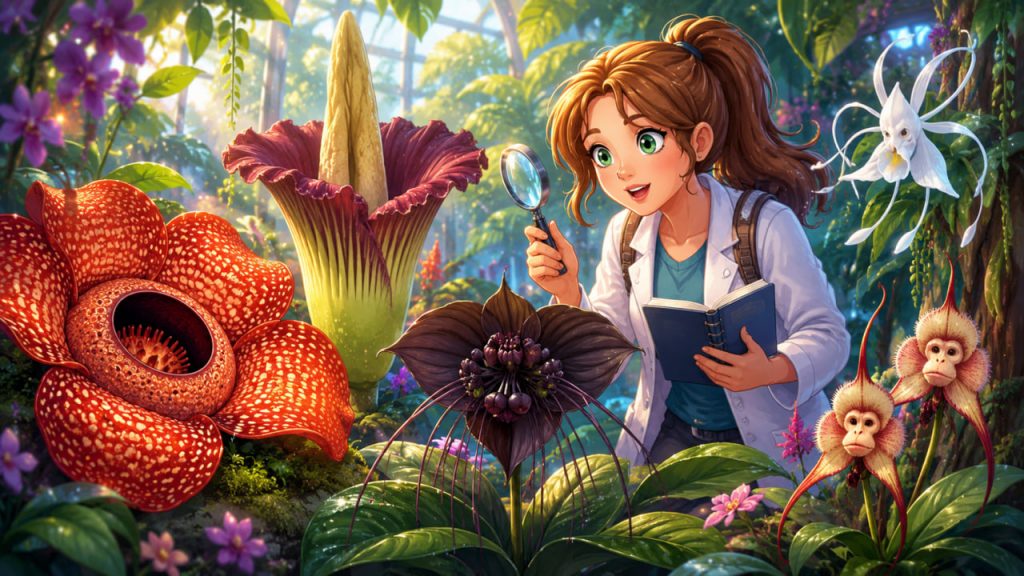
Flowers are often associated with symmetry, fragrance, and bright colors. Yet some plants produce blossoms that resemble animals, smell like decaying flesh, hide underground, or bloom for only a few hours.
These unusual flowers are not strange by accident. Their shapes, odors, colors, and timing evolved to attract particular pollinators, survive difficult environments, or reproduce while using as little energy as possible.
The world’s most extraordinary flowers reveal that beauty in nature is often closely connected to survival.
Rafflesia: The World’s Largest Individual Flower
Rafflesia arnoldi produces the largest known individual flower. It grows in the rainforests of Southeast Asia and can reach an enormous size, yet the plant has no conventional leaves, stems, or roots.
Rafflesia lives as a parasite inside vines belonging to the genus Tetrastigma. For most of its life, it remains almost completely hidden within the tissues of its host.
When the flower finally emerges, it forms a huge reddish structure covered with pale spots. Its appearance is dramatic, but its smell is even more memorable.
The flower releases an odor resembling rotting meat. This attracts flies and beetles that normally visit animal remains. As they move around the flower, they may carry pollen between separate male and female blossoms.
Rafflesia demonstrates how a flower can imitate decay to recruit insects as pollinators.
Its reproductive strategy is extremely vulnerable. A male and female flower must open close enough together and at approximately the same time for successful pollination to occur.
Titan Arum: A Giant That Heats Itself
The titan arum, Amorphophallus titanum, is also commonly called a corpse flower, although it is very different from Rafflesia.
Instead of producing one enormous flower, it creates the world’s largest unbranched inflorescence—a structure containing many small flowers. The central spike, called a spadix, rises from a large folded bract known as a spathe.
At full bloom, the inflorescence may grow several meters tall. It produces a powerful odor resembling decomposing flesh and usually remains open for only two or three days.
The plant can also generate heat. Warming helps release and distribute its odor through the surrounding air, making the floral structure more convincing to carrion flies and beetles.
Titan arums do not bloom according to a fixed annual schedule. They store energy in a massive underground corm and flower only after accumulating sufficient reserves. Several years—or sometimes much longer—may pass between blooms.
Hydnora Africana: The Flower That Lives Underground
Hydnora africana looks more like a strange marine creature than a flowering plant.
Most of it remains hidden beneath dry ground in southern Africa. It has no leaves and no chlorophyll, so it cannot manufacture food through photosynthesis. Instead, it attaches to the roots of a host shrub and obtains water and nutrients from that plant.
After rainfall, its thick flower breaks through the soil. The exterior is brown and cracked, while the interior can be vivid salmon-orange.
The flower produces a pungent odor that attracts carrion beetles. It may temporarily trap visiting insects inside, giving them time to become covered with pollen before they escape.
Its fruit also develops underground and resembles a small potato.
Hydnora is unusual not only because of its appearance, but because nearly its entire life takes place out of sight.
The Monkey-Face Orchid
Some flowers appear unusual because humans recognize familiar faces in their patterns.
Dracula simia, commonly called the monkey-face orchid, is a striking example. The arrangement of its petals, sepals, column, and central lip can create the appearance of a small monkey’s face.
The resemblance is not a deliberately created image. It is a result of natural floral anatomy combined with the human brain’s strong tendency to recognize faces.
Dracula orchids generally occur in cool, moist mountain forests in Central and South America. Their flowers often hang downward and possess long, narrow sepal extensions that resemble tails.
The monkey-like appearance has made this orchid famous online, but its unusual structure is connected to pollination rather than human entertainment.
The Bee Orchid: A Botanical Impersonator
The bee orchid, Ophrys apifera, produces flowers whose central lip resembles the body of a bee.
Its velvety brown surface, yellow markings, rounded shape, and smaller petal-like structures create a surprisingly insect-like image. Kew describes its modified lip as forming the rounded “body” of the bee, while other floral parts resemble antennae.
Many orchids in the genus Ophrys use sexual deception. Their flowers imitate the appearance and chemical signals of female insects, encouraging males to attempt mating with the blossom and carry pollen to another plant.
The bee orchid is unusual because it frequently reproduces through self-pollination across much of its range. Its floral resemblance nevertheless reflects the remarkable evolutionary history of the group.
The Ghost Orchid: A Flower That Appears to Float
The Florida ghost orchid, Dendrophylax lindenii, has no ordinary leaves.
Its green roots attach tightly to the bark of trees, where they perform much of the photosynthesis normally carried out by leaves. When the pale flower emerges from the root-covered trunk, it can appear to float in the darkness.
The orchid grows naturally in humid forests and swamps of South Florida and Cuba. Its white flower releases fragrance at night, when its pollinators are active.
The ghost orchid’s roots depend on suitable trees, humid conditions, and relationships with microscopic fungi. This complex biological dependence makes the plant difficult to cultivate and highly sensitive to habitat disturbance.
Another ghost-like orchid from Madagascar, Didymoplexis stella-silvae, grows in almost complete darkness, lacks leaves, and depends entirely on fungi for energy. Its white flowers can open after rainfall and disappear within about 24 hours.
The Black Bat Flower
The black bat flower, Tacca chantrieri, produces one of the most theatrical displays in the plant kingdom.
Its dark purple or nearly black bracts spread outward like wings. Beneath them hang clusters of small flowers, accompanied by extremely long threadlike structures that may resemble whiskers.
The complete display can look like a bat in flight.
Very dark flowers are comparatively uncommon in nature. What appears black is usually an intense concentration of purple pigments rather than a complete absence of reflected light.
The species comes from tropical parts of Southeast Asia, where it grows in warm, shaded, humid environments.
Its dramatic form attracts human attention, but the long bracts and filaments are part of the plant’s reproductive display rather than decorative extras.
Why Some Flowers Smell Terrible
Humans usually prefer flowers with sweet fragrances, but floral scent evolved for pollinators—not for people.
Plants pollinated by bees, butterflies, moths, birds, flies, or beetles may produce very different chemical signals. Flowers that depend on carrion-associated insects often imitate decomposing animals.
They may combine several signals:
- Dark red or brown coloring
- Shiny surfaces resembling moist tissue
- Rotten-meat odors
- Heat production
- Hairlike structures
- Temporary insect traps
The titan arum, Rafflesia, and Hydnora independently developed versions of this strategy.
This is an example of convergent evolution, in which unrelated organisms evolve similar solutions to comparable ecological problems.
Why Animal-Shaped Flowers Exist
A flower that looks like a monkey, bee, bird, or bat does not necessarily imitate that animal for a biological purpose.
Sometimes the resemblance exists mainly in human perception. People naturally search for recognizable patterns, especially faces—a psychological tendency called pareidolia.
In other cases, imitation is an authentic pollination strategy.
Bee-like orchids can deceive insects, while some flowers mimic food, nesting sites, female insects, or decaying material.
To understand an unusual flower scientifically, researchers examine more than its appearance. They study its scent, ultraviolet patterns, flowering season, pollinators, habitat, and reproductive success.
Expert Perspective
Botanists at the Royal Botanic Gardens, Kew emphasize that unusual flowers are products of highly specialized ecological relationships. The odors of Rafflesia and titan arum, for example, attract insects associated with dead animals, while leafless orchids depend on trees, fungi, and precise environmental conditions.
The most important lesson is that extreme specialization can make a flower both extraordinary and vulnerable.
A plant may depend on one host species, a narrow climate, a particular fungus, and a small group of pollinators. If any part of that system disappears, the plant may be unable to survive or reproduce.
Protecting unusual flowers therefore requires conserving entire habitats rather than preserving isolated specimens alone.
Interesting Facts
- Rafflesia produces the world’s largest known individual flower.
- Titan arum produces an inflorescence containing many small flowers rather than one giant flower.
- Some carrion flowers generate heat to spread their odors more effectively.
- Hydnora spends most of its life underground.
- The bee orchid can produce thousands of tiny, wind-dispersed seeds.
- Some orchids lack leaves and depend partly or entirely on fungi.
- The Florida ghost orchid performs photosynthesis through its exposed roots.
- Very dark “black” flowers usually contain deep purple pigments.
- Some flowers trap pollinators temporarily without digesting them.
- Human face recognition helps make the monkey orchid appear especially striking.
- Several unrelated plants independently evolved the smell of rotting flesh.
- Rare flowers may bloom briefly after waiting years for suitable conditions.
Glossary
- Flower — The reproductive structure of a flowering plant.
- Inflorescence — A group or cluster of multiple flowers arranged on one structure.
- Pollinator — An animal that transfers pollen between flowers.
- Pollination — The transfer of pollen to the reproductive part of a flower.
- Parasite — An organism that obtains resources from another living organism.
- Host plant — A plant that supports or supplies resources to another organism.
- Chlorophyll — The green pigment used by plants to absorb light for photosynthesis.
- Photosynthesis — The process through which plants use light to produce chemical energy.
- Spadix — A fleshy spike bearing numerous small flowers.
- Spathe — A modified leaf or bract surrounding a flower cluster.
- Corm — A thick underground storage stem.
- Bract — A modified leaf associated with a flower or flower cluster.
- Labellum — A specialized lip-like petal found in orchids.
- Sepal — A floral structure that usually protects the developing flower bud.
- Carrion — The decaying body of a dead animal.
- Convergent evolution — The independent evolution of similar traits in unrelated organisms.
- Pareidolia — The tendency to perceive familiar shapes or faces in random patterns.
- Mycoheterotrophy — A nutritional strategy in which a plant obtains carbon through relationships with fungi.
- Epiphyte — A plant that grows on another plant without normally taking nutrients directly from it.
- Sexual deception — A pollination strategy in which a flower imitates a potential insect mate.