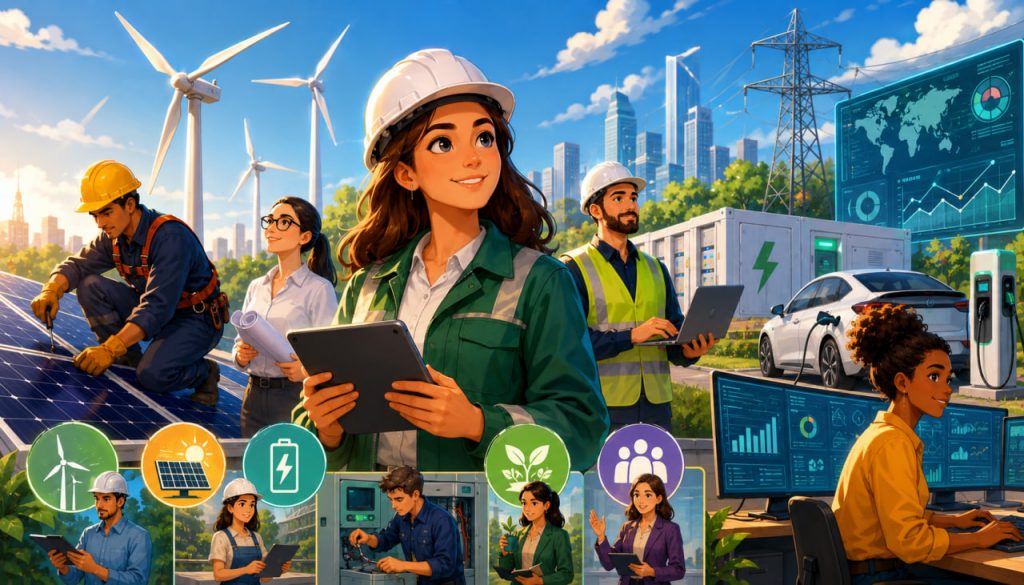
The global energy industry is undergoing one of the largest workforce transformations in modern history. Renewable power, battery storage, electric transport, smart grids, energy efficiency, and low-carbon manufacturing are creating new professions while changing traditional engineering and technical roles.
This shift does not mean that every future employee must become a solar engineer or climate scientist. Green energy needs electricians, technicians, software developers, project managers, analysts, construction specialists, sales professionals, lawyers, and communication experts.
The strongest career opportunities will belong to people who combine practical industry knowledge with digital, technical, and sustainability skills.
Why Energy Professions Are Changing
The energy system is becoming more decentralized, electrified, automated, and data-driven.
Traditional power plants sent electricity in one direction through relatively predictable networks. Modern systems must integrate variable solar and wind generation, batteries, electric vehicles, heat pumps, distributed generators, and consumers who can also produce electricity.
This creates demand for workers who understand both physical infrastructure and digital control systems.
The International Energy Agency reported that global energy employment reached approximately 76 million jobs in 2024. Energy-sector employment grew by 2.2% that year, faster than employment across the wider economy.
Renewable energy alone employed 16.2 million people worldwide in 2023, up from 13.7 million in 2022, according to IRENA and the International Labour Organization.
Solar Energy Careers
Solar power creates jobs across manufacturing, installation, design, operation, financing, and maintenance.
Solar photovoltaic installers assemble mounting systems, connect panels, route cables, and help commission residential or commercial installations. Electricians complete much of the electrical work and ensure that systems comply with safety standards.
Solar design engineers calculate expected energy output, select equipment, study shading, and prepare technical plans. Larger projects also require civil engineers, surveyors, procurement specialists, environmental consultants, and construction managers.
Promising solar careers include:
- Solar photovoltaic installer
- Electrical engineer
- Solar design specialist
- Project development manager
- Operations and maintenance technician
- Energy yield analyst
- Solar sales consultant
Many installation roles can be entered through technical education, apprenticeships, and industry certification rather than a traditional four-year university degree.
Wind Energy Careers
Wind farms require workers during manufacturing, transportation, construction, commissioning, and decades of operation.
Wind turbine technicians inspect blades, electrical systems, gearboxes, sensors, and control equipment. The work can be physically demanding and may involve climbing tall towers or working offshore.
Engineers are needed to design foundations, improve turbine performance, connect projects to the grid, and manage structural loads. Offshore wind also creates demand for marine coordinators, vessel crews, underwater-cable specialists, and safety professionals.
The U.S. Department of Energy notes that wind-sector growth depends on trained workers who can manufacture, construct, operate, and maintain turbines.
Wind energy is especially suitable for people interested in mechanical systems, electrical equipment, fieldwork, and industrial safety.
Battery Storage and Electric Mobility
As renewable generation expands, energy storage becomes increasingly important.
Battery engineers work on cell chemistry, thermal management, electronics, safety, manufacturing, and recycling. Technicians install and maintain residential, commercial, and utility-scale battery systems.
Electric vehicles are also transforming employment in automotive manufacturing, charging infrastructure, power electronics, software, and grid planning.
Relevant professions include:
- Battery systems engineer
- Battery laboratory technician
- Charging-infrastructure installer
- Power electronics engineer
- Battery safety specialist
- Recycling process engineer
- Electric vehicle fleet manager
These jobs often require knowledge of high-voltage systems, thermal behavior, data analysis, and safety procedures.
Smart Grids and Digital Energy
A renewable energy system cannot function reliably without advanced grids.
Smart grids use sensors, automated controls, communication networks, software, and forecasting systems to balance electricity supply and demand. This creates a growing connection between energy engineering and information technology.
The IEA has identified digitalization as an important driver of demand for workers who can modernize energy infrastructure and develop tools for a cleaner, more efficient system.
High-value digital energy professions include:
- Grid automation engineer
- Power systems analyst
- Energy software developer
- Data scientist
- Cybersecurity specialist
- Artificial intelligence engineer
- Renewable energy forecaster
Cybersecurity is becoming particularly important because power plants, substations, batteries, meters, and charging stations are increasingly connected to digital networks.
Energy-Efficiency Careers
Some of the most valuable green energy work involves reducing energy consumption rather than producing more electricity.
Energy auditors inspect buildings and identify heat loss, inefficient lighting, outdated equipment, and poor control systems. Building-performance engineers design improvements involving insulation, ventilation, heat pumps, windows, and automation.
Energy-efficiency specialists may work in homes, factories, offices, hospitals, schools, or public buildings.
Potential careers include:
- Building energy auditor
- HVAC engineer or technician
- Heat-pump installer
- Building automation specialist
- Industrial efficiency engineer
- Sustainability consultant
- Energy manager
These professions are difficult to automate completely because they often require physical inspections, site-specific judgment, installation work, and communication with clients.
Green Hydrogen and Emerging Fuels
Green hydrogen is produced using electricity from renewable sources to split water into hydrogen and oxygen.
The industry may create opportunities in electrolyzer manufacturing, chemical engineering, industrial process design, storage, transport, safety, and infrastructure development.
Hydrogen careers are likely to be concentrated in regions with major industrial clusters, ports, renewable resources, and government-supported projects.
Typical roles include:
- Electrolyzer engineer
- Chemical process engineer
- Hydrogen safety specialist
- Pipeline engineer
- Industrial project developer
- Fuel-cell technician
Green hydrogen is not equally suitable for every application, but it may become important in sectors that are difficult to electrify directly, including parts of heavy industry, shipping, and chemical production.
Environmental, Financial, and Policy Careers
Green energy development involves much more than engineering.
Projects need environmental assessments, permits, contracts, financing, insurance, community engagement, supply-chain planning, and regulatory analysis.
A renewable energy project may therefore employ:
- Environmental scientists
- Energy economists
- Financial analysts
- Sustainability lawyers
- Public-policy specialists
- Carbon accountants
- Communications professionals
- Community engagement managers
People with backgrounds in business, law, economics, geography, or communications can enter the energy transition without becoming engineers.
Understanding how energy projects are financed, approved, and accepted by communities can be as valuable as understanding the equipment itself.
Which Traditional Skills Can Be Transferred?
Workers from conventional energy sectors often possess valuable transferable experience.
Oil and gas engineers may understand large industrial projects, pipelines, geology, offshore operations, and safety management. Power-plant employees may already have experience with turbines, electrical equipment, maintenance, and control rooms.
Construction workers, electricians, welders, mechanics, and heavy-equipment operators can often move into renewable infrastructure after targeted retraining.
The ILO emphasizes that skills policies, lifelong learning, and coordinated training systems are essential for preparing workers for greener economies.
A successful transition usually builds on existing abilities rather than forcing workers to start from zero.
Skills Employers Will Value Most
Technical knowledge remains important, but employers increasingly need hybrid abilities.
Useful skills for the green energy economy include:
- Electrical and mechanical fundamentals
- Data analysis
- Digital monitoring and automation
- Project management
- Health and safety
- Environmental regulation
- Financial literacy
- Communication and teamwork
- Systems thinking
- Continuous learning
English-language skills can also improve access to international documentation, software, research, training, and multinational employers.
For students, a combination such as electrical engineering plus programming, or environmental science plus data analysis, can create wider career options than a narrowly specialized degree.
Expert Perspective: The Skills Shortage Is a Major Challenge
The IEA reports that energy employment has continued to grow, but shortages of qualified workers are becoming a serious obstacle. Employers are struggling to recruit people with specialized technical and practical skills, particularly for infrastructure development and skilled trades.
This means the energy transition is not only creating jobs. It is creating an urgent need for vocational schools, universities, employers, and governments to modernize training.
Electricians, technicians, engineers, and digital specialists may become more important to the transition than many highly publicized executive roles.
How to Start a Green Energy Career
Begin by choosing a direction based on your interests.
People who enjoy practical work may consider electrical installation, turbine maintenance, heat pumps, or building systems. Those who prefer mathematics and technology may focus on power engineering, battery research, forecasting, or software.
Business-oriented candidates can enter project finance, sales, procurement, consulting, or policy.
A practical entry plan should include:
- Studying local job advertisements
- Identifying repeated skill requirements
- Completing a relevant course or certification
- Building a small portfolio or technical project
- Applying for apprenticeships, internships, and junior roles
- Learning industry software and safety standards
The U.S. Department of Energy’s career resources show that energy employment exists across public, private, and nonprofit organizations and ranges from apprenticeships to highly specialized professional positions.
Interesting Facts
- Global energy employment reached about 76 million jobs in 2024.
- Renewable energy employment increased to 16.2 million jobs worldwide in 2023.
- Solar energy accounts for a major share of global renewable energy employment.
- Green energy careers include legal, financial, digital, construction, scientific, and communication roles.
- Many renewable energy jobs are located outside major cities because projects are built where energy resources and land are available.
- Electricians and technicians are essential to solar power, batteries, heat pumps, charging networks, and grid modernization.
- Women hold only around one-fifth of jobs in the wider energy workforce, indicating significant potential for greater participation.
- Traditional energy workers may already possess many skills needed for renewable infrastructure.
Glossary
- Green Energy — Energy produced or managed with substantially lower environmental impact than conventional fossil-based systems.
- Energy Transition — The long-term shift from high-carbon energy sources toward cleaner, more efficient technologies.
- Smart Grid — An electricity network that uses digital monitoring, communication, and automated control.
- Energy Storage — Technologies that retain energy for later use, including batteries and pumped hydropower.
- Electrolyzer — A device that uses electricity to split water into hydrogen and oxygen.
- Power Electronics — Electronic systems that control and convert electrical power.
- Energy Auditor — A specialist who evaluates how a building or facility uses energy and recommends improvements.
- Grid Integration — The process of connecting and managing new energy resources within an electricity network.
- Upskilling — Learning additional abilities that improve performance or enable more advanced work.
- Reskilling — Training that prepares a worker to move into a different occupation.
- Just Transition — An approach that aims to make the move toward a greener economy fair for workers and communities.
- Distributed Energy Resources — Small energy systems located close to users, such as rooftop solar panels, batteries, and local generators.