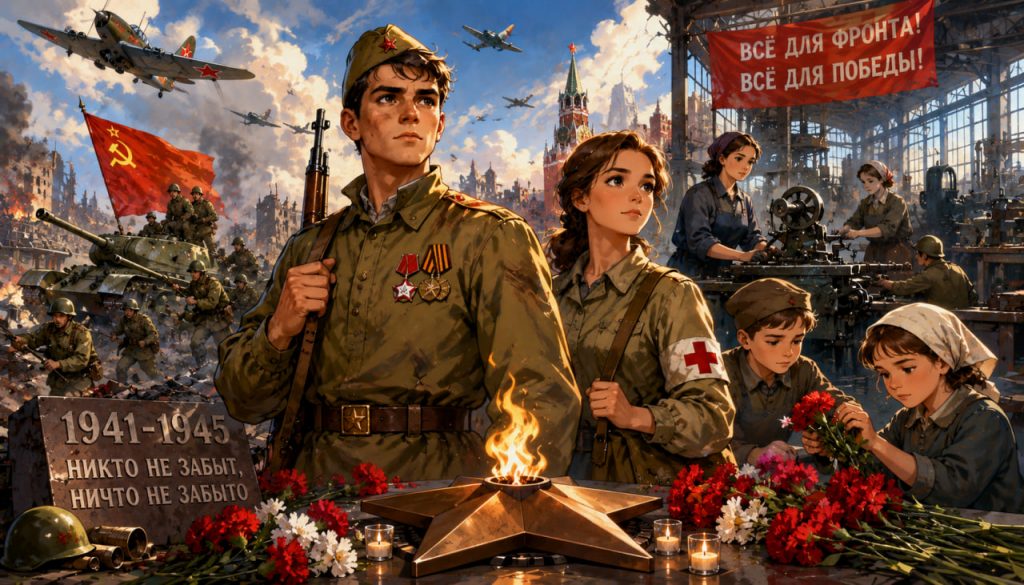
The Great Patriotic War remains one of the most devastating and decisive periods in the history of the twentieth century. The term usually refers to the Soviet Union’s struggle against Nazi Germany and its European allies from June 22, 1941, until the defeat of Germany in May 1945.
For millions of families, this history is not an abstract sequence of battles. It is the story of soldiers, medical workers, factory employees, partisans, prisoners, children, and civilians who endured invasion, occupation, starvation, forced labor, mass murder, and displacement.
Remembering the war does not mean glorifying violence or treating history as a simple legend. It means understanding how aggressive ideology, dehumanizing propaganda, dictatorship, and indifference can lead entire societies toward catastrophe.
What Was the Great Patriotic War?
The Great Patriotic War began when Nazi Germany invaded the Soviet Union on June 22, 1941, launching Operation Barbarossa.
The invasion opened the Eastern Front, which the United States Holocaust Memorial Museum describes as the largest and deadliest theater of the Second World War. German forces initially captured enormous territories, but Soviet resistance eventually stopped the advance and pushed the invaders westward.
The conflict included some of history’s largest battles, including those for Moscow, Stalingrad, Kursk, Leningrad, and Berlin.
The Battle of Stalingrad became a major turning point. After the defeat of German forces there in early 1943, the Red Army increasingly took the strategic initiative. Germany’s final major offensive at Kursk also failed later that year.
Soviet forces eventually reached Berlin, and Nazi Germany surrendered unconditionally in May 1945. The surrender took effect in the east on May 9, the date traditionally observed as Victory Day in many former Soviet republics.
A War of Annihilation
The German invasion was not intended to be an ordinary military campaign.
Nazi leaders sought territory, resources, racial domination, and the destruction of groups they considered ideological or biological enemies. Plans for the occupied east were shaped by the concept of Lebensraum, or “living space,” and by racist beliefs that presented Slavic peoples and Jews as inferior.
German forces and occupation authorities carried out mass shootings, starvation policies, village destruction, deportations, forced labor, and systematic persecution.
The Einsatzgruppen, often described as mobile killing squads, followed German armies into occupied Soviet territory. They played a central role in the mass shooting of Jewish communities and other targeted groups.
At Babyn Yar near Kyiv, German SS and police units, assisted by local auxiliaries, carried out one of the largest single mass shootings of the Second World War in September 1941.
Remembering this dimension of the war is essential because military aggression and genocide were closely connected.
The Human Cost of Occupation
The Eastern Front brought destruction on an almost unimaginable scale.
Entire cities and villages were ruined. Millions of people lost their homes, relatives, health, education, or childhood. Civilians faced hunger, executions, forced relocation, and the constant danger of military operations.
Soviet prisoners of war were treated with exceptional cruelty. Nazi policy subjected many to deliberate starvation, exposure, disease, shootings, and forced labor. The persecution was driven not merely by battlefield conditions but by Nazi racial and ideological objectives.
Jewish communities across occupied Soviet territory were destroyed through mass shootings, ghettos, deportations, and killing operations. Romani people were also targeted for persecution and murder by Nazi Germany and its allies.
History becomes easier to distort when victims are reduced to statistics. Personal letters, photographs, diaries, oral testimonies, military records, and local memorials restore the human dimension of events.
Why Victory Required More Than Soldiers
The defeat of Nazi Germany depended on soldiers at the front, but also on enormous efforts behind the lines.
Factories were relocated eastward and reorganized for wartime production. Workers manufactured weapons, ammunition, vehicles, uniforms, and medical supplies under extremely difficult conditions.
Women served as doctors, nurses, pilots, radio operators, snipers, engineers, factory workers, and agricultural laborers. Teenagers and older citizens often assumed responsibilities left by mobilized adults.
Partisans disrupted transport, gathered intelligence, attacked occupation forces, and assisted regular armies. Civilians donated blood, cared for wounded soldiers, dug defensive positions, and shared limited food.
Victory was achieved through collective sacrifice, industrial endurance, military resistance, and cooperation among the Allied powers.
Recognizing the Soviet contribution does not diminish the roles of Britain, the United States, China, resistance movements, or other Allied nations. Accurate remembrance makes it possible to understand how different countries and peoples contributed to the defeat of the Axis powers.
The Danger of Dehumanizing Propaganda
One of the most important lessons of the war concerns language.
Before people can be persecuted on a massive scale, they are often portrayed as dangerous, inferior, disloyal, or less than human. Nazi propaganda helped prepare soldiers and civilians to accept discrimination, occupation, deportation, and murder.
The German war against the Soviet Union was explicitly racial and ideological. Military orders encouraged extreme violence against both perceived resistance and entire categories of civilians.
This lesson remains relevant whenever political movements blame complex social problems on ethnic, religious, or national groups.
Hatred becomes especially dangerous when it is normalized, repeated constantly, and supported by state power.
Learning to recognize manipulation, conspiracy theories, fabricated enemies, and collective blame is therefore part of historical education.
Why Historical Accuracy Matters
Memory can unite societies, but it can also be simplified or manipulated.
A responsible understanding of the Great Patriotic War should distinguish documented evidence from myths, propaganda, and emotionally attractive claims. It should honor genuine heroism without hiding civilian suffering, military errors, political repression, collaboration, or the complexity of individual choices.
Historical knowledge depends on comparing archives, eyewitness accounts, material evidence, photographs, official documents, and scholarly research.
Postwar trials established important legal precedents by holding individuals responsible for war crimes and crimes against humanity, although many perpetrators were never prosecuted.
Understanding these legal developments helps explain why modern international law rejects the idea that people can escape responsibility simply because they followed orders.
Remembering Without Glorifying War
Commemoration should honor courage and sacrifice without presenting war as exciting, cleansing, or desirable.
Real war means destroyed families, permanent disability, hunger, psychological trauma, displacement, and the loss of cultural heritage. Even a necessary defensive struggle carries a terrible human cost.
Museums, memorials, school lessons, family archives, and remembrance ceremonies can help younger generations understand this reality.
The United Nations treats remembrance of the Second World War as an opportunity to honor those who died and to encourage reconciliation. It also emphasizes that education about genocide and violent histories can support the prevention of future atrocities.
The strongest tribute to past generations is not merely remembering their victory, but working to prevent similar destruction from happening again.
Lessons for the Modern World
The history of the Great Patriotic War offers several enduring lessons.
Aggression becomes more likely when dictators believe other nations are divided or unwilling to resist. International institutions and treaties matter, but they require political commitment and credible action.
Democratic institutions, independent historical research, responsible journalism, and civic education can make societies more resistant to propaganda.
Minorities must be protected before discrimination develops into systematic violence. The United Nations notes that genocide is particularly likely during armed conflict and that prevention requires addressing the roots of violence before atrocities escalate.
Finally, peace should never be treated as automatic. It depends on diplomacy, justice, collective security, public responsibility, and an honest understanding of the past.
Expert Perspective
The United States Holocaust Memorial Museum characterizes the Nazi campaign against the Soviet Union as a war of annihilation, not simply a conventional conflict between armies. Its historical research shows that racial ideology shaped military policies, the treatment of prisoners, occupation practices, and mass murder.
The United Nations similarly emphasizes that remembrance and education are not only ceremonial activities. They can help societies identify extremism, discrimination, and warning signs that precede genocide and other atrocity crimes.
Interesting Facts
- The Eastern Front was the largest and deadliest theater of the Second World War.
- Nazi Germany invaded the Soviet Union on June 22, 1941.
- Stalingrad became a decisive turning point after Soviet forces surrounded a major German army.
- The final German offensive at Kursk failed in the summer of 1943.
- Soviet and American forces met at the Elbe River in April 1945.
- Nazi mobile killing squads murdered Jewish communities across occupied Soviet territories.
- Millions of Soviet prisoners of war suffered starvation, disease, forced labor, and mass murder.
- Germany’s surrender ended the war in Europe in May 1945.
Glossary
- Great Patriotic War — The Soviet and post-Soviet term for the war against Nazi Germany and its allies from 1941 to 1945.
- Eastern Front — The major theater of war between Nazi Germany and the Soviet Union.
- Operation Barbarossa — The code name for Germany’s invasion of the Soviet Union.
- War of Annihilation — A conflict intended not only to defeat an army but also to destroy political systems and targeted populations.
- Lebensraum — The Nazi concept of acquiring “living space” through conquest and colonization.
- Einsatzgruppen — German mobile killing units that carried out mass shootings behind the front.
- Partisan — A member of an irregular resistance force operating in occupied territory.
- Occupation — Military control of foreign territory.
- Genocide — The intentional destruction, in whole or in part, of a national, ethnic, racial, or religious group.
- War Crime — A serious violation of the laws and customs of armed conflict.
- Crimes Against Humanity — Widespread or systematic attacks directed against civilians.
- Historical Revisionism — The reinterpretation of history; the term may describe legitimate scholarship or, in a negative sense, politically motivated distortion.
- Commemoration — An act or ceremony intended to preserve the memory of an event or its victims.