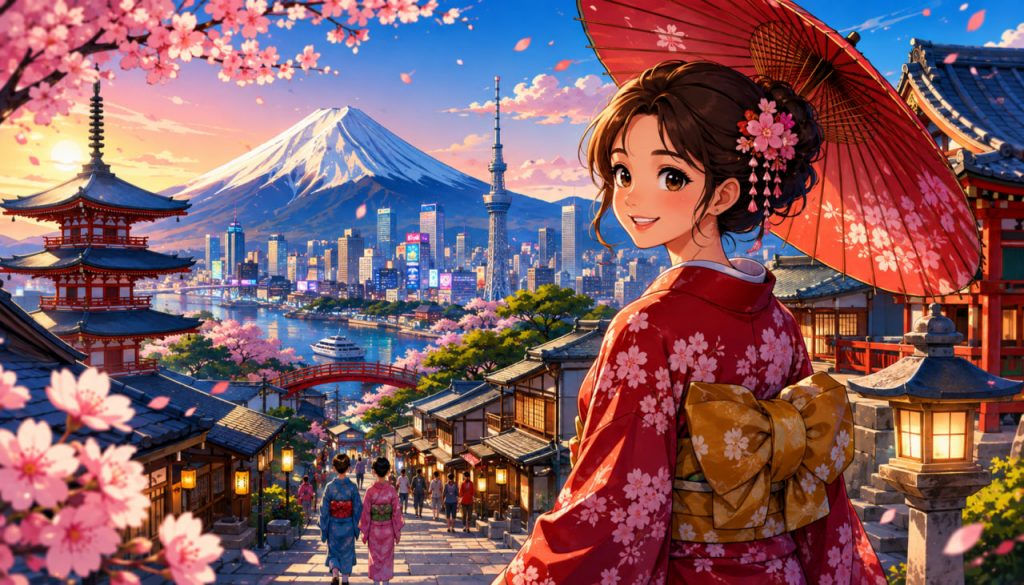
Japan is one of the world’s most fascinating countries because it combines ancient traditions with advanced technology, crowded megacities with quiet mountain villages, and strict social customs with constantly evolving popular culture.
Located in East Asia, Japan is an island nation with Tokyo as its capital and largest urban center. Its identity has been shaped by geography, periods of political isolation, rapid industrialization, natural disasters, and an extraordinary ability to adapt without completely abandoning the past.
Japan is not simply a futuristic country or a collection of temples and cherry blossoms. It is a complex society where tradition, innovation, discipline, creativity, and demographic change exist side by side.
Geography and the Japanese Islands
Japan is an archipelago stretching along the eastern coast of Asia. Its four principal islands are Honshu, Hokkaido, Kyushu, and Shikoku, while thousands of smaller islands extend from the colder north to subtropical Okinawa.
Much of the country is mountainous and heavily forested. This geography concentrates large populations, transport networks, and industries in relatively narrow coastal plains.
Mount Fuji, Japan’s tallest mountain, is both a natural landmark and an important cultural symbol. Volcanoes, hot springs, earthquakes, and dramatic coastlines are all connected to Japan’s position along tectonically active boundaries.
The country’s long north-to-south shape creates considerable climatic diversity. Hokkaido experiences snowy winters, central Japan has four distinct seasons, and Okinawa has a warm subtropical climate.
A History of Reinvention
Japan’s history includes imperial courts, powerful warrior governments, centuries of regional conflict, and long periods of relative political stability.
The samurai class became central to Japanese political life during the medieval period. Shoguns exercised practical military authority, while the emperor retained deep symbolic and cultural importance.
From the early seventeenth century, the Tokugawa shogunate restricted most foreign contact. This period did not mean complete isolation, but it limited external influence and allowed distinctive artistic, commercial, and social traditions to develop.
In the nineteenth century, the Meiji Restoration transformed Japan into a centralized industrial state. Railways, modern factories, schools, military institutions, and Western scientific knowledge expanded rapidly.
Following the destruction of the Second World War, Japan rebuilt its economy and emerged as a major industrial and technological power.
Japan’s modern history is defined by repeated transformation: the country adopted foreign ideas quickly while reshaping them to fit local priorities.
Tokyo: The Energy of Modern Japan
Tokyo is the political, financial, and cultural center of Japan.
The city is known for skyscrapers, dense railway networks, fashion districts, small neighborhood restaurants, historic shrines, electronics stores, and an enormous creative economy.
Different areas offer sharply contrasting experiences. Shibuya represents youth culture and urban energy, while Asakusa preserves a more traditional atmosphere. Akihabara is associated with electronics, gaming, and anime culture, and Ginza is famous for luxury shopping and architecture.
Tokyo’s transport system can appear complicated, but it is known for extensive coverage and efficient connections. Railway stations often function as complete commercial centers containing restaurants, shops, offices, and entertainment facilities.
Despite its scale, Tokyo contains many quiet residential streets, gardens, riverside paths, and small shrines hidden between modern buildings.
Kyoto and Japan’s Cultural Heritage
Kyoto served as Japan’s imperial capital for more than one thousand years and remains one of the country’s most important cultural destinations.
The city is famous for Buddhist temples, Shinto shrines, traditional wooden houses, gardens, seasonal festivals, and historic districts.
Kyoto demonstrates that Japanese cultural heritage is not limited to museum displays. Traditional crafts, tea ceremonies, religious rituals, cuisine, and architecture remain part of living communities.
Other major historic destinations include Nara, with its early temples and sacred deer, and Kamakura, known for Buddhist monuments and its connection to samurai government.
The Japan National Tourism Organization describes the country’s culture as a distinctive combination of long-established traditions and modern life.
Shinto, Buddhism, and Everyday Spirituality
Japan’s religious culture is strongly influenced by both Shinto and Buddhism.
Shinto centers on respect for kami, spiritual presences associated with nature, places, ancestors, and particular forces of life. Shinto shrines are recognized by their torii gates and are often visited during festivals, New Year celebrations, weddings, and important personal moments.
Buddhism arrived from the Asian continent and shaped philosophy, art, architecture, funerary customs, and meditation traditions.
Many Japanese people participate in practices associated with both religions without seeing them as mutually exclusive. A family might visit a Shinto shrine for a celebration and observe Buddhist customs when remembering deceased relatives.
Japanese spirituality is often expressed through seasonal rituals, respect for place, purification, gratitude, and remembrance rather than through strict doctrinal identity.
Japanese Food Beyond Sushi
Japanese cuisine is much broader than sushi and ramen.
Regional traditions are extremely important. Osaka is famous for casual foods such as takoyaki and okonomiyaki, Hokkaido is known for seafood and dairy products, and Kyoto has refined dishes influenced by temple cuisine and seasonal ingredients.
Common elements include rice, noodles, fish, vegetables, fermented foods, seaweed, soy products, and carefully prepared broths.
Presentation matters because meals often reflect seasonality, balance, texture, and visual harmony.
Convenience-store food is also a distinctive part of modern Japanese life. Stores sell prepared meals, rice balls, desserts, drinks, and everyday necessities, often with a level of variety that surprises international visitors.
Technology, Industry, and Innovation
Japan has played a major role in automobiles, robotics, electronics, precision manufacturing, high-speed rail, gaming, and industrial engineering.
Companies such as Toyota, Sony, Nintendo, Honda, and Panasonic became globally recognized through a combination of engineering, design, and manufacturing expertise.
Japan’s Shinkansen high-speed railway network is one of the country’s most visible technological achievements. It connects major cities while representing speed, reliability, and infrastructure planning.
Modern Japan is also investing in artificial intelligence, automation, semiconductor production, renewable energy, and medical technology.
However, the image of Japan as universally futuristic can be misleading. Highly advanced factories and transport systems coexist with paperwork, older administrative processes, and businesses that remain cautious about rapid organizational change.
Anime, Manga, Gaming, and Global Influence
Japanese popular culture has become one of the country’s most successful international exports.
Anime and manga cover nearly every genre, including science fiction, historical drama, romance, horror, sports, philosophy, and everyday life. They are not produced exclusively for children.
Japan has also had an enormous influence on video games. Nintendo, Sony, Sega, Capcom, Square Enix, and other companies created characters and franchises recognized around the world.
Fashion, architecture, product design, cuisine, martial arts, and minimalist aesthetics have further expanded Japan’s cultural influence.
Japanese creative industries succeed partly because they combine universal emotions with highly distinctive visual and narrative traditions.
Social Etiquette and Public Behavior
Courtesy, consideration, cleanliness, and awareness of other people are highly valued in Japanese public life.
Visitors are generally expected to speak quietly on public transportation, wait in orderly lines, avoid blocking walkways, and follow local rules regarding shoes, waste, and photography.
Bowing is a common form of greeting and respect, although foreign visitors are not expected to master every social detail.
Public rubbish bins can be surprisingly difficult to find, so people often carry waste until they can dispose of it properly. Eating while walking may be discouraged in certain areas, especially where crowding or litter has become a concern.
JNTO’s etiquette guidance emphasizes situational awareness, moderate noise levels, respect for local establishments, and sensitivity toward surrounding people.
Japan’s Economic and Demographic Challenges
Japan remains one of the world’s largest advanced economies. World Bank data placed its 2025 GDP at approximately $4.44 trillion, with GDP per person near $35,951.
Yet the country faces major long-term challenges.
Its population is shrinking and aging, creating labor shortages and increasing pressure on healthcare, pensions, rural communities, and public finances.
The OECD expects moderate economic growth, forecasting real GDP expansion of about 0.6% in 2026 and 0.8% in 2027. It identifies domestic demand and wage growth as supportive factors while noting pressure from energy-import costs.
Japan is responding through workplace automation, increased participation by women and older workers, selected immigration reforms, regional development programs, and efforts to raise productivity.
Nature and Seasonal Travel
Japan’s natural scenery changes dramatically through the year.
Spring is associated with cherry blossoms, while summer brings festivals, fireworks, mountain hiking, and humid weather. Autumn attracts visitors with red and golden foliage, and winter offers skiing, snow festivals, hot springs, and illuminated city displays.
Beyond famous cities, travelers can explore the Japanese Alps, Hokkaido’s wilderness, Okinawa’s coral-rich waters, rural villages, national parks, and remote islands.
JNTO highlights experiences ranging from temple stays and regional cooking to rafting, festivals, coastal exploration, and traditional cultural encounters.
Responsible tourism has become increasingly important as popular destinations manage crowding and pressure on local infrastructure.
Expert Perspective
The OECD’s 2026 Economic Survey describes Japan’s economy as resilient despite global pressures, while emphasizing that demographic aging, productivity, fiscal sustainability, and labor-market reform remain central challenges.
This perspective captures an important truth about modern Japan: its future depends not only on technological invention, but also on whether institutions and workplaces can adapt to a smaller and older population.
Interesting Facts
- Japan consists of four principal islands and thousands of smaller islands.
- More than two-thirds of the country is mountainous or forested.
- Japan has 47 prefectures.
- Mount Fuji is an active volcano, although it has not erupted since the early eighteenth century.
- The Shinkansen began operating in 1964.
- Japanese writing commonly combines kanji with the hiragana and katakana syllabaries.
- Japan contains thousands of natural hot springs known as onsen.
- Convenience stores provide services ranging from prepared food to bill payment and parcel collection.
- Okinawa has a distinct history shaped by the former Ryukyu Kingdom.
- Japan’s official tourism organization presents the country as a destination where modern culture and long-established tradition continuously interact.
Glossary
- Archipelago — A group or chain of islands.
- Shinto — Japan’s indigenous religious tradition centered on kami, sacred places, nature, and ritual practice.
- Kami — Spiritual presences or sacred forces recognized in Shinto.
- Buddhism — A religious and philosophical tradition that strongly influenced Japanese culture.
- Samurai — Members of Japan’s historic warrior class.
- Shogun — A military ruler who exercised political authority in premodern Japan.
- Meiji Restoration — The political transformation beginning in 1868 that accelerated Japan’s modernization.
- Torii — A gateway commonly marking the entrance to a Shinto shrine.
- Shinkansen — Japan’s high-speed railway system.
- Onsen — A Japanese natural hot spring or bathing facility using hot-spring water.
- Anime — Japanese animation, covering a wide range of genres and audiences.
- Manga — Japanese comics or graphic narratives.
- Prefecture — A principal administrative division of Japan.
- Demographic Aging — An increase in the proportion of older people within a population.