Nature is filled with dramatic chases. A cheetah pursues a gazelle, an owl hunts a mouse, and a spider waits patiently for an unsuspecting insect. At first glance, these encounters seem like simple battles of speed, strength, or camouflage. In reality, they represent millions of years of continuous evolution.
One of the most fascinating questions in evolutionary biology is whether predators or their prey evolve faster. The answer is more complex than choosing one side. In most ecosystems, predators and prey evolve together, constantly responding to each other’s adaptations in a process known as coevolution.
This ongoing competition has shaped some of the most remarkable traits found in the natural world.
What Is Coevolution?
Coevolution occurs when two or more species influence each other’s evolution through repeated interactions.
In predator-prey relationships, every improvement made by one species creates new selection pressure on the other.
For example:
- Faster predators favor faster prey.
- Better camouflage favors sharper vision.
- Stronger defenses encourage more effective hunting strategies.
- More intelligent prey selects for smarter predators.
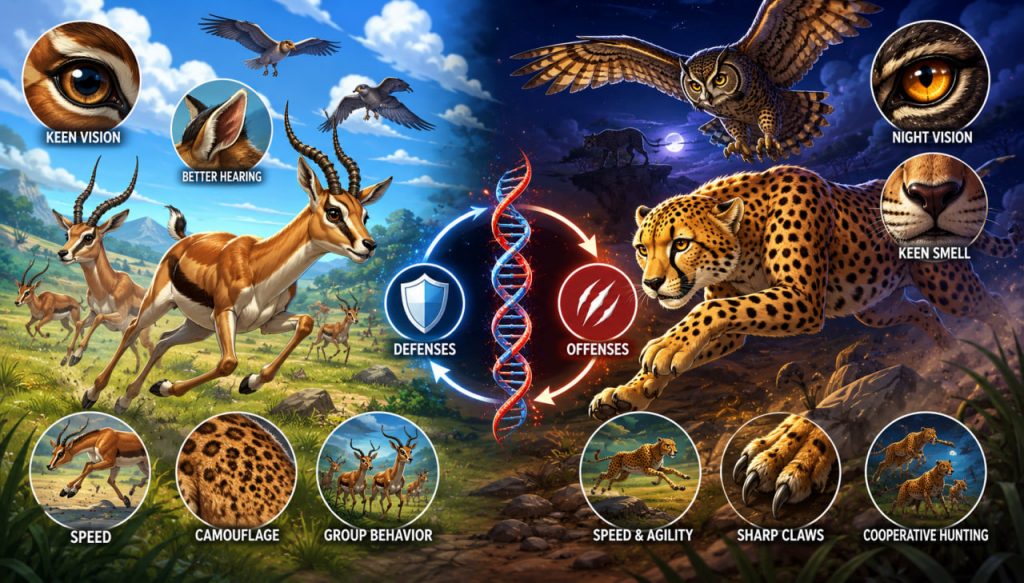
Over thousands or millions of generations, these changes accumulate into an evolutionary “arms race.”
Neither side remains permanently ahead because each adaptation changes the selective environment for the other.
Why Prey Often Evolves First
Prey species typically face stronger immediate selection pressure.
Every unsuccessful escape attempt may result in death before reproduction.
Individuals with even slight survival advantages are therefore more likely to pass their genes to the next generation.
Common prey adaptations include:
- Faster running
- Improved camouflage
- Better hearing
- Wider fields of vision
- Defensive armor
- Toxic chemicals
- Group behavior
Because predators constantly remove vulnerable individuals from the population, natural selection can act very efficiently on prey populations.
Predators Must Keep Up
Predators experience strong selection as well.
A predator that repeatedly fails to capture enough food may not survive long enough to reproduce.
As prey becomes more difficult to catch, predators evolve improvements such as:
- Greater speed
- Enhanced endurance
- Better night vision
- Improved smell
- Stronger jaws
- More sophisticated hunting behaviors
- Cooperative hunting strategies
However, predators often require only occasional hunting success rather than perfect success.
A lion does not need to catch every zebra.
It only needs enough successful hunts to survive and reproduce.
This difference sometimes creates stronger selection pressure on prey than on predators.
The Red Queen Hypothesis
One of the best-known explanations for this evolutionary competition is the Red Queen Hypothesis, proposed by evolutionary biologist Leigh Van Valen in 1973.
The name comes from Through the Looking-Glass by Lewis Carroll, where the Red Queen tells Alice:
“It takes all the running you can do, to stay in the same place.”
In evolutionary biology, this means both predator and prey must continually evolve simply to maintain their current relative positions.
Evolution is not a race with a finish line—it is a continuous process of adaptation.
Speed Is Only One Part of the Battle
Many people assume predator-prey evolution is mainly about running faster.
In reality, evolution affects nearly every aspect of biology.
Predators may evolve:
- Silent movement
- Better depth perception
- Improved coordination
- Venom
- Ambush behavior
- Advanced learning
Prey may evolve:
- Alarm calls
- Mimicry
- Spines
- Thick shells
- Startle displays
- Unpredictable escape patterns
Some species invest more in intelligence than physical abilities.
Others rely on teamwork instead of individual performance.
Evolution Depends on Generation Time
Which species evolves faster often depends on how quickly generations replace one another.
Species with:
- Short life cycles
- Large populations
- High mutation rates
can evolve relatively rapidly.
For example, bacteria can evolve antibiotic resistance within years because they reproduce extremely quickly.
Large mammals reproduce much more slowly, so evolutionary changes usually require many generations.
This means that in some predator-prey systems, neither predator nor prey has an inherent evolutionary advantage—it depends largely on their biology.
Famous Examples of Evolutionary Arms Races
Nature offers countless examples of predator-prey coevolution.
Cheetahs and Gazelles
Cheetahs evolved extraordinary acceleration and top speed.
Gazelles evolved remarkable agility, rapid acceleration, and unpredictable escape maneuvers.
The result is one of nature’s fastest evolutionary competitions.
Rough-Skinned Newts and Garter Snakes
Some rough-skinned newts produce tetrodotoxin, an extremely powerful neurotoxin.
Certain populations of garter snakes evolved resistance to the toxin.
In response, some newt populations evolved even higher toxin concentrations.
This represents one of the clearest documented examples of an evolutionary arms race.
Bats and Moths
Many bats hunt using echolocation.
Some moths evolved ears capable of detecting ultrasonic calls.
Other moths produce ultrasonic clicks that may interfere with bat hunting or signal that they are distasteful to predators.
Why Neither Side Usually Wins
People often imagine evolution producing a final winner.
Biology rarely works this way.
If predators became too efficient, prey populations could collapse.
Without prey, predators would also decline.
Conversely, if prey became completely impossible to capture, predators would struggle to survive.
Natural selection therefore tends to produce a dynamic balance rather than absolute dominance.
The long-term survival of both predator and prey often depends on neither becoming overwhelmingly successful.
Other Forces Shape Evolution
Predators are not the only factor influencing prey evolution.
Environmental conditions also matter.
Species must simultaneously adapt to:
- Climate change
- Disease
- Competition
- Habitat alteration
- Food availability
- Human activity
As a result, predator-prey interactions represent only one part of a much larger evolutionary landscape.
Expert Perspective
Evolutionary biologist Leigh Van Valen introduced the Red Queen Hypothesis to explain why species must continuously adapt simply to maintain their ecological position. His work highlighted that predator-prey interactions are not isolated events but ongoing evolutionary feedback loops. Modern research continues to support this idea, showing that reciprocal selection between interacting species is a powerful driver of biological diversity and adaptation.
Why This Matters Beyond Wildlife
Predator-prey evolution provides insights far beyond ecology.
The same principles help scientists understand:
- Antibiotic resistance in bacteria
- Viral evolution
- Host-parasite interactions
- Agricultural pest management
- Conservation biology
- Artificial intelligence inspired by evolutionary processes
Studying these biological competitions helps researchers predict how organisms respond to changing environments and emerging threats.
The question is not whether predators or prey evolve faster in every case. Instead, the evidence shows that both continually shape each other’s evolution, creating one of nature’s most powerful engines of adaptation.
Interesting Facts
- The Red Queen Hypothesis takes its name from a character in Lewis Carroll’s Through the Looking-Glass.
- Some prey species survive by confusing predators rather than outrunning them.
- Tetrodotoxin produced by rough-skinned newts is among the most potent natural neurotoxins known.
- Many moths can detect the ultrasonic echolocation calls of hunting bats.
- Cheetahs can accelerate from 0 to about 96 km/h (60 mph) in only a few seconds, but they cannot sustain top speed for long.
- Evolutionary arms races also occur between parasites and hosts, plants and herbivores, and bacteria and viruses.
Glossary
- Coevolution — The reciprocal evolutionary change between interacting species.
- Natural Selection — The process by which individuals with advantageous traits are more likely to survive and reproduce.
- Red Queen Hypothesis — The idea that species must continually evolve simply to maintain their relative fitness in changing biological environments.
- Selection Pressure — Environmental factors that influence which traits become more common over generations.
- Adaptation — A heritable characteristic that improves survival or reproduction.
- Evolutionary Arms Race — Continuous reciprocal adaptations between competing species.
- Camouflage — Coloration or patterns that help organisms avoid detection.
- Mimicry — An adaptation in which one species resembles another for protection or advantage.
- Tetrodotoxin — A powerful neurotoxin produced by certain animals, including rough-skinned newts.
- Echolocation — A biological sonar system used by animals such as bats to locate objects using reflected sound waves.