Imagine losing an entire arm and watching it grow back within a few months—complete with bones, muscles, nerves, blood vessels, skin, and perfectly functioning joints. While this sounds like science fiction for humans, it is an everyday biological reality for certain animals such as newts and salamanders.
Limb regeneration is one of the most extraordinary abilities found in nature. Scientists have studied it for more than a century because understanding how these animals regenerate complex body parts could one day transform regenerative medicine. The surprising question is not why newts can regenerate limbs, but why humans lost much of this remarkable ability during evolution.
What Is Limb Regeneration?
Limb regeneration is the process by which an organism completely rebuilds a lost appendage.
Unlike ordinary wound healing, true regeneration restores the missing structure almost perfectly.
A regenerated limb contains:
- Bones
- Muscles
- Tendons
- Blood vessels
- Skin
- Nerves
- Connective tissue
- Functional joints
The new limb closely matches the original in both structure and function.
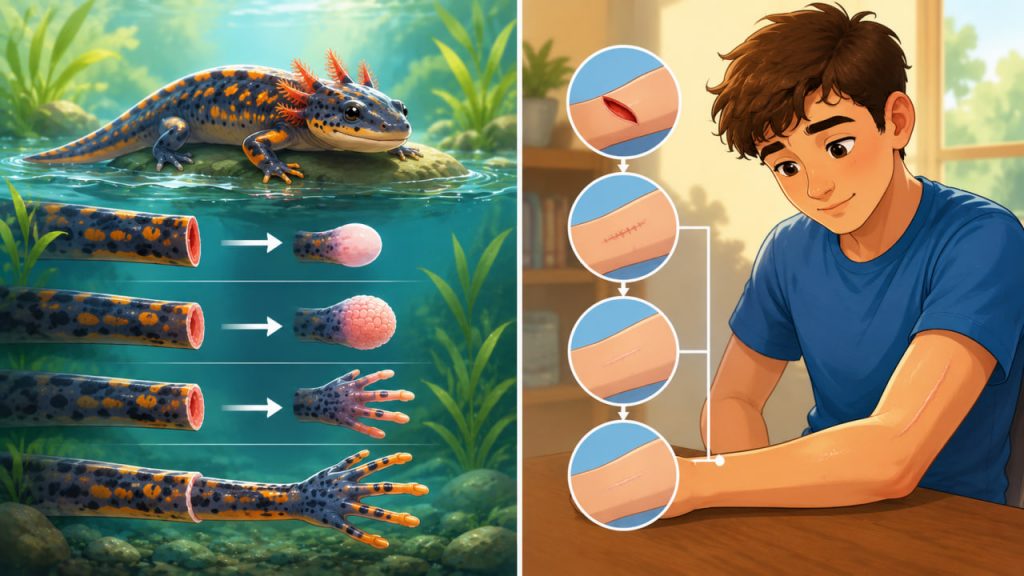
This is fundamentally different from scar formation, which repairs damage without replacing the original architecture.
Which Animals Can Regenerate Limbs?
Several animal groups possess impressive regenerative abilities.
Among the best-known examples are:
- Newts
- Axolotls
- Salamanders
Some reptiles can regenerate tails, although the replacement is usually simpler than the original.
Certain fish regenerate fins.
Some invertebrates—including starfish and planarian flatworms—can regenerate even larger portions of their bodies.
Humans, however, have only limited regenerative capacity.
We can repair skin, heal broken bones, regenerate part of the liver, and continually replace blood cells, but we cannot regenerate an entire arm or leg.
How Does a Newt Regrow a Limb?
The regeneration process begins almost immediately after injury.
Instead of producing a large permanent scar, cells near the wound undergo remarkable biological changes.
The process generally follows several stages.
Rapid Wound Closure
Within hours, specialized skin cells cover the injury.
This protective layer forms without creating the extensive scar tissue typically seen in humans.
Formation of the Blastema
Perhaps the most remarkable step is the formation of the blastema.
The blastema is a collection of highly specialized regenerative cells that accumulates beneath the wound surface.
Many mature cells partially revert to a more flexible state while retaining information about their tissue of origin.
These cells then multiply rapidly.
Pattern Formation
As regeneration continues, cells receive molecular signals that determine their future roles.
Some become muscle.
Others form cartilage, bone, nerves, or blood vessels.
Growth occurs in an organized sequence remarkably similar to embryonic limb development.
Why Humans Form Scars Instead
Humans evolved a very different response to severe injuries.
Our bodies prioritize rapid wound closure to reduce:
- Blood loss
- Infection
- Tissue exposure
This emergency repair strategy relies heavily on scar formation.
Scar tissue quickly stabilizes damaged areas but lacks the complex organization of the original tissue.
While scars can be lifesaving, they also prevent the extensive cellular remodeling required for complete limb regeneration.
The Role of the Immune System
Recent research has shown that the immune system plays a crucial role in regeneration.
Newts produce carefully controlled inflammatory responses after injury.
This inflammation helps remove damaged tissue while supporting regeneration.
Humans also generate inflammation, but it often becomes stronger and leads to scar-producing pathways.
Scientists now believe that differences in immune regulation may explain part of the gap between regenerative and non-regenerative species.
Understanding these immune responses has become an active area of biomedical research.
Do Humans Still Have Regenerative Potential?
Surprisingly, humans have not completely lost regenerative abilities.
Several tissues regenerate throughout life.
Examples include:
- Skin
- Blood
- Intestinal lining
- Liver tissue
- Bone after fractures
Young children can occasionally regenerate the tip of a finger under specific conditions if the injury is properly managed.
These examples suggest that human regeneration has been reduced rather than completely eliminated.
The challenge is understanding how to safely reactivate more powerful regenerative mechanisms.
Why Evolution May Have Favored Scar Formation
One intriguing question is why mammals evolved away from extensive regeneration.
Several hypotheses exist.
Rapid scar formation may have provided advantages by:
- Reducing fatal blood loss
- Preventing infections
- Allowing quicker recovery
- Conserving energy
- Supporting survival after severe injuries
For animals facing predators, surviving the injury may have been more important than perfectly replacing the missing body part.
Natural selection favors traits that improve reproductive success, not necessarily perfect tissue restoration.
Can Science Unlock Human Limb Regeneration?
Researchers are investigating multiple approaches to stimulate regeneration.
Current areas of study include:
- Stem cell biology
- Gene regulation
- Growth factors
- Tissue engineering
- Biomaterials
- Developmental biology
- Regenerative immunology
Scientists are particularly interested in understanding the signaling pathways that allow blastema formation in salamanders.
Rather than copying salamanders directly, researchers hope to identify the underlying biological principles that might someday improve human healing.
Although complete human limb regeneration remains beyond current medical capabilities, progress in regenerative medicine has accelerated considerably over the past two decades.
Challenges Scientists Must Overcome
Regrowing a human limb is vastly more complicated than healing a wound.
Researchers must coordinate the regeneration of:
- Multiple bone types
- Skeletal muscles
- Tendons
- Blood vessels
- Peripheral nerves
- Skin
- Joints
- Precise anatomical proportions
Every structure must develop in the correct location and reconnect properly with existing tissues.
Even a small error could impair movement or function.
This complexity explains why limb regeneration remains one of biology’s greatest scientific challenges.
Expert Perspective
Developmental biologist Elly Tanaka, whose research has significantly advanced understanding of salamander limb regeneration, has shown that regeneration depends on highly coordinated interactions between cells, nerves, immune responses, and genetic signaling pathways. Her work demonstrates that regeneration is not controlled by a single “master gene” but by a complex network of biological processes working together. These discoveries continue to guide efforts in regenerative medicine aimed at improving tissue repair in humans.
The Future of Regenerative Medicine
Scientists do not expect humans to suddenly grow new arms like salamanders.
Instead, research is moving step by step toward practical medical advances.
Future therapies may focus on:
- Reducing scar formation
- Improving nerve regeneration
- Repairing damaged cartilage
- Regenerating bone
- Restoring muscle tissue
- Enhancing wound healing
Each breakthrough brings medicine closer to treatments that once seemed impossible.
The study of salamanders reminds us that nature has already solved problems that modern science is only beginning to understand.
Interesting Facts
- Newts can regenerate the same limb multiple times throughout their lives.
- Axolotls are capable of regenerating limbs, parts of the spinal cord, sections of the heart, and portions of the brain.
- Human liver tissue can regenerate significantly after partial surgical removal.
- Salamanders generally regenerate limbs without forming permanent scars.
- Blastema cells remember where they originated, helping ensure that regenerated tissues develop correctly.
- Researchers use salamanders as important model organisms for studying regenerative medicine and developmental biology.
Glossary
- Regeneration — The biological process of replacing lost or damaged body structures with fully functional new tissue.
- Blastema — A mass of regenerative cells that forms at the site of an injury and gives rise to new tissues during regeneration.
- Scar Tissue — Fibrous tissue that repairs injuries but does not fully restore the original structure or function.
- Stem Cell — A cell capable of self-renewal and, under appropriate conditions, differentiating into specialized cell types.
- Differentiation — The process by which cells become specialized for specific biological functions.
- Growth Factor — A signaling protein that regulates cell growth, division, and tissue repair.
- Inflammation — The body’s protective response to injury or infection involving immune cells and signaling molecules.
- Developmental Biology — The branch of biology that studies how organisms grow and develop from embryos to adulthood.
- Regenerative Medicine — A field of medicine focused on repairing or replacing damaged tissues and organs.
- Tissue Engineering — The use of cells, biomaterials, and engineering techniques to create or restore biological tissues.