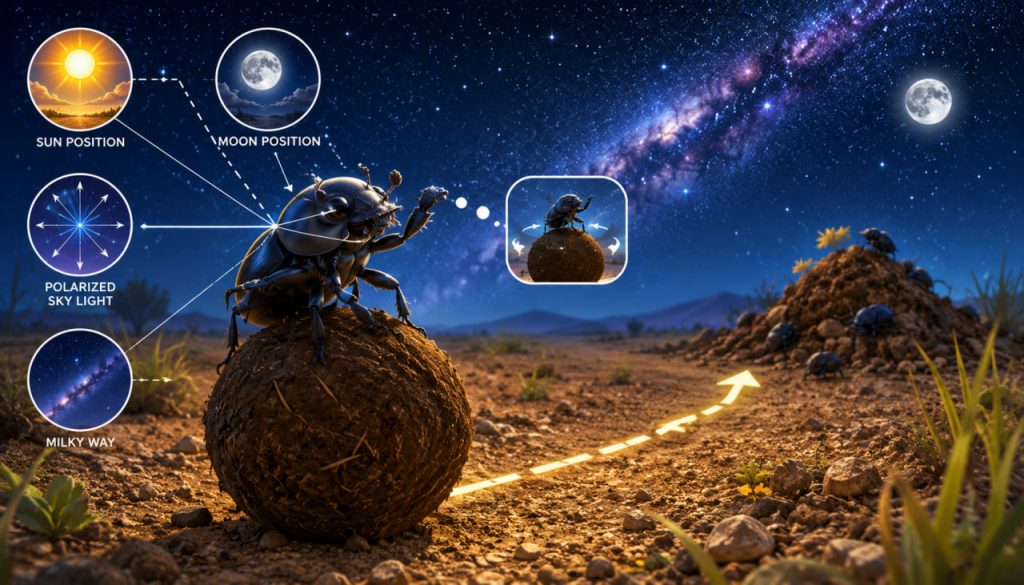
Scarab beetles may look like simple insects, but some of them perform one of the most astonishing navigation tricks in the animal kingdom. Certain dung beetles can roll their dung balls away from a crowded dung pile by using cues from the Sun, Moon, polarized light, and even the Milky Way.
This behavior is not a poetic exaggeration. It has been demonstrated in controlled experiments, including studies in natural environments and planetariums. Ball-rolling dung beetles are among the few animals known to use celestial information with such elegance, and they do it with a brain far smaller than a grain of rice.
Scarab beetle astronavigation shows that advanced navigation does not always require a large brain. Sometimes, it requires the right sensory system and a very efficient survival strategy.
Why Dung Beetles Need Navigation
For a dung beetle, a fresh dung pile is both a treasure and a battlefield.
Many beetles arrive at the same pile quickly. They compete for food, breeding material, and space. Some species carve out a piece of dung, shape it into a ball, and roll it away before rivals can steal it.
The safest strategy is simple: move away from the pile as fast as possible in a straight line.
A curved path wastes time. Circling back is even worse because it may bring the beetle directly into the competition zone again.
That is why straight-line orientation matters. The beetle does not need to know where “north” is. It only needs to hold a stable direction long enough to escape.
The Beetle’s Celestial Compass
Ball-rolling dung beetles use the sky as a compass.
During the day, they can use the position of the Sun and patterns of polarized skylight. Polarized light is light that vibrates in a particular orientation after scattering in the atmosphere. Many insects can detect it, even though humans cannot normally see it without special filters.
At night, some dung beetles use the Moon, the polarization pattern created by moonlight, and, under very dark conditions, the broad glowing band of the Milky Way.
Research on African dung beetles has shown that they can orient using polarized moonlight, even though moonlight is vastly dimmer than sunlight. One Nature study described Scarabaeus zambesianus as the first animal known to use the polarization pattern of moonlight for orientation.
The beetle is not reading a star map. It is using large-scale light patterns in the sky to keep a consistent heading.
The Milky Way Discovery
One of the most famous discoveries in insect navigation came from research showing that dung beetles can use the Milky Way.
In a 2013 study published in Current Biology, researchers found that African ball-rolling dung beetles could maintain straight paths under a starry sky, but became less oriented when the sky was obscured or when key celestial cues were removed. The study reported that these beetles exploit the Sun, Moon, polarized light patterns, and the Milky Way to move along straight paths away from the dung pile.
The researchers also tested beetles in a planetarium. This allowed them to control which parts of the night sky were visible. When the Milky Way was visible, beetles rolled more directly. When only dim stars were available without the bright galactic band, their orientation became poorer.
This does not mean dung beetles identify constellations. Their eyes are not designed for detailed astronomical observation.
Instead, they seem to detect the bright, extended stripe of the Milky Way as a directional reference.
The Famous Beetle “Dance”
Before rolling away, dung beetles often climb on top of their dung ball and rotate. This behavior is sometimes called a dance.
It may look amusing, but it has a serious function.
Scientists studying dung beetle orientation have suggested that this rotation helps the beetle take a celestial “snapshot.” During this brief scanning behavior, the beetle gathers information about available compass cues before starting its journey.
A study on snapshot-based celestial orientation found that beetles use this dance-like rotation to establish a heading based on simulated celestial cues such as the Sun, polarized light, and spectral information.
Once the direction is chosen, the beetle climbs down and begins rolling the ball backward with its hind legs, while keeping its body aligned with the selected compass direction.
Why the Sky Works Better Than Landmarks
In many habitats, ground landmarks are unreliable for a dung beetle.
Grass stems, stones, shadows, and small terrain features may change appearance as the beetle moves. The beetle is also often rolling backward, pushing a ball larger than itself, which limits how it views the world.
The sky is different.
Celestial cues are distant, stable, and visible from many locations. The Sun, Moon, and polarization patterns provide broad directional information that does not shift dramatically when the beetle moves a few centimeters.
This is why celestial navigation is so useful for animals that need a fast escape route rather than a detailed map.
Dung beetles are not navigating like humans with GPS. They are using a compass system: choose a direction, hold it, and keep moving.
Sunlight, Moonlight, and Polarized Light
The dung beetle compass is flexible.
Day-active species may rely heavily on the Sun. Night-active species can use the Moon and the polarization pattern around it. Some species can switch between cues depending on visibility and light conditions.
A study on the role of the Sun in dung beetle navigation explains that foraging dung beetles use several celestial compass cues, including the Sun, Moon, polarized light, and the Milky Way, but that thick clouds can reduce or hide many of these cues.
Another review describes how dung beetles steer straight using multiple cues and notes that at night or in forested environments they may rely strongly on polarized skylight.
This flexibility is important because nature rarely offers perfect conditions. Clouds, vegetation, dust, moon phase, and time of day can all affect the available information.
Expert Perspective
The dung beetle Milky Way work is strongly associated with researchers Marie Dacke, Marcus Byrne, Eric Warrant, and colleagues, who have studied insect celestial navigation for years.
Their research helped demonstrate that dung beetles are not simply wandering randomly with occasional corrections. They possess a compact but sophisticated compass system that can integrate different sky cues.
The broader expert lesson is powerful: small nervous systems can solve complex problems when evolution shapes them around a precise ecological need.
In dung beetles, that need is urgent. Find dung, make a ball, escape the crowd, and bury the prize.
What This Teaches Us About Intelligence
Scarab beetle astronavigation challenges a common assumption: that complex behavior always requires complex thinking.
A dung beetle does not need to understand astronomy. It does not need to know what a galaxy is. It only needs sensory equipment capable of detecting reliable patterns and a neural system that converts those patterns into movement.
This is a form of biological efficiency.
Engineers and roboticists are interested in such systems because small animals often solve navigation problems with minimal energy, limited processing power, and compact sensory organs.
The dung beetle is a tiny natural navigator using the sky as a low-cost guidance system.
Why Light Pollution Matters
The discovery that dung beetles can use the Milky Way also raises an important environmental concern.
Artificial light at night can reduce the visibility of stars and natural sky patterns. For animals that depend on celestial cues, this may interfere with orientation, migration, feeding, or reproduction.
Dung beetles are ecologically important because they recycle nutrients, bury dung, improve soil, reduce parasites, and support healthier grassland ecosystems.
Protecting dark skies is not only about astronomy. It can also be about protecting animal behavior.
Interesting Facts
- Some dung beetles roll balls much larger than their own bodies.
- Ball-rolling dung beetles often move backward while pushing with their hind legs.
- The “dance” on top of the dung ball may help the beetle set or reset its compass direction.
- Dung beetles do not appear to recognize individual stars; they use broader sky patterns.
- The Milky Way can serve as a visual compass cue because it forms a bright band across the night sky.
- Dung beetles are important ecosystem engineers because they bury and recycle dung.
- Some dung beetles navigate by the Sun during the day and by moonlight or starlight at night.
Glossary
- Scarab Beetle — A beetle from the family Scarabaeidae, which includes many dung beetles.
- Dung Beetle — A beetle that feeds on, buries, or rolls animal dung.
- Astronavigation — Navigation using celestial objects or sky patterns.
- Celestial Compass — A navigation system based on cues from the Sun, Moon, stars, or polarized light.
- Polarized Light — Light waves aligned in a particular direction, often produced when sunlight or moonlight scatters in the atmosphere.
- Milky Way — The galaxy that contains Earth, visible from dark places as a pale band across the night sky.
- Orientation — The ability to choose and maintain a direction of movement.
- Planetarium Experiment — A controlled test using an artificial night sky to study how animals respond to celestial cues.
- Ecological Engineer — An organism that changes its environment in ways that affect other species.
- Light Pollution — Artificial nighttime light that brightens the sky and reduces visibility of natural celestial cues.